




01. Edit your form online
Type text, add images, blackout confidential details, add comments, highlights and more.

Type text, add images, blackout confidential details, add comments, highlights and more.

Draw your signature, type it, upload its image, or use your mobile device as a signature pad.

Send it via email, link, or fax. You can also download it, export it or print it out.
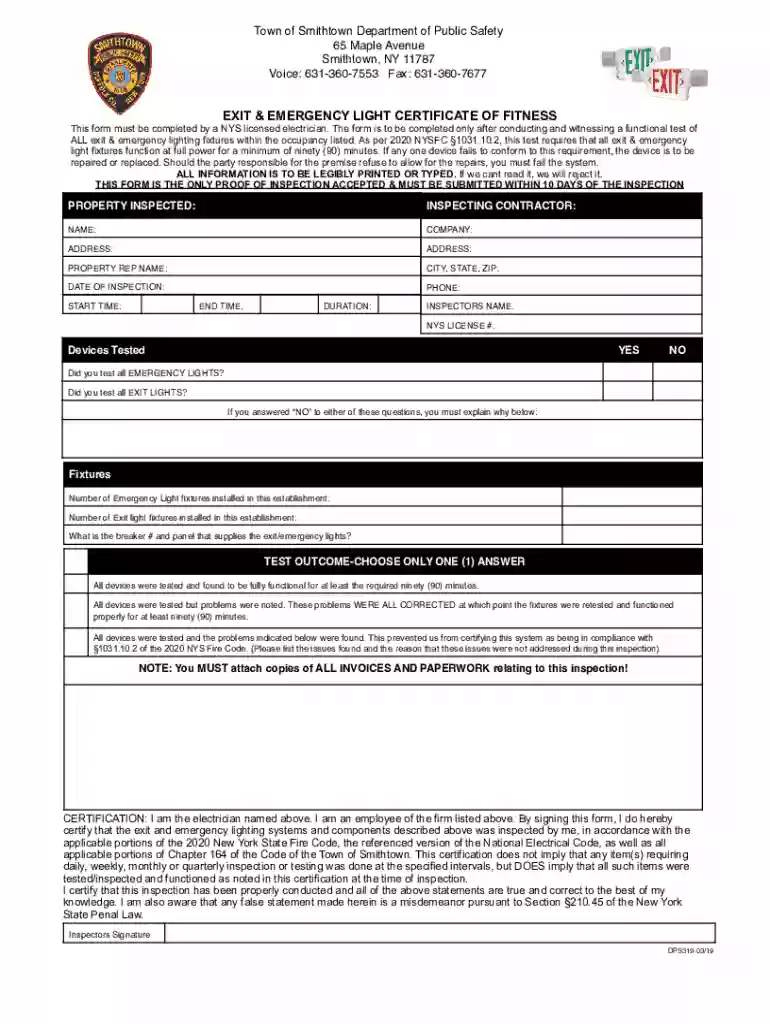
The Fillable Online Exit and Emergency Lighting Certificate, often referred to simply as the Exit Certificate, is a crucial document required by the Town of Smithtown’s Department of Public Safety. This certificate serves as the official proof of inspection for exit and emergency lighting systems, ensuring they comply with the New York State Fire Code. Licensed electricians complete this form following thorough testing of the lighting fixtures, which must remain operational for at least ninety minutes in case of an emergency. Its purpose is to verify that all safety standards are met, providing assurance of the property's safety infrastructure.
The certificate is structured to capture essential information that verifies compliance with safety regulations. Key elements include:
These components ensure that the certificate serves as a comprehensive record for both property owners and local authorities.
Filling out the Exit and Emergency Lighting Certificate involves a systematic process:
These steps provide a clear guide to efficiently completing the certification process.
Using the fillable online version of the Exit and Emergency Lighting Certificate offers several advantages:
Overall, the fillable format supports a more streamlined and efficient workflow.
This certificate is predominantly used by:
Understanding the primary users underscores the targeted utility of the certificate within safety compliance processes.


The Exit and Emergency Lighting Certificate has significant legal implications. It is the only accepted proof of inspection and compliance with the New York State Fire Code. Failure to complete and submit this form within the stipulated time frame can lead to penalties or legal action. It is crucial for property owners to ensure that their properties are inspected and certified to avoid any liability issues in case of an emergency.
While the form follows New York State standards, it is relevant to note that requirements may vary with each state. Other regions may have additional or slightly different criteria for what constitutes compliance in terms of emergency lighting systems. Always verify specific local regulations that might apply beyond the Town of Smithtown to ensure full regulatory compliance.
Here are some scenarios illustrating the practical use of this certificate:
These examples highlight the diverse circumstances under which this certificate proves crucial.
For users opting to fill and manage this certificate digitally, it is important to know its compatibility with various software. DocHub offers seamless integration with platforms such as Google Drive and Dropbox which simplifies the process of managing these documents. Leveraging these integrations can enhance the overall efficiency and security of handling legally sensitive documents like this certificate.
We've got more versions of the Fillable Online Exit and Emergency lighting Certificate of form. Select the right Fillable Online Exit and Emergency lighting Certificate of version from the list and start editing it straight away!
At DocHub, your data security is our priority. We follow HIPAA, SOC2, GDPR, and other standards, so you can work on your documents with confidence.
Easily access forms, applications, and permits, sorted by department. Exit Sign and Emergency Lighting Log (PDF)
Departments may set up their own Training Records, use the one provided in this standard, or use the fillable Training Record found online on UFRAs website.


