




01. Edit your form online
Type text, add images, blackout confidential details, add comments, highlights and more.

Type text, add images, blackout confidential details, add comments, highlights and more.

Draw your signature, type it, upload its image, or use your mobile device as a signature pad.

Send it via email, link, or fax. You can also download it, export it or print it out.
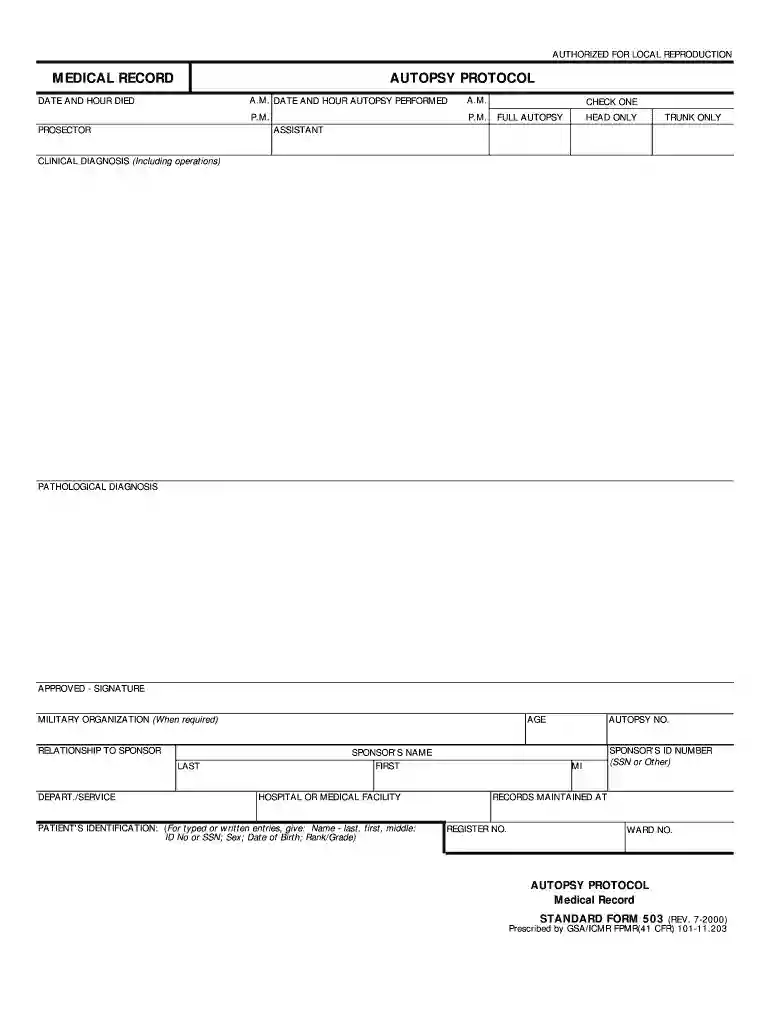
The form titled "DATE AND HOUR AUTOPSY PERFORMED" is critical in documenting vital time-related information during autopsy procedures. This form serves as an official record that captures the specific date and precise hour an autopsy is initiated. It is essential for maintaining the accuracy of medical and legal documentation. This information is critical for forensic investigations, as it helps establish timelines and can be crucial in legal proceedings where the time of death plays a pivotal role. By accurately recording this data, the form supports the integrity and accuracy of the autopsy report.
To utilize the "DATE AND HOUR AUTOPSY PERFORMED" form effectively, follow these steps:
Initial Verification: Before filling in the form, ensure that all preliminary details about the deceased are verified. This includes confirming the identity of the body being examined.
Recording Date and Time: Accurately log the date using the appropriate format (MM/DD/YYYY) and note the exact hour in a 24-hour format or with an AM/PM distinction, to ensure clarity.
Cross-Referencing Details: It is crucial to cross-reference the recorded date and hour with accompanying documentation, such as the time of death or discovery reports, to provide a consistent and corroborated timeline.
Integrating with Digital Records: If the form is part of a digital record system such as DocHub, ensure it is properly integrated or synchronized to maintain a cohesive digital document trail.
Following a methodical approach when completing the form can enhance accuracy:
Preparation: Gather all necessary background information about the case, including preliminary reports and any related documents.
Documentation: Fill out the form with careful attention to detail, ensuring that each field is completed legibly if on paper, or accurately in digital formats.
Verification: Double-check all entries for potential errors. Verify the recorded date and time with available digital time-stamps or watches to mitigate manual entry mistakes.
Submission: Submit the form as required, whether as part of a digital autopsy software workflow or as a physical document in an official case file.
This form is an integral document in the autopsy process for several reasons:
Legal Documentation: It provides key evidence in legal disputes, particularly those involving time-sensitive incidents such as suspected foul play.
Medical Accuracy: Ensuring the preciseness of this data upholds the standards of medical examination, promoting accurate post-mortem results.
Regulatory Compliance: The form helps satisfy statutory obligations related to forensic procedures and medical examinations.
The form includes several critical elements:
Identifying Information: Details about the deceased, including name, age, and identification number, are essential to associate the data with the correct individual.
Autopsy Timing: The exact date and hour the autopsy is performed, usually recorded in both text and digital formats for accuracy.
Official Signatures: Authorization by attending medical examiners and any involved parties, which certifies the recorded time.
From a legal standpoint, recording the date and hour an autopsy is performed complies with forensic and medico-legal standards.
Evidentiary Role: The documentation serves as a factual basis for court proceedings or investigations, providing indisputable evidence of procedural conduct.
Regulatory Adherence: Institutions and professionals must adhere to the legality of documentation, ensuring entries are made promptly and accurately to prevent legal complications.
Forensic Investigations: In cases of suspected homicide, the documented time of the autopsy can provide clues regarding time-of-death estimations.
Clinical Research: Data from multiple autopsies, such as the start times, can be compiled for epidemiological studies, providing insights into death patterns.
Administrative Review: During audits or quality control checks within medical facilities, the form is examined to ensure adherence to operational protocols.
Different states in the U.S. might have variances in how the "DATE AND HOUR AUTOPSY PERFORMED" form is utilized:
State Regulations: Some states may require additional certifications or supporting documentation alongside the form.
Submission Processes: The way this information is logged and retained can vary, with some states mandating digital submission, while others still rely heavily on paper records.
Confidentiality Laws: There might be specific privacy laws or regulations in place that dictate how this information can be shared or accessed.
We've got more versions of the DATE AND HOUR AUTOPSY PERFORMED form. Select the right DATE AND HOUR AUTOPSY PERFORMED version from the list and start editing it straight away!
| Versions | Form popularity | Fillable & printable |
|---|---|---|
| 2000 | 4.8 Satisfied (30 Votes) |
At DocHub, your data security is our priority. We follow HIPAA, SOC2, GDPR, and other standards, so you can work on your documents with confidence.


Autopsy date and time are arranged. Autopsies are conducted Monday through Friday, and on holidays. Bodies received prior to 2 pm will be autopsied on that
by LP Dehner 2010 Cited by 39 At one time, 600700 autopsies were performed per year; more recent figures demonstrate that the number of autopsies averages 360 cases per year representingRead more


