







Definition and Meaning
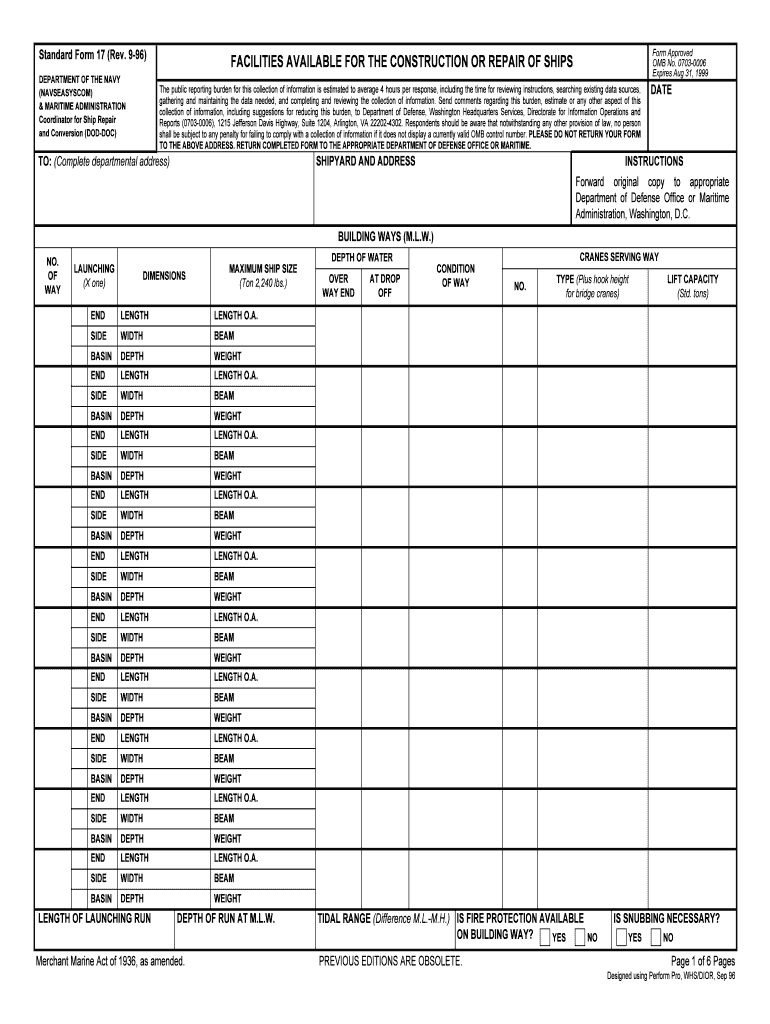
Standard Form 17, issued by the Department of the Navy and Maritime Administration, serves as an essential tool for assessing the capabilities of ship construction and repair facilities within the United States. This document is critical for evaluating vital shipyard specifications, including dimensions, crane capabilities, and drydock availability. By collecting comprehensive data on these facilities, Standard Form 17 aids in ensuring the readiness and efficiency of both military and commercial maritime operations.
Shipyard Capabilities Evaluation
- Dimensions and Crane Specifications: Key data points include the sizes of drydocks and the lifting capacities of cranes, assisting in determining the types of ships that can be accommodated.
- Principal Shops and Equipment: Information about available machinery and equipment supports the assessment of production potential.
- Employment and Production Experience: Data on the workforce and historical production levels help evaluate the shipyard's operational efficiency.
Key Elements of the Form
This form comprises several sections that require precise information to ensure the thorough evaluation of shipyard facilities.
Drydocks and Storage Space
- Types and Sizes: Details on existing drydocks, including length, width, and depth, are vital for understanding the scale of operations.
- Storage Space: Includes the specifications of indoor and outdoor storage areas for materials and equipment.
Employment and Workforce
- Personnel Details: Information about the number and type of employees, their skills, and training, is essential for analyzing labor capabilities.
- Hiring Practices: Insights into seasonal or contractual employment trends add context to workforce stability.
Steps to Complete the Form
Completing Standard Form 17 requires careful attention to detail and accuracy. Follow these steps to ensure a comprehensive submission.
- Collect Facility Data: Gather all relevant information about physical dimensions, equipment, and workforce.
- Document Historical Production: Include past projects and output levels to provide a complete picture.
- Verify Data Accuracy: Check all entries for errors and ensure alignment with existing records.
- Complete Form Sections: Fill out each section methodically, ensuring no detail is overlooked.
- Review and Submit: Conduct a final review for accuracy and completeness before submission to the appropriate agency.
Legal Use and Compliance
The completion and submission of Standard Form 17 come with specific legal obligations. Understanding these requirements ensures compliance with maritime regulations.
Maritime Administration's Role
- Oversight and Review: The administration evaluates submitted forms for compliance and adherence to relevant laws.
- Data Integrity: Ensures all data provided is accurate and truthful, minimizing the risk of penalties.
Regulations and Penalties
- Compliance Requirements: Non-compliance with submission requirements can result in penalties or delays in processing.
- Legal Ramifications: Misrepresentation or omission of critical data may lead to further legal consequences.
Who Typically Uses the Form
Standard Form 17 is utilized by a varied group of stakeholders within the maritime industry. Identifying these users provides insight into the form's reach and importance.


Key Users
- Navy Contractors: Often required to assess shipyard capabilities for defense contracts.
- Shipbuilding Companies: Use the form to declare their facility capabilities to potential clients.
- Regulatory Agencies: Rely on the data to ensure compliance with maritime regulations.
Form Submission Methods
Understanding how to submit Standard Form 17 effectively is crucial for timely processing and evaluation.
Options for Submission
- Online Submission: Upload the completed form via the Maritime Administration's portal for faster processing.
- Mail-In: Physical copies can be mailed, but be aware of additional time needed for delivery and processing.
- In-Person: Direct submissions can be made at specific office locations, useful for those who prefer face-to-face interactions.
Important Terms Related to the Form
Familiarity with certain terms related to Standard Form 17 can aid in the accurate completion and understanding of the document.
Glossary of Terms
- Drydock: A structure for the construction, maintenance, and repair of ships.
- Crane Capacity: The maximum weight a crane can lift, crucial for operational assessments.
- Production Experience: Historical data on the shipyard’s output, reflecting its capabilities.
Digital vs. Paper Version
Choosing between the digital and paper versions of Standard Form 17 depends on various factors, including convenience and personal preference.
Advantages of Each Format
- Digital Version: Easier to edit and submit, with intuitive error-checking features.
- Paper Version: Preferred by those who work in environments where digital access is limited or when original signatures are required.
In conclusion, Standard Form 17 is a critical document for assessing shipyard capabilities in the maritime sector. By understanding the intricate details of this form and its usage, stakeholders can effectively contribute to the efficiency and readiness of maritime operations in the United States.




