




01. Edit your form online
Type text, add images, blackout confidential details, add comments, highlights and more.

Type text, add images, blackout confidential details, add comments, highlights and more.

Draw your signature, type it, upload its image, or use your mobile device as a signature pad.

Send it via email, link, or fax. You can also download it, export it or print it out.
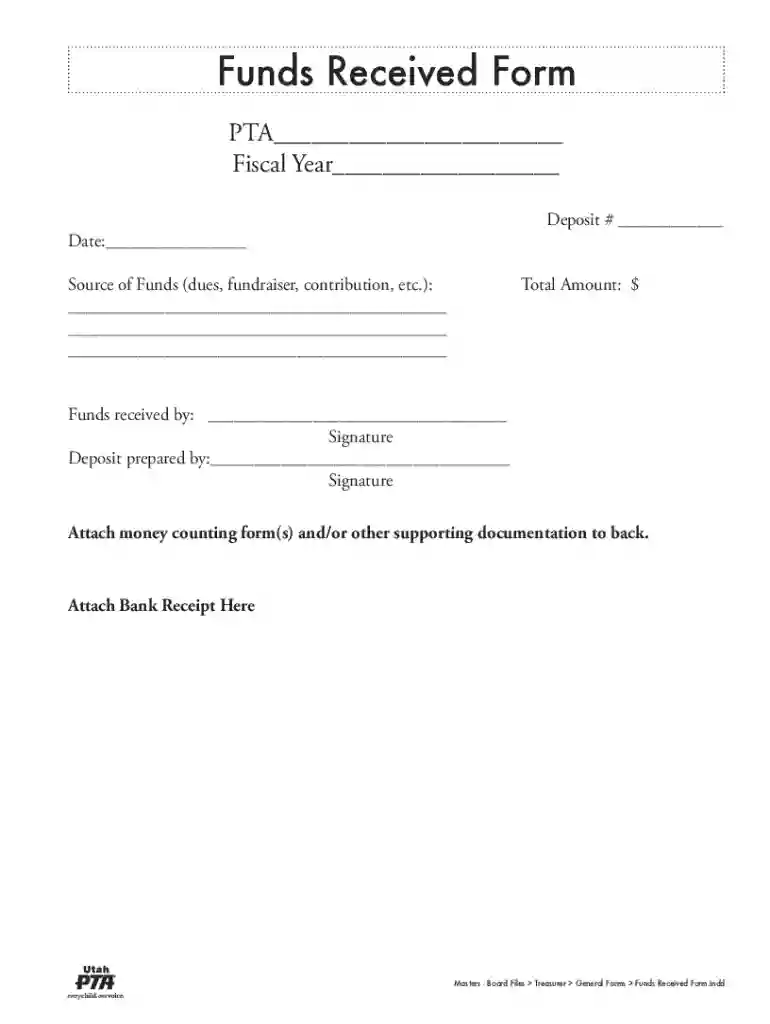
A "Funds Received Form" is a crucial document used to record and acknowledge the receipt of money within organizations like Parent-Teacher Associations (PTAs). This form simplifies the process of tracking financial transactions for a specific fiscal year. It serves as official documentation that outlines the transaction's key elements, such as the date, source of funds, total amount received, and the involved parties' signatures. By ensuring that each transaction is systematically documented, this form aids in maintaining transparency and accountability in financial management.
Completing a Funds Received Form requires careful attention to detail to ensure accuracy and compliance. Below is a step-by-step guide to filling out the form efficiently:
Enter the Date of Receipt: Begin by specifying the exact date on which the funds were received. This is crucial for maintaining an accurate financial timeline.
Identify the Source of Funds: Clearly state where the funds originated. This may include individual donations, corporate sponsorships, or fundraising events.
Specify the Total Amount: Record the exact amount of money received. Double-check this amount to ensure there are no errors.
Attach Supporting Documentation: Include any relevant attachments, such as receipts or donation letters, to verify the transaction and provide additional context.
Obtain Required Signatures: Ensure all relevant parties involved in the transaction sign the form, affirming the accuracy of the details provided.
Review for Completeness: Before submission, review the entire form for completeness and accuracy, verifying that all sections are appropriately filled.
The Funds Received Form includes several critical elements that are essential for comprehensive documentation of financial transactions:
This form is primarily utilized by organizations that handle multiple financial transactions, such as:
These entities prioritize transparency and accountability in their financial dealings, making the Funds Received Form an essential documentation tool.


Utilizing a Funds Received Form offers numerous advantages:
The Funds Received Form serves a critical legal purpose by providing concrete evidence of financial transactions. It is essential for:
The practical use of a Funds Received Form can be illustrated through the following scenarios:
While the basic structure of a Funds Received Form remains consistent, different states may impose specific regulations or additions:
These variations necessitate organizations to review their local state requirements to ensure their Funds Received Forms meet all legal and regulatory standards.
We've got more versions of the Funds Received Form form. Select the right Funds Received Form version from the list and start editing it straight away!
At DocHub, your data security is our priority. We follow HIPAA, SOC2, GDPR, and other standards, so you can work on your documents with confidence.

A bank or other financial institution uses this to acknowledge they have received a court order to deposit funds into a blocked account (form MC-355).Read more
Date. Detailed Description. Fund. Raising. Member. Dues. Donations. Investment. Income. Youth. Development. Services. Other. TOTAL. FUNDS RECEIVED REGISTER.Read more


