01. Edit your sf 123 online
Type text, add images, blackout confidential details, add comments, highlights and more.

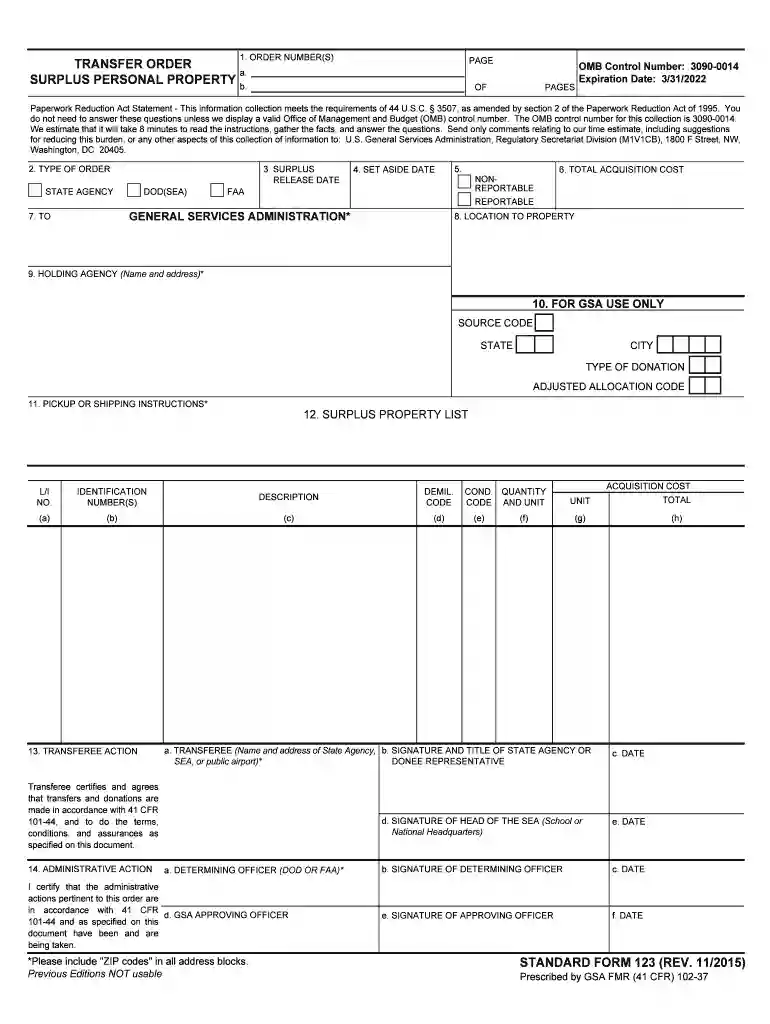
Type text, add images, blackout confidential details, add comments, highlights and more.

Draw your signature, type it, upload its image, or use your mobile device as a signature pad.

Send it via email, link, or fax. You can also download it, export it or print it out.
The "OMB control number for this collection is 3" serves as a unique identifier provided by the Office of Management and Budget (OMB) for managing and tracking information collection requests within federal agencies. Under U.S. law, specifically the Paperwork Reduction Act, this control number ensures that agencies streamline their paperwork processes, reducing unnecessary burdens on the public and improving data collection efficiency. This identifier also signifies compliance with federal guidelines, validating that the collection process has undergone thorough review and approval by the OMB.
Several critical components characterize the function and purpose of this control number. Primarily, it enforces data collection standards, clarifying information concerning the respondent's burden, data usage, and collection methodology. The affiliated documentation provides a thorough assessment of these factors, ensuring clarity and accessibility for the entities involved. Additionally, it aligns with federal regulations requiring public consultation, incorporating feedback to optimize data collection methods.
Effectively implementing this OMB control number involves integrating it within official documentation submitted by federal agencies for information collection approval. Agencies must include this identifier when soliciting data to ensure legitimate and recognized requests. The control number must be clearly visible on relevant documents, signaling compliance with OMB protocols to entities providing or managing requested information.
Completing processes under this control number involves several methodical stages. Initially, entities must identify whether their data collection activities fall under its purview by reviewing associated guidelines and ensuring compliance with paperwork regulations. Further steps include preparing required forms, adhering to submission timelines, and providing accurate and verifiable information. Using robust record-keeping practices is essential to track collected data, ensuring adherence to OMB's stringent compliance requirements.
Utilizing this control number offers tangible benefits, chiefly enhancing consistency and reliability within information collection. Adhering to OMB guidelines mitigates redundancies and inefficiencies, ensuring streamlined processes that minimize the administrative burden on participants and organizations. Additionally, employing such a control number underscores a commitment to transparency and accountability within governmental data practices, reinforcing trust among stakeholders.
A diverse range of participants, particularly within federal agencies and their contractors, frequently engage with the OMB control number. Individuals responsible for managing information collection activities include regulatory compliance officers, data analysts, and administrative personnel tasked with ensuring agency adherence to federal guidelines. These stakeholders ensure that all data-handling practices align with stipulated policies and that forms displaying the OMB control number are correctly utilized.


This control number's legal applicability is firmly rooted in its role to fulfill regulatory compliance under the Paperwork Reduction Act. Legal guidelines necessitate that information collections displaying the control number have undergone proper review and authorization, meeting stringent standards set by the OMB to ensure legal protection of parties involved. This regulatory framework is vital to guaranteeing that federal information requests are both legitimate and justifiable.
Practical applications of this control number are evidenced across multiple scenarios. Federal agencies, for example, incorporate it into tax forms and surveys requiring public submissions, ensuring that these documents meet federal approval standards. Other instances include use within regulatory compliance checks during audits, facilitating transparent verification processes, and verifying that involved parties receive legitimate and validated federal requests.
Failure to comply with regulations associated with the OMB control number could result in significant repercussions. Agencies not adhering to these guidelines may face legal challenges, sanctions, or the invalidation of collected data. These penalties underscore the importance of compliance, maintaining federal standards, and mitigating the potential for misuse or inefficiencies within data-handling processes. Understanding the implications of non-compliance ensures that stakeholders take precautionary and proactive measures.
We've got more versions of the sf 123 form. Select the right sf 123 version from the list and start editing it straight away!
| Versions | Form popularity | Fillable & printable |
|---|---|---|
| 2015 | 4.8 Satisfied (81 Votes) |
At DocHub, your data security is our priority. We follow HIPAA, SOC2, GDPR, and other standards, so you can work on your documents with confidence.