




01. Edit your form online
Type text, add images, blackout confidential details, add comments, highlights and more.

Type text, add images, blackout confidential details, add comments, highlights and more.

Draw your signature, type it, upload its image, or use your mobile device as a signature pad.

Send it via email, link, or fax. You can also download it, export it or print it out.
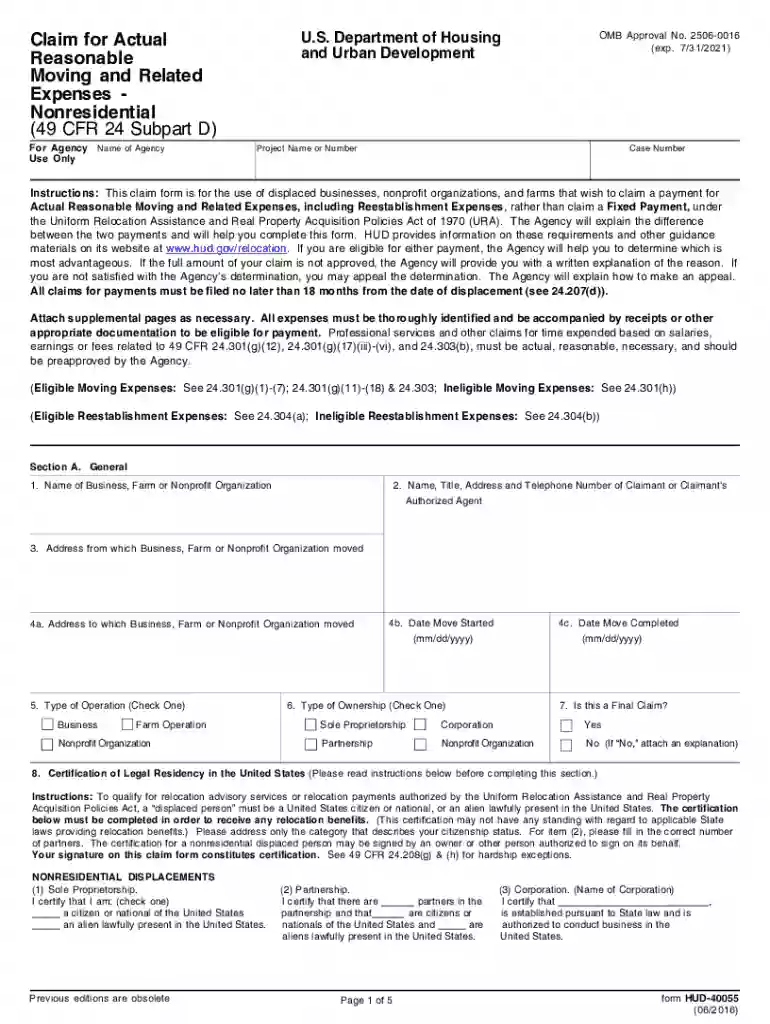
The "Claim for Actual U S Department of Housing - MiPlace" refers to a specific form used by displaced entities such as businesses, nonprofit organizations, and farms to claim reimbursement for moving and related expenses under the Uniform Relocation Assistance and Real Property Acquisition Policies Act of 1970. It is intended to provide financial relief to eligible parties affected by federal or federally assisted projects by covering a range of expenses incurred due to displacement.
To qualify for the "Claim for Actual U S Department of Housing - MiPlace," claimants must be legally recognized as displaced under the provisions outlined by the Uniform Relocation Assistance Act. Eligible applicants include:
Claimants also need to certify their legal residency in the U.S. and provide detailed evidence of expenses to substantiate their claims.


Applicants must provide a suite of supporting documents to validate their claims. These may include:
Organized presentation of these documents is crucial to ensure a smooth verification process.
Completing the form involves several critical steps:
Ensure each section is thoroughly reviewed to prevent omissions or inaccuracies.
The form is composed of various sections designed to capture detailed information:
Each element must be completed accurately to facilitate approval.
Claimants can obtain the form through their local U.S. Department of Housing and Urban Development (HUD) offices or online from the HUD website. For those without internet access, visiting a HUD office in person is an effective alternative. It's crucial to ensure the latest version is utilized to avoid processing delays.
The "Claim for Actual U S Department of Housing - MiPlace" can be submitted through multiple channels:
Choosing the appropriate method depends on the claimant’s resources and preference.
The form is legally significant as it provides the grounds for financial compensation under federal law. Adherence to legal requirements—such as providing accurate information and truthful certifications—is crucial. Providing false information may lead to penalties, including denial of claims and potential legal action.
Once submitted, the application undergoes a review process:
Typically, processing times can vary; however, applicants should anticipate feedback within several weeks, allowing for potential delays related to peak application periods.
While the form follows federal guidelines, specific states may have additional rules or benefits in place based on local legislation. It's essential for claimants to consult state-specific regulations or contact local HUD offices to understand any additional documentation or steps required for compliance.
We've got more versions of the Claim for Actual U S Department of Housing - MiPlace form. Select the right Claim for Actual U S Department of Housing - MiPlace version from the list and start editing it straight away!
At DocHub, your data security is our priority. We follow HIPAA, SOC2, GDPR, and other standards, so you can work on your documents with confidence.


