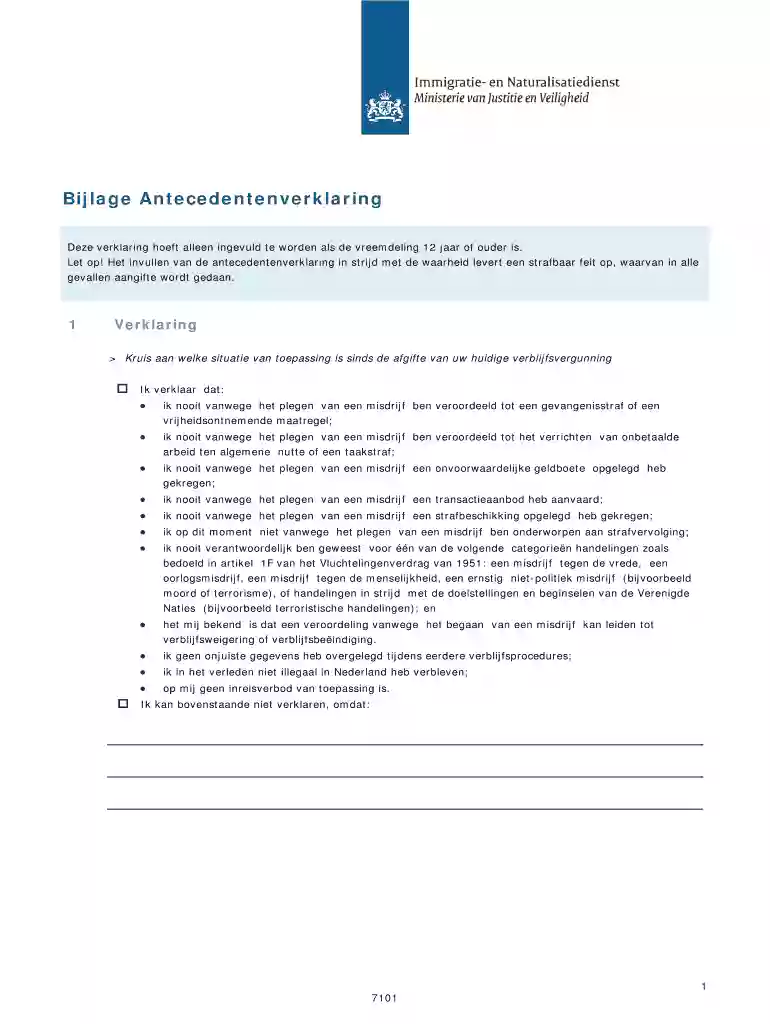
Antecedentenverklaring 2026

Get Form
antecedentenverklaring Preview on Page 1

Here's how it works

01. Edit your antecedentenverklaring online
Type text, add images, blackout confidential details, add comments, highlights and more.

02. Sign it in a few clicks
Draw your signature, type it, upload its image, or use your mobile device as a signature pad.

03. Share your form with others
Send antecedentenverklaring via email, link, or fax. You can also download it, export it or print it out.

Definition and Meaning

The "Antecedentenverklaring" is a legal document known in English as a Criminal Record Declaration. It is essential for foreigners aged twelve and older who are applying for residency in the Netherlands. This document requires individuals to disclose their criminal history, affirming they have not been convicted of crimes that might influence their eligibility for residency. Understanding the significance and implications of this declaration is critical, as it plays a vital role in immigration procedures governed by the Immigration and Naturalization Service (IND).

How to Use the Antecedentenverklaring

Using the antecedentenverklaring involves several clear steps. It must be filled out accurately, reflecting the individual's criminal history. The applicant should:

  1. Obtain the form from the Immigration and Naturalization Service (IND).
  2. Go through each section thoroughly to understand the questions regarding criminal history.
  3. Fill out the form, ensuring all information regarding any past convictions is transparent and truthful.
  4. Review the completed form to check for any errors or omissions.
  5. Submit the form as part of the residency application package to the IND.

Given its legal significance, precise completion is required to prevent any potential pitfalls in the immigration process.

Steps to Complete the Antecedentenverklaring

Completing the antecedentenverklaring necessitates careful attention to detail to ensure compliance with legal requirements. Here are the key steps:

  1. Fill Out Personal Information: Ensure all personal details match official documents, including name, date of birth, and residency particulars.

  2. Declare Criminal History: Provide detailed information on any prior convictions, if applicable. Include the nature of offenses, dates, and jurisdictions.

  3. Sign the Declaration: Affirm that all provided information is accurate and complete to the best of your knowledge. Understand the consequences of falsifying information.

  4. Submit The Form: Include the antecedentenverklaring in your complete application to the IND. Keep a copy for personal records.

Legal Use of the Antecedentenverklaring

The antecedentenverklaring serves a legal purpose under Dutch immigration law. Its primary function is to assess the applicant's suitability for residency based on their criminal history. The IND uses this declaration to evaluate potential risks to public safety and integrity. False declarations can lead to severe consequences, such as denial of residency. The document ensures transparency and compliance, safeguarding the immigration system's integrity while respecting individuals' privacy.

Key Elements of the Antecedentenverklaring

Several key elements must be understood when dealing with this document:

  • Personal Identification: Accurate reflection of the applicant's identity.
  • Criminal History Section: Comprehensive details about past convictions, if applicable.
  • Signature and Date Field: Confirms the declaration's authenticity and timing.
  • Legal Warnings: Includes statements about the consequences of providing false information.

Each component serves a distinct purpose in establishing the lawfulness and accuracy of the declaration.

Important Terms Related to the Antecedentenverklaring

Familiarity with the terminology associated with the antecedentenverklaring is vital. Key terms include:

  • Criminal Record: A documented history of criminal convictions.
  • Residency Status: The legal standing of a non-citizen in the Netherlands.
  • Immigration and Naturalization Service (IND): The body responsible for immigration and naturalization processes in the Netherlands.
  • False Declaration: Providing incorrect or misleading information in the context of legal documentation.

Understanding these terms aids in correctly interpreting and executing the requirements of the declaration.

Penalties for Non-Compliance

Non-compliance with the antecedentenverklaring process can result in significant penalties. If the applicant is found to have falsified information, consequences may include:

  • Denial of Residency: Immediate rejection of residency application.
  • Legal Action: Potential for prosecution based on false declarations.
  • Future Application Barriers: Difficulty in future applications due to a history of non-compliance.

Awareness of these penalties underscores the importance of accurate and honest completion of the form.

Examples of Using the Antecedentenverklaring

Practical scenarios highlight the use of the antecedentenverklaring. For example:

  • An international student applying for a study permit may use the form to declare a clear criminal history, facilitating their entry into the Netherlands for educational purposes.
  • A business professional seeking long-term employment in the Netherlands may utilize the declaration to demonstrate a clean legal record, paving the way for a smooth transition into the country.

Each scenario emphasizes how the antecedentenverklaring can be crucial in various immigration applications.

be ready to get more

Complete this form in 5 minutes or less

Get form

Got questions?

We have answers to the most popular questions from our customers. If you can't find an answer to your question, please contact us.
Contact us
Antecedents generally refers to criminal records, past visa/pass rejections, overstays, immigration offences, bans, or other legal issues (in Singapore or abroad). It can also mean the applicant answered No to questions about past offences or rejections, when in fact there is a record.
V-number: the ten digits of your V-number are at the bottom of your residence permit. The number comes after the letters VNR. Your V-number is also on letters from the IND. You use the V-number when you contact the IND. Your residence permit.
Verification of character and antecedents is the process of confirming a persons background, references, and reputation to ensure they are who they claim to be and have a history of good behavior. It is commonly used in hiring processes and for security purposes.
An antecedents certificate is a statement in which you indicate whether you have committed a criminal offense in the past, or are currently being prosecuted for committing a criminal offense.
On this form you fill in whether you have ever committed a crime or a criminal offence. These are crimes committed in the Netherlands and criminal offences committed outside the Netherlands. You must answer the questions with Yes or No. Not completing the form truthfully or failing to report is a criminal offence.

Security and compliance

At DocHub, your data security is our priority. We follow HIPAA, SOC2, GDPR, and other standards, so you can work on your documents with confidence.

Learn more
ccpa2
pci-dss
gdpr-compliance
hipaa
soc-compliance

People also ask

An antecedents certificate is a statement in which you indicate whether you have committed a criminal offense in the past, or are currently being prosecuted for committing a criminal offense. This includes crimes committed in the Netherlands or criminal offenses abroad.

Related links