






Definition & Meaning
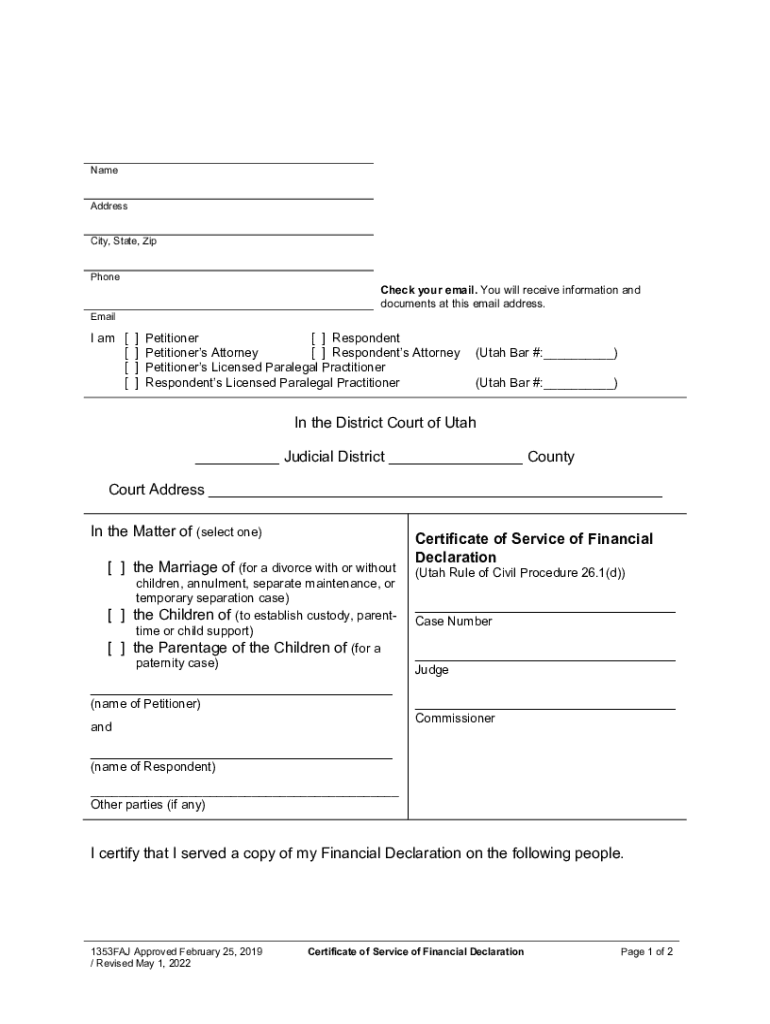
The "Families and Children, Paternity and Parentage - Utah Courts" form is a legal instrument used within Utah's judicial system to address issues related to family law. This may include matters involving establishing paternity, determining parental rights, and addressing custody agreements. The form seeks to ensure that all parties involved have their rights defined and responsibilities clearly articulated, which is integral for cases involving divorce, custody, or other family-related legal proceedings.
Key Elements of the Families and Children, Paternity and Parentage - Utah Courts
The form contains several critical components:
- Personal Information: It requires detailed personal details of the petitioner and respondent, including names, addresses, and contact information.
- Case Details: Information regarding the specific family law case, such as case numbers, court locations, and the nature of the claim, is necessary.
- Method of Service: The form includes sections that specify how legal documents will be served to involved parties, whether through mail, in person, or electronically.
- Signatures: Both parties, along with their legal representatives, must sign the form to affirm the accuracy and truthfulness of the provided information.
Steps to Complete the Families and Children, Paternity and Parentage - Utah Courts
- Gather Necessary Information: Collect all relevant details, such as personal data and case specifics.
- Fill Out Personal Information: Enter the names and contact details of all parties involved.
- Detail the Case: Provide comprehensive information about the family law case, including any pertinent background.
- Specify Method of Service: Choose the method by which services will be delivered to the parties involved.
- Sign the Document: Both parties and their legal representatives need to review and sign the form to complete it.
How to Obtain the Families and Children, Paternity and Parentage - Utah Courts
The form can be accessed from the Utah Courts website or through the local district court clerk's office. It is also possible to request it from legal representatives involved in family law matters. Having a digital or paper version available ensures flexible access for various case needs.
Legal Use of the Families and Children, Paternity and Parentage - Utah Courts
This form is legally significant for affirming parental rights and responsibilities. Its correct completion and submission are mandatory for involving court decisions on paternity and parentage. The form becomes part of the official court records upon submission, impacting subsequent legal proceedings.
Important Terms Related to Families and Children, Paternity and Parentage - Utah Courts
- Petitioner: The person who initiates the legal action.
- Respondent: The individual responding to the legal action.
- Paternity: Legal recognition of a man as the father of a child.
- Custody: Legal right to care for and make decisions for a child.
State-Specific Rules for the Families and Children, Paternity and Parentage - Utah Courts
Utah has unique family law procedures and standards. These include the necessity of filing detailed financial disclosures and adhering to specific deadlines for form submission, which impact the adjudication process.
Examples of Using the Families and Children, Paternity and Parentage - Utah Courts
- Paternity Cases: Used to establish the legal father of a child for custody or child support purposes.
- Custody Disputes: Defines parenting time and responsibilities between divorced or separated parents.
- Child Support: Establishes parameters for financial support obligations.
Required Documents
Alongside this primary form, you may need to submit associated documents such as birth certificates, custody agreements, and financial declarations. Ensuring all required documents are in order before submission is crucial for compliance and processing.
Form Submission Methods (Online / Mail / In-Person)
The completed form can be submitted:
- Online: Through the Utah Courts electronic filing system.
- Mail: Sent to the relevant district court handling the case.
- In-Person: Delivered directly to the court clerk’s office for immediate processing.
Who Typically Uses the Families and Children, Paternity and Parentage - Utah Courts
This form is predominantly used by parents, legal guardians, and attorneys involved in family law disputes, including paternity acknowledgment, custody arrangements, and parental rights establishments. Legal professionals often facilitate its completion to ensure accuracy and compliance with court requirements.