




01. Edit your form 1195 identity declaration online
Type text, add images, blackout confidential details, add comments, highlights and more.

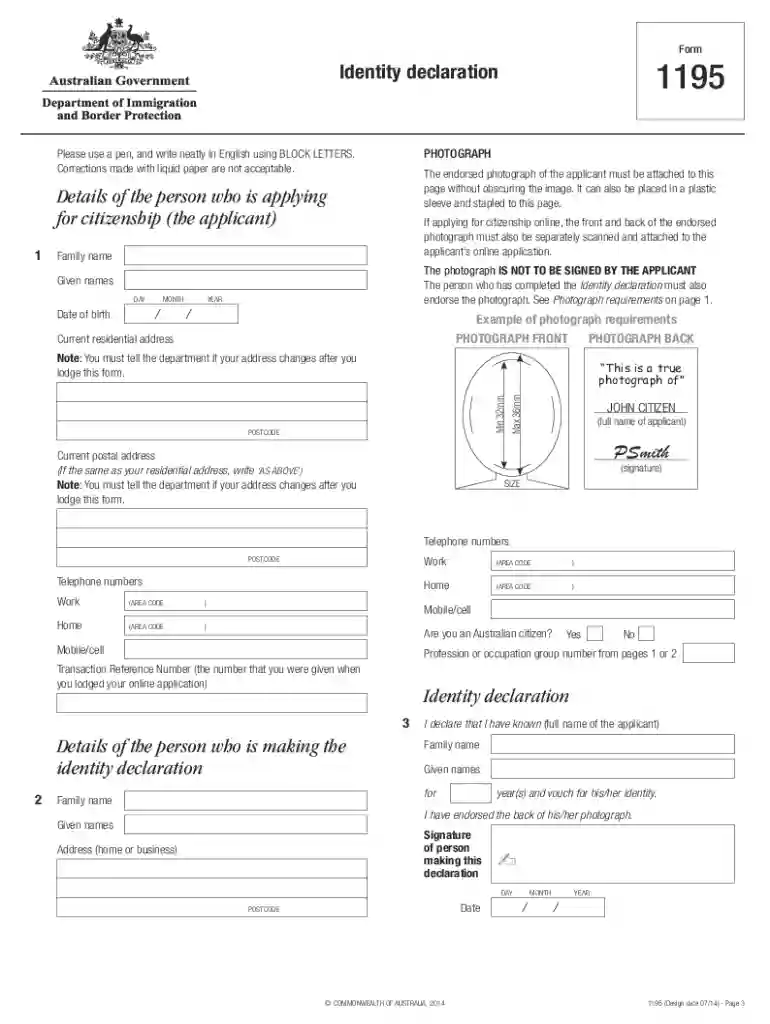
Type text, add images, blackout confidential details, add comments, highlights and more.

Draw your signature, type it, upload its image, or use your mobile device as a signature pad.

Send form 1195 via email, link, or fax. You can also download it, export it or print it out.
Form 1195, also known as the Identity Declaration form, is a crucial document required for Australian citizenship applications. It serves the primary purpose of confirming the identity of individuals applying for citizenship. By using this form, applicants certify that they have provided true and accurate information. This document is part of the broader effort by Australian authorities to ensure the integrity and authenticity of citizenship applications and to prevent identity fraud.
The form includes several components, such as a declaration section that must be signed by an authorised witness. An authorised person from a list of acceptable professions can certify the applicant's photograph and identity details. Understanding the form's purpose helps ensure that applicants supply all necessary information to facilitate a smooth and efficient application process.
Applicants must complete Form 1195 when applying for Australian citizenship to verify their identity. The process involves filling out sections with personal information, such as full name, date of birth, and contact details. Additionally, a passport-style photograph must accompany the form, which an authorised witness needs to endorse.
Specific instructions are included on the form to guide applicants through the proper steps to ensure compliance. Applicants should review these guidelines carefully and adhere to all provided directions to avoid processing delays or complications in their citizenship application.
To acquire Form 1195, individuals can access it through the official website of the Department of Immigration and Border Protection. Applicants can download the form in PDF format, allowing them to print and complete it by hand. For those without internet access, alternative procurement methods may include visiting a local Department of Home Affairs office or contacting their helpline for assistance.
Ensuring that the latest version of the form is used is crucial, as using outdated versions might lead to submission errors or the need to resubmit. Always check the official site for the most recent updates.
Fill Out Personal Details: Enter your full name, date of birth, address, and other requested details precisely as they appear on your identification documents.
Attach a Passport Photo: Securely attach a recent, passport-sized photograph to the form. The photo must be typical of passport standards — clear, in colour, and on a plain background.
Authorised Witness Endorsement: Choose an authorised person from a list of approved professions — such as a lawyer, a doctor, or a police officer — to witness your declaration. They will need to certify the attached photograph as being a true likeness of you.
Complete the Declaration: Sign the declaration in the presence of the authorised witness, who will then complete their section of the form to confirm your identity.
Review and Submit: Double-check all sections for accuracy and completeness. Once all required fields are verified, submit the form as part of your citizenship application packet.
Individuals applying for Australian citizenship frequently use Form 1195. This includes permanent residents and eligible New Zealand citizens seeking to obtain Australian citizenship. By requiring this form, the Australian government aims to maintain consistent identity verification standards for all applicants.
Moreover, it ensures that applicants' claims of identity are substantiated by a third party, enhancing the overall security of the citizenship application process.


Properly understanding these elements helps ensure the form is completed accurately and meets all submission criteria.
Submitting a completed Form 1195 as part of an Australian citizenship application constitutes a legal declaration of identity. It is critical that applicants understand the legal implications of this process, including the ramifications of supplying false or misleading information. The form supports compliance with legal frameworks established by the Australian government to maintain the citizenship application's integrity.
Applicants should take care to adhere strictly to the instructions within the form, avoid unauthorized alterations, and provide only factual information. Non-compliance with these requirements could lead to rejection of the application and potential legal penalties.
These documents must be organized and submitted together with Form 1195 to complete the verification process effectively. Ensuring all submitted documents are accurate and current is critical to the success of the application.
At DocHub, your data security is our priority. We follow HIPAA, SOC2, GDPR, and other standards, so you can work on your documents with confidence.
by L Wright Dominico- Haitians form national identity in four ways: through legally ascribed means; through cultural constructs that are perpetuated in their actions;
A copy of the applicants foreign birth certificate or sufficient secondary evidence of birth must be submitted to establish the applicants country ofRead more


