Pastoral-Christian-Counseling-Agreement 2026

Get Form
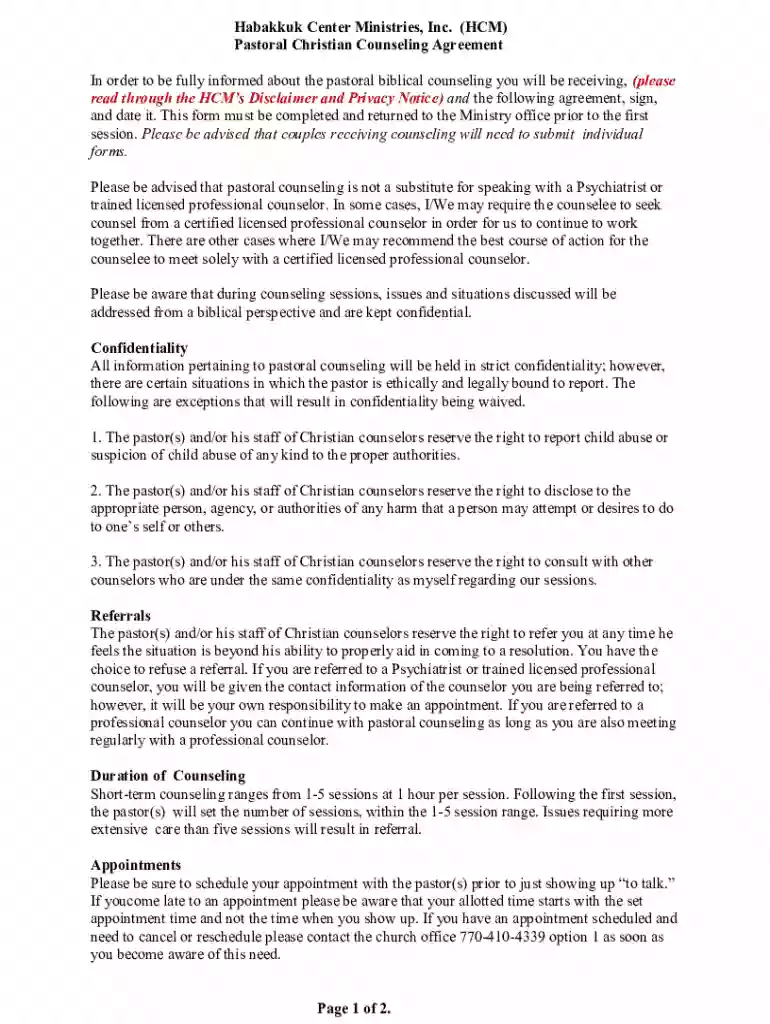
Pastoral-Christian-Counseling-Agreement Preview on Page 1

Here's how it works

01. Edit your form online
Type text, add images, blackout confidential details, add comments, highlights and more.

02. Sign it in a few clicks
Draw your signature, type it, upload its image, or use your mobile device as a signature pad.

03. Share your form with others
Send it via email, link, or fax. You can also download it, export it or print it out.

Definition and Meaning of the Pastoral-Christian-Counseling-Agreement

The Pastoral-Christian-Counseling-Agreement is a formal document utilized by Habakkuk Center Ministries, Inc. (HCM) to outline the expectations and framework for pastoral counseling sessions. This agreement serves to clarify that pastoral guidance offered is not a replacement for professional mental health services. It sets the groundwork for confidentiality, session logistics, potential referral protocols, and counselor-counselee rights. This document is essential in ensuring both parties understand their roles and the consensual nature of the pastoral counseling relationship.

Key Elements of the Agreement

The Pastoral-Christian-Counseling-Agreement includes several critical components that structure the counseling interaction:

  • Confidentiality Protocols: Defines what information will be kept private and the circumstances under which it may be disclosed.
  • Session Details: Outlines session length, frequency, and agreed-upon scheduling practices.
  • Donation Policies: Clarifies any expected donations or fees associated with the sessions.
  • Termination Rights: Provides guidelines for ending the counseling relationship from either party's side, detailing any required notice period.

How to Use the Pastoral-Christian-Counseling-Agreement

Utilizing the Pastoral-Christian-Counseling-Agreement effectively involves understanding its clauses and their implications. Here's a guide to its usage:

  1. Discuss with Counselor: Before signing, review the terms with your counselor to ensure mutual understanding.
  2. Review Detailed Sections: Pay attention to confidentiality clauses, session schedules, and termination terms.
  3. Sign and Return: Ensure you sign and return the document to the counselor ahead of the first session.

Important Terms Explained

The agreement contains terms that may require further clarification:

  • Pastoral Counseling: Refers to guidance that is spiritual and religious in nature, distinct from clinical mental health counseling.
  • Waiver of Liability: Indicates that the ministry or counselor is not liable for outcomes beyond spiritual guidance.

Steps to Complete the Pastoral-Christian-Counseling-Agreement

Completing the agreement correctly ensures a smooth start to counseling sessions. Follow these steps:

  1. Read Thoroughly: Begin by carefully reading through each section to understand the agreement fully.
  2. Clarify Doubts: Reach out to your counselor to clarify any ambiguous terms or sections.
  3. Fill Required Information: Complete all necessary fields with accurate personal and contact information.
  4. Initial and Sign: Initial any changes or additions, and sign in the designated areas.
  5. Submit: Return the completed agreement to your counselor, either in person, via email, or using a secure document sharing platform.

Who Typically Uses the Pastoral-Christian-Counseling-Agreement

The agreement is predominantly used by individuals seeking spiritual guidance within the framework of Christian beliefs. Those who may benefit include:


  • Church Members: Individuals who are part of a church congregation seeking advice for personal or spiritual matters.
  • Individuals in Distress: Those experiencing life challenges who require moral and faith-based support.
  • Seeking Religious Guidance: Counselees desiring development in their religious faith and practice.
decoration image ratings of Dochub

Legal Use of the Pastoral-Christian-Counseling-Agreement

The agreement serves as a legally recognized document, reinforcing the rights and responsibilities of both counselor and counselee:

  • Waivers and Consents: Includes clauses for consent to counseling and waivers of liabilities, providing legal protection.
  • Documented Terms: Clearly recorded terms offer both parties a mutual understanding, reducing conflicts.

Examples of Using the Pastoral-Christian-Counseling-Agreement

In practical scenarios, the Pastoral-Christian-Counseling-Agreement is employed as follows:

  • Counseling for Marriage Issues: Couples looking to resolve marital disputes might use the agreement to define their counseling sessions.
  • Grief Counseling: Individuals coping with loss may use this document to outline the spiritual support they seek.
  • Youth Guidance: Youth members in a church may utilize the agreement to set expectations for their mentoring and spiritual growth.

State-Specific Rules for the Pastoral-Christian-Counseling-Agreement

While the agreement is generally applicable across the United States, state-specific regulations may influence its execution:

  • State Confidentiality Laws: Each state has distinct privacy laws affecting how information can be shared.
  • Licensing Requirements for Counselors: Some states may require specific credentials for those providing counseling, including pastoral advisers.

Required Documents for the Pastoral-Christian-Counseling-Agreement

To complete the Pastoral-Christian-Counseling-Agreement, gather the following documents:

  • Personal Identification: Such as a driver’s license or state ID for verification.
  • Contact Information: Provide updated phone numbers and email addresses.
  • Relevant Background Information: Include any pertinent details related to the counseling subject, if applicable.

By adhering to these guidelines, users can ensure the effective use of the Pastoral-Christian-Counseling-Agreement and its structured pathway to receiving spiritual counseling.

be ready to get more

Complete this form in 5 minutes or less

Get form

Got questions?

We have answers to the most popular questions from our customers. If you can't find an answer to your question, please contact us.
Contact us
Colossians 1:21 gives the pastor clear directions about the responsibility we have to teach AND counsel: We proclaim Him, admonishing every man and teaching every man with all wisdom, so that we may present every man complete in Christ. Paul reminds us again in Galatians 6:1-2, Brothers, if anyone is caught in any
A Christian counselor is not a formal licensure or certification required, but instead an expressed viewpoint of the therapist. (That being said, if you want to seek out Christian counseling principles, I recommend AACCs Light University.
14 counseling careers without a degree Teachers aide. Developmental service worker. Camp counselor. Safe house program assistant. Community health worker. Peer counselor. Residential counselor. Health coach.
Pastoral care and counseling are very similar and there is not much difference between the two. Pastoral care is more suited to the spiritual needs of the whole church congregation and counseling is more direct toward the individual member. Another thing is you dont need to be a pastor to be a counselor.
Pastors offer biblical advice while Christian counselors are using clinical skills. Jenny points out that most pastors have excellent knowledge and training in theology and the bible, but usually only one class on counseling This makes them less equipped to handle more complex or long-term mental health issues.

Security and compliance

At DocHub, your data security is our priority. We follow HIPAA, SOC2, GDPR, and other standards, so you can work on your documents with confidence.

Learn more
ccpa2
pci-dss
gdpr-compliance
hipaa
soc-compliance
be ready to get more

Complete this form in 5 minutes or less

Get form

People also ask

However, depending on your jurisdiction, employer, and professional goals, you may need to attend seminary, earn an advanced degree, such as your MS in pastoral counseling, and obtain certification or state licensure to become a pastoral counselor.
However, pastoral counselors must hold state licensure if they counsel members of the public, work in private practice, or accept payment specifically for counseling services.
Yes, trained clinical pastoral counselors or chaplains can charge for counseling services, but several factors influence this practice: Licensure and Certification: The ability to charge for services may depend on whether the counselor is licensed or certified in their state or country.

Related links