




01. Edit your conservation of mass worksheet online
Type text, add images, blackout confidential details, add comments, highlights and more.

Type text, add images, blackout confidential details, add comments, highlights and more.

Draw your signature, type it, upload its image, or use your mobile device as a signature pad.

Send conservation of mass worksheet answer key via email, link, or fax. You can also download it, export it or print it out.
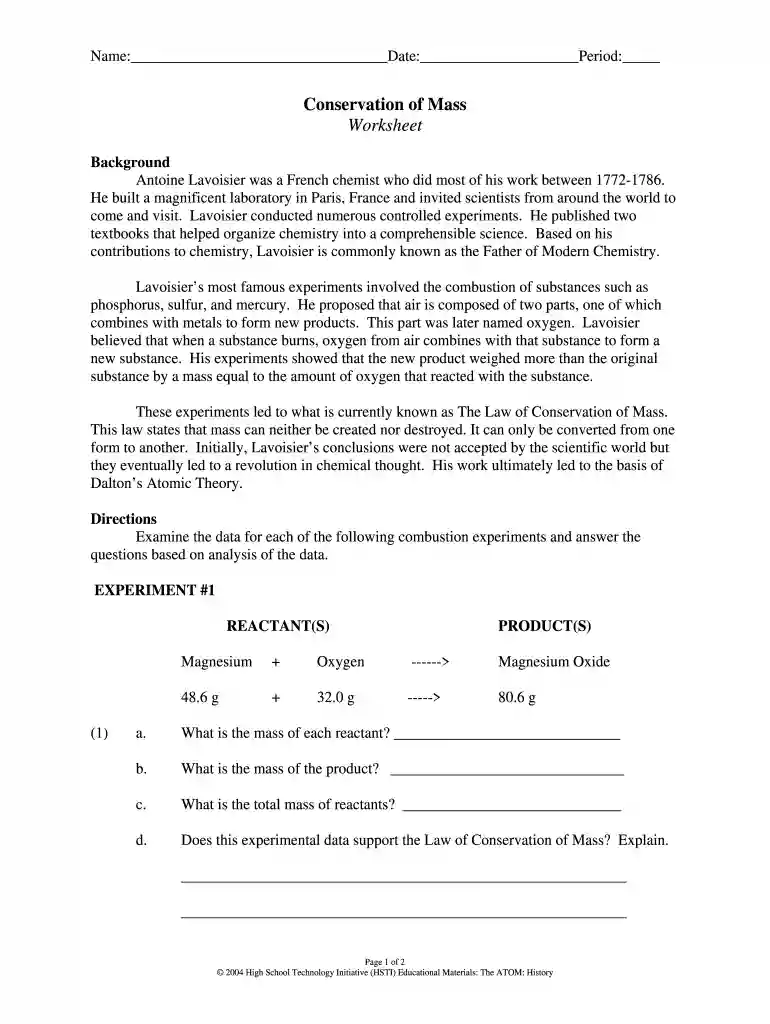
The conservation of mass worksheet serves as an educational tool designed to help students understand and apply the Law of Conservation of Mass, established by Antoine Lavoisier. This law states that mass in a closed system remains constant, as matter is neither created nor destroyed but only transformed. The worksheet offers explanations of Lavoisier's experiments, notably with combustion and oxygen, helping to illustrate how these foundational experiments underpin the law. Students utilize the worksheet to analyze data from various chemical reactions, recording observations of reactants and products.
Completing the conservation of mass worksheet involves several steps, each critical for reinforcing scientific concepts through practical application:
Read Background Information: Begin by reviewing the historical context and foundational experiments conducted by Lavoisier. Understanding the principles he established is vital for accurate analysis.
Perform Experiments: Follow detailed instructions to conduct experiments that demonstrate the conservation of mass. Properly measure all reactants and products to ensure precise results.
Data Collection: Record the mass of reactants and products before and after the experiments. This data will be crucial in confirming the conservation of mass.
Analysis: Compare the recorded data, noting any changes or consistencies in mass. Discuss potential reasons for any discrepancies observed.
Discussion and Conclusion: Summarize findings, drawing conclusions about the experiments' outcomes and their alignment with the Law of Conservation of Mass.
The conservation of mass worksheet can be obtained through various educational platforms and resources. Teachers often distribute it as part of a science curriculum in schools. It may also be available through online educational portals, where it can be downloaded directly. Some educational publishers offer comprehensive science workbooks that include this worksheet, providing additional context and related activities.
Understanding specific terminology is essential for effectively using the conservation of mass worksheet:
The primary users of the conservation of mass worksheet are students within secondary and post-secondary education settings, particularly those studying chemistry or physical science. Teachers use the worksheet as a didactic tool to facilitate hands-on learning, encouraging students to engage with foundational scientific principles actively. Beyond educational settings, researchers and educators may use similar worksheets for demonstrations or workshops.


In practice, students might perform an experiment involving the reaction between sodium bicarbonate and acetic acid. By carefully measuring the mass before and after the reaction within a sealed container, students can observe that the overall mass remains constant, thereby demonstrating the conservation of mass. Worksheets may also include virtual simulation exercises, where students manipulate variables within a digital program to see mass conservation in action, especially when physical resources are limited.
The conservation of mass worksheet is available in both digital and paper formats, each offering distinct advantages:
While the conservation of mass worksheet is a standard educational tool, various versions exist to accommodate different educational levels and learning objectives. Alternatives might focus on different scientific phenomena while maintaining the core principle of mass conservation. Adaptations may include simplified versions for younger students or more complex analyses for advanced learners, each tailored to the appropriate cognitive and educational stage.
We've got more versions of the conservation of mass worksheet form. Select the right conservation of mass worksheet version from the list and start editing it straight away!
| Versions | Form popularity | Fillable & printable |
|---|---|---|
| 2004 | 4.1 Satisfied (32 Votes) |
At DocHub, your data security is our priority. We follow HIPAA, SOC2, GDPR, and other standards, so you can work on your documents with confidence.
While mass conservation deals with matter, energy conservation Law Of Conservation Of Mass Worksheet: An Analytical Exploration Law Of Conservation.
by CF Herrmann-Abell 2016 Cited by 29 Most materials are organized around topics, such as physical or chemical change, chemical equations, conservation of mass, and balancing chemical equations
Dec 5, 2012 A mass balance/mass discharge analysis was applied to evaluate TCE dechlorination, dissolution, advection, and volatilization in the ZVI test


