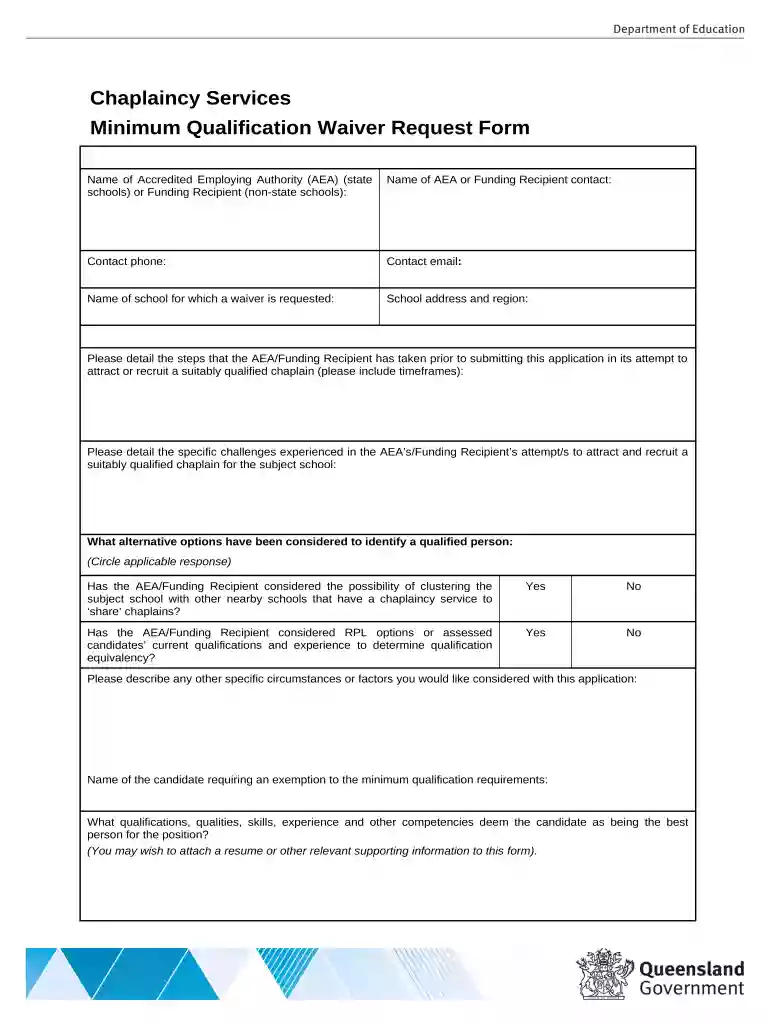
Chaplaincy minimum qualification waiver request form 2026

Get Form
Chaplaincy minimum qualification waiver request form Preview on Page 1

Here's how it works

01. Edit your form online
Type text, add images, blackout confidential details, add comments, highlights and more.

02. Sign it in a few clicks
Draw your signature, type it, upload its image, or use your mobile device as a signature pad.

03. Share your form with others
Send it via email, link, or fax. You can also download it, export it or print it out.

Definition and Meaning

The Chaplaincy Minimum Qualification Waiver Request Form is an official document used by accredited employing authorities or funding recipients to request a waiver of the standard qualification requirements for chaplains. This form is essential when there is a need to fill chaplaincy positions in schools or organizations, but suitable candidates with the specified qualifications are not available. The request must outline why a waiver is necessary by detailing recruitment efforts, challenges faced in finding qualified personnel, and the evaluation of candidates considered for the position.

Eligibility Criteria

To be eligible to utilize the Chaplaincy Minimum Qualification Waiver Request Form, employing authorities must demonstrate substantial efforts in hiring qualified chaplains. These efforts include advertising the position widely and conducting interviews with available candidates. Additionally, the organization must ensure that the candidate they seek to employ under the waiver has relevant experience and competencies that partially satisfy the requirements. Providing documentation verifying these efforts and qualifications is crucial to justify the waiver request.


decoration image ratings of Dochub

Key Elements of the Form

The form encompasses several critical sections, each serving a distinct purpose in the waiver request process:

  • Contact Information: Requires detailed information about the employing authority, including name, address, and contact details.
  • Statement of Need: Describes the recruitment challenges and the necessity for a waiver.
  • Candidate Information: Covers the details of the candidate, such as experience, alternative qualifications, and why they are deemed suitable despite not meeting the full criteria.
  • Declaration of Compliance: Confirms that all recruitment processes comply with legal and organizational standards.

Steps to Complete the Form

  1. Gather Necessary Information: Collect all relevant details about the employing authority, recruitment efforts, candidate qualifications, and compliance records.
  2. Fill Out Contact Information: Provide accurate details in the contact section to ensure proper identification and correspondence.
  3. Draft the Statement of Need: Clearly outline the barriers faced in recruiting a qualified chaplain and the rationale for requesting a waiver.
  4. Input Candidate Details: Document the candidate's qualifications and experience.
  5. Complete the Declaration: Ensure the declaration section is filled out truthfully to affirm adherence to the necessary guidelines.
  6. Review and Submit: Double-check all entered information for accuracy and completeness before submission via the designated method.

Legal Use of the Chaplaincy Minimum Qualification Waiver Request Form

The legal framework surrounding the waiver request form ensures that it is used solely for its intended purpose: to facilitate the employment of suitable chaplaincy personnel in situations where qualified candidates are unavailable. Employing authorities must adhere to the guidelines and accurately disclose all required information to maintain the integrity of the waiver process. Providing false information may lead to legal repercussions and potential bans from future waiver requests.

Who Typically Uses This Form

The primary users of the Chaplaincy Minimum Qualification Waiver Request Form are educational institutions, non-profit organizations, and religious bodies that provide chaplaincy services. These entities often operate in areas where there is a shortage of qualified chaplains and are, therefore, eligible to apply for a waiver based on specific criteria and documented recruitment challenges.

Examples of Using the Form

An example could involve a school district in a rural area that has advertised extensively for a chaplaincy position but has received few to no applications from candidates meeting the standard qualifications. Under this circumstance, the district could use this form to apply for a waiver, providing details of their recruitment strategy and the credentials of a candidate who possesses alternative qualifications deemed sufficient for the role.

Important Terms Related to the Form

Understanding the terminology associated with the form is crucial:

  • Accredited Employing Authorities: Bodies recognized and authorized to recruit for chaplaincy positions.
  • Waiver: An official approval allowing deviation from the standard qualification requirements.
  • Chaplains: Individuals providing spiritual support and counseling, often in educational or institutional settings.

State-Specific Rules

Different states may have varying requirements or additional constraints when it comes to employing chaplains and utilizing waiver forms. It is vital for organizations to consult local guidelines and regulations to ensure compliance and successful processing of their waiver requests.

Form Submission Methods

Submission methods for the Chaplaincy Minimum Qualification Waiver Request Form can vary by region or organizational policies. Generally, the form can be submitted online through a secure portal, by mail, or in person at designated offices. It is important to verify the accepted submission method with the relevant governing body to ensure timely processing.

be ready to get more

Complete this form in 5 minutes or less

Get form

Got questions?

We have answers to the most popular questions from our customers. If you can't find an answer to your question, please contact us.
Contact us
A chaplain is a certified clergy member who provides spiritual care for individuals in a non-religious organization, rather than a church congregation. Chaplains can work in government roles and serve members of the military in different locations.
The Queensland Department of Education requires that a chaplain holds a Certificate IV in Pastoral Care, Youth Work, or Chaplaincy and Pastoral Care, or an equivalent or higher qualification; and the certificate or equivalent/higher qualification must include competencies in making appropriate referrals and mental
Clergy or officiants differ from chaplains in that the clergy serve the members of their congregation, while chaplains are usually employed by an institution such as the military, a hospital or other health care facility, etc.
The four functional capabilities of chaplains to provide, facilitate, advise, and care inform chaplains and management alike how this tension is lived out with integrity.
Have at least two units of Clinical Pastoral Education (CPE) (this normally includes 800 hours of supervised ministry in a formal training program). Be a member in good standing in a NAE Chaplains Commission denomination or church and have affirmation by that church of the individuals call to chaplaincy ministry.

Security and compliance

At DocHub, your data security is our priority. We follow HIPAA, SOC2, GDPR, and other standards, so you can work on your documents with confidence.

Learn more
ccpa2
pci-dss
gdpr-compliance
hipaa
soc-compliance
be ready to get more

Complete this form in 5 minutes or less

Get form

People also ask

Local Chaplaincy Committee Members of the LCC understand the cultural and religious customs and needs of individuals and groups within the school and range of services and support currently available and/or required.
A pastors ministry deals mainly with in-docHub, or we can say is church-based. IS THERE A DEMAND FOR CHAPLAINS? Whereas, a chaplains ministry deals mainly with out-docHub, and is community-based.
Entry requirements Employers expect chaplains to have experience as a leader in their own faith and experience of spiritual and pastoral care. Employers may also ask for some experience in healthcare work. This could be from, for example, hospital visiting while working as a faith leader elsewhere.

Related links