
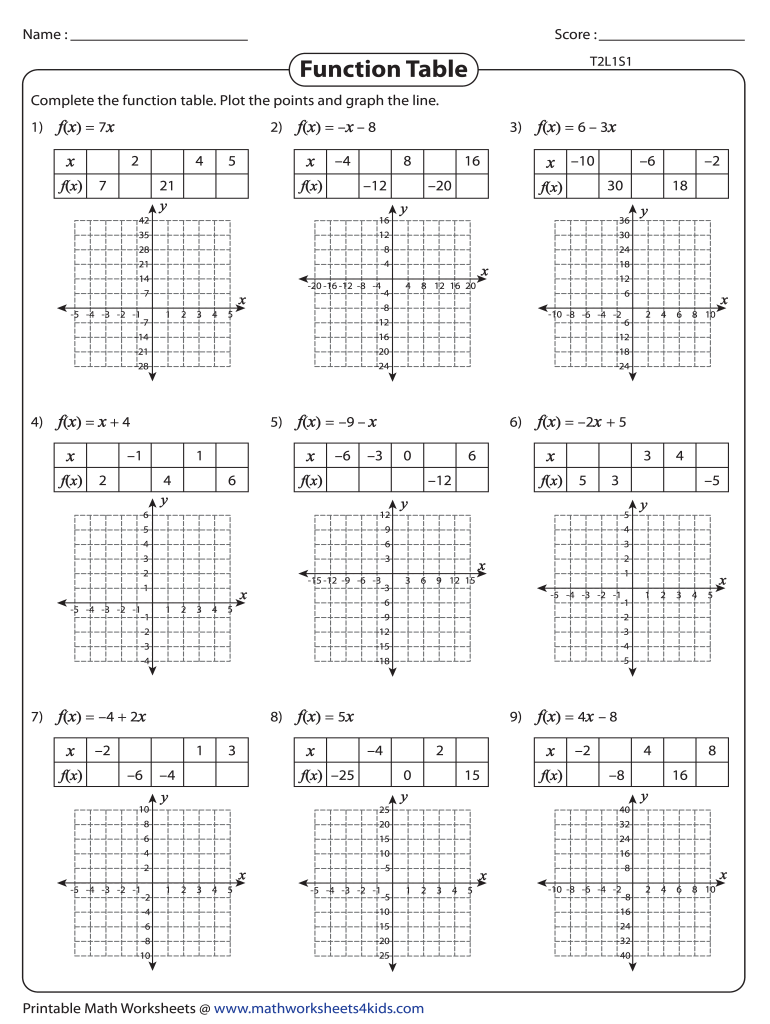







Understanding the Function Table Answer Key
The function table answer key serves as a resource to verify calculations and understand how to complete function tables, an essential aspect of mathematics, especially in courses like algebra and geometry. These tables help organize input-output pairs, allowing students to plot points and visualize relationships between variables.
Components of Function Tables
Function tables display a relationship where each input corresponds to exactly one output. Key elements of a function table include:
- Inputs: These are the values entered into the function, often structured in a vertical column.
- Outputs: The results obtained after applying the function to each input, listed in parallel with the inputs.
- Function Rule: A mathematical expression that describes the relationship between the input and output. This may involve linear functions, quadratic functions, or other expressions.
For example, in a linear function such as ( f(x) = 2x + 3 ), if the input ( x ) is two, the corresponding output would be five, leading to the pair (2, 5).
How to Use the Function Table Answer Key
To utilize a function table answer key effectively, follow these systematic steps:
- Identify the Function: Check the function or rule being applied to the inputs.
- Fill in the Table: Using the function rule, calculate the output for each input sequentially.
- Compare with Answer Key: Once the table is filled out, use the answer key to check the accuracy of your answers.
- Analyze Discrepancies: If there are differences between your answers and the key, revisit your calculations to identify errors.
This approach ensures that the learning process is reinforced through verification and correction.
Educational Benefits of Function Table Worksheets
Function table worksheets provide numerous educational advantages:
- Visual Learning: Students learn to visualize relationships between variables, which is crucial in understanding concepts in higher mathematics.
- Reinforcement of Skills: Completing these worksheets helps reinforce skills related to function evaluation and graphing.
- Preparation for Advanced Topics: Mastery of function tables is foundational for understanding more complex mathematical ideas encountered in algebra and calculus.
For educators, function table worksheets are an effective tool for assessing student comprehension and guiding further instruction.
Common Variants of Function Tables
There are several types and formats of function tables that students may encounter:
- Linear Function Tables: These tables illustrate relationships described by linear equations, demonstrated by consistent differences in output for equal changes in input.
- Quadratic Function Tables: These require students to recognize the pattern in outputs that stem from quadratic equations, typically leading to curvilinear representations on graphs.
- Custom Function Tables: Depending on instructional goals, teachers may create specific function tables with unique rules that students must interpret.
Each variant presents unique challenges and learning opportunities that cater to different aspects of mathematical understanding.
Real-World Applications of Function Tables
Function tables are not just academic exercises; they have practical applications in various fields, such as:
- Engineering: Engineers use function tables to model relationships between forces, materials, and environmental influences.
- Economics: Economists may represent the relationships between supply, demand, and pricing through function tables.
- Data Analysis: In statistics, function tables help organize and present relationships in datasets, facilitating data interpretation.
Recognizing these applications demonstrates the relevance of function tables beyond the classroom, illustrating their value in critical thinking and problem-solving.
Completing the Function Table Worksheet
Completing a function table worksheet typically involves several steps:
- Analyze the Function: Read the given function carefully to understand how inputs are transformed into outputs.
- Determine Input-Output Pairs: Create a list of input values, followed by calculating each respective output.
- Check Against the Answer Key: Verify each calculated output with the function table answer key to ensure accuracy.
By practicing with function tables, students solidify their understanding of functions and enhance their overall mathematical fluency.
Conclusion
For anyone involved in mathematics education, mastering function tables through worksheets and corresponding answer keys is instrumental. These tools not only support learning but also lay the groundwork for more advanced studies in mathematics and various professional fields.




