Trying self government answer key 2026

Get Form
trying self government answer key Preview on Page 1

Here's how it works

01. Edit your trying self government answer key online
Type text, add images, blackout confidential details, add comments, highlights and more.

02. Sign it in a few clicks
Draw your signature, type it, upload its image, or use your mobile device as a signature pad.

03. Share your form with others
Send trying self government answer key pdf via email, link, or fax. You can also download it, export it or print it out.

Definition and Meaning of the Trying Self Government Answer Key

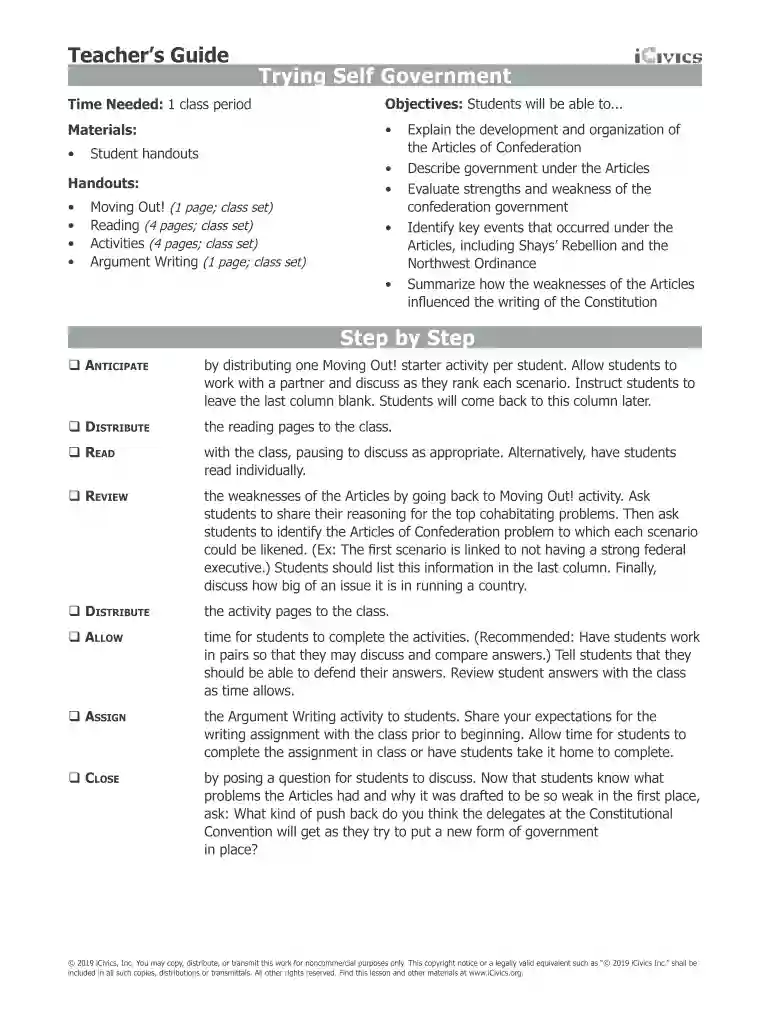
The trying self government answer key serves as an educational resource that provides answers to questions and prompts relating to the lesson on self-government, specifically focusing on the Articles of Confederation and their influence on U.S. governance. This answer key is designed for teachers and educators who aim to facilitate student learning by providing clear, accurate responses to lesson-related inquiries. It often includes the correct answers to key questions derived from various educational materials, such as quizzes and worksheets used in classrooms.

  • Purpose: It aids educators in assessing student understanding and reinforces learning objectives by giving accurate answers for reference.
  • Audience: Primarily educators, but it can also serve as a study aid for students wishing to verify their understanding of the material.
  • Usage Context: It is typically used in civics or government classes, particularly when discussing historical documents and events that underpin the U.S. political system.

How to Use the Trying Self Government Answer Key

Using the trying self government answer key involves a few simple steps to ensure that both educators and students derive the maximum benefit from the resource.

  1. Reference Teaching Materials: Compare the answer key with lesson plans, textbooks, and quizzes to confirm that the content aligns with current teaching methods.
  2. Assess Student Understanding: After a lesson on self-government, educators can use the answer key to correct quizzes or assignments, facilitating prompt feedback.
  3. Guide Discussions: The key can act as a discussion guide, helping teachers lead classroom conversations and address any misconceptions.
  4. Facilitate Revision: Students can use the answer key for self-assessment, revising their understanding of key concepts before tests or assessments.

Advantages of Using the Answer Key

  • Promotes Accurate Knowledge: Ensures that students learn the correct interpretations of historical and governmental concepts.
  • Saves Time: Reduces the hours educators spend correcting student work manually.
  • Encourages Self-Learning: Empowers students to take responsibility for their learning process by allowing them to check their answers independently.

How to Obtain the Trying Self Government Answer Key

Obtaining the trying self government answer key can be essential for educators and students alike. Here are the primary methods to access this resource:

  • Educational Websites: Many educational resource platforms offer downloadable versions of answer keys, including PDFs that can be accessed easily online.
  • School District Resources: Sometimes, school districts provide resources for teachers that include answer keys for various curricula.
  • iCivics Platform: If the lesson is based on iCivics materials, educators can find the official answer keys directly on the iCivics website, specifically tailored for their lesson plans.
  • Teacher Collaborations: Networking with fellow educators can also yield additional resources, as teachers frequently share materials for various lessons.

Important Considerations

  • Ensure that the obtained answer key is specifically tailored to the lesson being taught, as different educational materials may have varying answer keys.
  • Verify whether the answer key is updated regularly, matching new educational standards and historical interpretations.

Key Elements of the Trying Self Government Answer Key

Understanding the key components of the trying self government answer key is crucial for effective use. The following elements are typically included:

  • Question and Answer Format: Standard layout that includes a list of questions followed by their corresponding correct answers.
  • Explanatory Notes: Some keys may contain additional explanations for particular answers, providing context for better understanding.
  • Lesson References: Citation of specific lesson plans or educational materials relevant to each answer, offering a comprehensive view.

Typical Sections

  • Introduction Section: May provide an overview of the lesson's objectives.
  • Question Categories: Organized based on themes or topics related to self-government, such as constitutional principles, historical events like Shays' Rebellion, or the role of the Articles of Confederation.
  • Conclusion Notes: Sometimes includes recommendations for further reading or additional resources to extend learning beyond the basic lesson.

Important Terms Related to the Trying Self Government Answer Key

Familiarity with specific terminology surrounding the trying self government answer key can enhance educators' and students' understanding. Here are some important terms:

  • Articles of Confederation: The original framework of government for the United States that was replaced by the U.S. Constitution.
  • Self-Government: The concept that a community or nation governs itself, free from outside control, reflecting democratic principles.
  • Civic Education: A field of study that prepares learners to be informed and active participants in a democratic society.
  • Constitutional Framework: The structure and principles established by the U.S. Constitution guiding governmental authority.

Importance of Terminology

  • Enhances Learning: Familiarity with these terms can deepen students' comprehension of the fundamental concepts of American governance.
  • Facilitates Discussion: Encourages richer classroom discussions when students and educators share a common language regarding civic education.

Examples of Using the Trying Self Government Answer Key

Practical applications of the trying self government answer key help elucidate its usefulness. Here are several scenarios illustrating how it can enhance learning experiences:

  1. Classroom Quizzes: After a quiz on the Articles of Confederation, teachers can use the answer key to provide immediate feedback, reinforcing correct understanding and addressing any confusion.
  2. Group Activities: In a group activity focused on self-government scenarios, students can refer to the answer key to ensure their analyses align with established historical facts.
  3. Homework Review: When reviewing homework assignments related to self-government concepts, students can cross-reference their responses with the answer key, fostering independent learning.

Enhanced Learning Through Examples

  • Case Study Discussion: In discussions about historical events like Shays' Rebellion, teachers might utilize the answer key to clarify why governmental weaknesses led to public unrest, guiding students to analyze the consequences of inadequate governance.
  • Interactive Learning Sessions: Teachers can incorporate trivia games based on the information in the answer key, engaging students in a fun and educational manner while reinforcing their understanding of important civic principles.

Each of these examples illustrates the practical usage of the trying self government answer key in educational contexts, ensuring robust understanding and engagement with the material.

be ready to get more

Complete this form in 5 minutes or less

Get form

Got questions?

We have answers to the most popular questions from our customers. If you can't find an answer to your question, please contact us.
Contact us
Local self-government means that residents in towns, villages and rural settlements are the people who elect local councils and their heads authorising them to solve the important issues. India is a federal republic with three spheres of government: union, state and local.
The first three words of the Constitution are We the People, symbolizing self-government. The phrase We the People implies that the government is created by and for the people.
Self-government is related to the concept of autonomy. It is the ability of an individual, a state, or a country to govern itself. Self-governing states are free from oversight by higher governments, including external influences. In other words, the political authority of a state comes from its citizens.
Explanation: Local self-government refers to the administration of a local area by elected representatives, allowing communities to make decisions on local issues. The Panchayati Raj system consists of three levels: the Gram Panchayat (village level), Panchayat Samiti (block level), and Zilla Parishad (district level).
The core idea of self-government is that people should have a say in the terms by which we live our lives. Self-government contains the idea that people should be free from unjust control over their lives, but it also means that people are responsible for their own actions.

Security and compliance

At DocHub, your data security is our priority. We follow HIPAA, SOC2, GDPR, and other standards, so you can work on your documents with confidence.

Learn more
ccpa2
pci-dss
gdpr-compliance
hipaa
soc-compliance

People also ask

Local governments typically constitute a subdivision of a higher-level political or administrative unit, such as a nation or state. Local governments generally act within the powers and functions assigned to them by law or directives of a higher level of government.

icivics trying self government answer key pdf