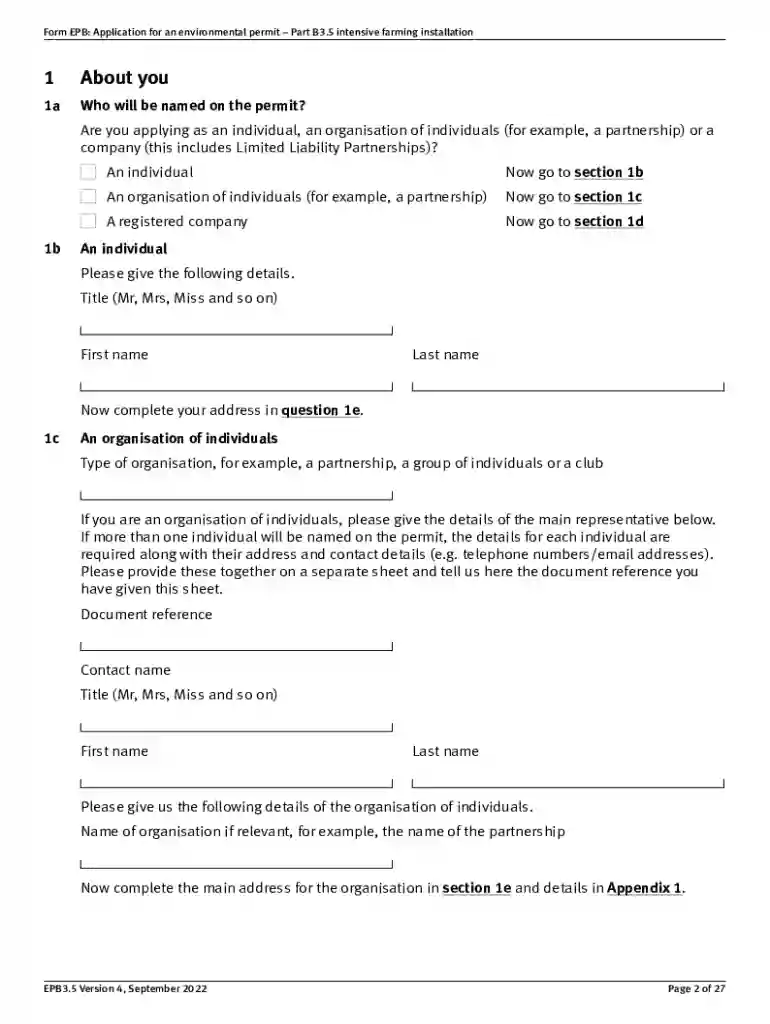
Assets publishing service ukgovernmentGuidance notes on part B3 5Application for an 2026

Get Form
uk environmental permit application intensive Preview on Page 1

Here's how it works

01. Edit your uk environmental permit application intensive online
Type text, add images, blackout confidential details, add comments, highlights and more.

02. Sign it in a few clicks
Draw your signature, type it, upload its image, or use your mobile device as a signature pad.

03. Share your form with others
Send it via email, link, or fax. You can also download it, export it or print it out.

Definition & Meaning

The "assets publishing service UK government Guidance notes on Part B3 5 Application for an" refers to a specific set of instructions and guidelines used for completing a UK government application related to environmental permits. These permits are essential for intensive farming operations, involving activities like pig or poultry rearing. The form's guidance notes play a crucial role in clarifying the requirements for applicants, ensuring compliance with environmental regulations.

Key Points:

  • Purpose: The guidance notes provide clarity on how to complete the environmental permit application for certain agricultural activities.
  • Audience: Targeted towards farmers and agricultural businesses intending to apply for permits in intensive farming sectors such as pig or poultry.

How to Use the Guide

The guidance notes serve as an instructional tool that applicants must refer to when filling out the environmental permit application. These notes are crucial for understanding each section of the application, which covers a variety of critical compliance areas.

Steps for Usage:

  1. Read Thoroughly: Start by reading through the entire guidance document to get an overview of the requirements and sections.
  2. Section-by-Section Review: Pay special attention to each part of the application to understand what information is needed.
  3. Question Clarification: Use the notes to clarify any questions about particular sections or how information should be presented.

Steps to Complete the Application

The application for an environmental permit involves several steps, each guided by the publication's detailed notes. Following these steps meticulously is critical for ensuring a complete submission.

Detailed Process:

  1. Collect Required Information: Gather all necessary details about the farming operation, including site details and management systems.
  2. Fill the Application Forms: Use the guidance to accurately complete each section of the application, ensuring all relevant environmental and operational information is included.
  3. Submit Supporting Documents: Attach all necessary ancillary documents as indicated by the guidance notes, such as risk assessments and emissions information.

Key Elements of the Application

The application consists of several critical elements that applicants need to accurately fill out as guided by the document notes. Understanding these elements ensures no crucial details are overlooked.

Core Components:

  • Applicant Information: Personal and business details of those applying.
  • Site Details: Location specifics and scale of farming operations.
  • Environmental Assessments: Comprehensive evaluation of potential environmental impacts and proposed mitigative measures.
  • Operational Procedures: Detailed description of farming methods and techniques.

Who Typically Uses the Application

The application and its accompanying notes are tailored specifically for intensive farming operations. Understanding who uses these tools helps contextualize their importance.


decoration image ratings of Dochub

Common Users:

  • Farmers: Especially those involved in large scale pig or poultry operations.
  • Agricultural Businesses: Firms needing legal clearance to run intensive farming activities.
  • Environmental Consultants: Professionals helping farming operations stay compliant.
decoration image

Legal Use of the Application

Understanding the legal implications of the environmental permit application and its guidance is vital for ensuring compliance and avoiding potential penalties.

Legal Considerations:

  • Compliance: Ensures adherence to environmental laws and regulations.
  • Penalties for Non-Compliance: Failure to properly use the application could result in fines or operational restrictions.
  • Confidentiality and Data Protection: Guidelines on how personal and operational data should be handled.

Important Terms Related to the Application

The guidance notes contain specific terminology crucial for comprehension and accurate application completion.

Notable Terms:

  • Environmental Risk Assessments: Evaluations of potential impacts on the environment from farming activities.
  • Operational Techniques: Standard practices used in farming to minimize environmental and health impacts.
  • Emissions Documentation: Recorded data on potential emissions from farming operations.

Required Documents

The application process requires specific documents alongside the form, as specified in the guidance notes. These documents substantiate claims made within the application.

Necessary Documentation:

  • Site Plans: Maps and diagrams detailing the farm's location and infrastructure.
  • Management Plans: Strategic plans outlining operational and environmental management strategies.
  • Risk Assessment Reports: Detailed assessments of potential environmental risks and proposed management strategies.

Eligibility Criteria

Before even beginning the application process, it’s essential to establish eligibility, as detailed in the guidance notes.

decoration image

Key Criteria:

  • Operational Scope: Typically targets large operations, often defined by specific head counts or farm sizes.
  • Compliance History: Past adherence to environmental regulations may be a factor in determining eligibility.
  • Location Constraints: Permits may be influenced by geographic and local environmental conditions.
be ready to get more

Complete this form in 5 minutes or less

Get form

Got questions?

We have answers to the most popular questions from our customers. If you can't find an answer to your question, please contact us.
Contact us
This division culminated in the formulation of two divergent descriptive theses: (1) associated dependent development, (2) development of underdevelopment. The followers of associated dependent development maintained that some peripheral states have historically experienced economic development, which involves
Associated Development, broadly, is that development which is connected to the principal NSIP development for which development consent is sought. In England, the Secretary of State determines applications for Associated Development where included within an NSIP application.
Related Development means any development of which the Project is a part or is related and the Project cannot be completed, either structurally or financially, without the completion of the development.
Associated Infrastructure means any building or infrastructure that is necessary for the functioning of a facility or activity or that is used for an ancillary service or use from the facility.

Security and compliance

At DocHub, your data security is our priority. We follow HIPAA, SOC2, GDPR, and other standards, so you can work on your documents with confidence.

Learn more
ccpa2
pci-dss
gdpr-compliance
hipaa
soc-compliance
be ready to get more

Complete this form in 5 minutes or less

Get form