Forms Clayton County, Georgia 2026

Get Form
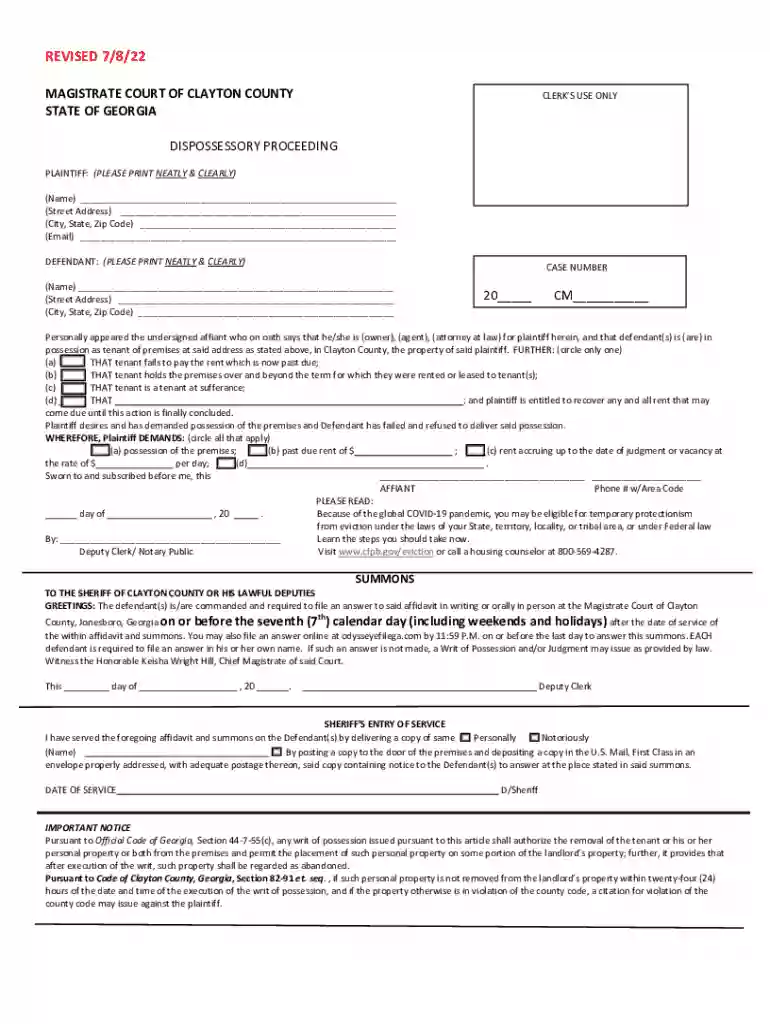
dispossessory proceeding form Preview on Page 1

Here's how it works

01. Edit your dispossessory proceeding form online
Type text, add images, blackout confidential details, add comments, highlights and more.

02. Sign it in a few clicks
Draw your signature, type it, upload its image, or use your mobile device as a signature pad.

03. Share your form with others
Send it via email, link, or fax. You can also download it, export it or print it out.

Definition & Meaning

The "Forms Clayton County, Georgia" primarily refer to legal documents used within the Magistrate Court of Clayton County for specific legal processes, such as dispossessory proceedings. A dispossessory proceeding is a legal action taken by a landlord (plaintiff) to evict a tenant (defendant) from a rental property due to non-payment of rent or unlawful occupation. The form includes critical sections that outline the details of the eviction process, parties involved, grounds for eviction, and legal demands.

The term suggests a collection of forms associated with legal and administrative procedures within Clayton County. Different forms under this category might serve various legal requirements and typically require completion to initiate or respond to specific court actions.

How to Use the Forms Clayton County, Georgia

To effectively utilize the forms, it's imperative to understand their purpose and the relevant procedures. For a dispossessory proceeding, the form must be filled out by the landlord to initiate eviction. Essential steps include:

  1. Gather Necessary Information: Collect all relevant tenant details, lease agreements, and any communication regarding unpaid rent.
  2. Follow the Official Instructions: Each section of the form contains instructions. Carefully read and adhere to these guidelines to avoid errors that might invalidate the form.
  3. Complete All Sections Accurately: Details must include the names of both parties, the exact grounds for eviction, and the amount of past-due rent.
  4. Legal Language: Use precise legal terms as indicated in the instructions to ensure clarity and avoid potential disputes.
  5. Sign and Submit: Ensure the document is signed correctly and submitted to the appropriate court office for processing.

Steps to Complete the Forms Clayton County, Georgia

Completing the form requires accuracy and attention to detail. Follow these essential steps:

  1. Section A – Personal Information: Start by entering the accurate contact and identification information for both the plaintiff and defendant.

  2. Section B – Grounds for Eviction: Clearly state the reasons for the dispossessory proceeding, such as non-payment of rent. Ensure that the reasons align with the lease agreement terms.

  3. Section C – Demands for Possession and Rent: Indicate the specific demands being made, including the eviction date and any overdue rent.

  4. Section D – Court Procedures and Mediation Options: Familiarize yourself with potential court procedures and opt for mediation if suitable.

  5. Verification and Signature: Conclude by verifying all provided information and signing the document.

Important Terms Related to Forms Clayton County, Georgia

Understanding the legal terminology on these forms enhances accuracy when completing them. Key terms include:

  • Plaintiff: The party initiating the legal action, usually the landlord in eviction cases.
  • Defendant: The party being accused or sued, typically the tenant in these proceedings.
  • Dispossessory: A legal term referring to the action of eviction.
  • Past Due Rent: Rent that has not been paid by the due date, often forming the basis for eviction proceedings.

Legal Use of the Forms Clayton County, Georgia

The form's legal use is crucial in adhering to court protocols and ensuring justice is served effectively. It allows landlords to assert their legal rights while providing tenants an official means to respond to allegations. This form:

  • Ensures both parties understand their rights and obligations.
  • Provides a framework for resolving disputes in a structured legal environment.
  • Supports legal transparency by documenting the claims and defenses of each party.

Key Elements of the Forms Clayton County, Georgia

Key elements include:

  • Identifying Information: Names, addresses, and contact details of both the plaintiff and defendant.
  • Legal Grounds for Action: Specifics regarding the plaintiff's claims against the defendant.
  • Court Filing Information: Details on how and where the form must be submitted.
  • Signatures: Legal endorsements signifying the authenticity of the document's contents.

State-Specific Rules for the Forms Clayton County, Georgia

Clayton County, Georgia, abides by specific state laws governing eviction and tenant-landlord relationships. These include:

  • Mandatory adherence to the Georgia Landlord-Tenant Code.
  • Requirement for fair notice periods before initiating evictions.
  • Compliance with both state and local housing regulations.

Understanding these rules helps in ensuring the form's legality and enforceability under Georgia law.

Examples of Using the Forms Clayton County, Georgia

The forms facilitate several practical scenarios, such as:

  • Landlords Seeking Eviction: A property owner uses the form to reclaim possession when a tenant fails to comply with rental terms.
  • Tenants Responding to Claims: Tenants can use the same forms to officially respond or dispute the eviction action, possibly seeking court-mandated mediation.
  • Property Managers: Incorporate these forms into standard lease agreements to ensure compliance and preparedness for legal actions if necessary.

These examples highlight the practical applicability of these forms within legal and routine rental management contexts.

be ready to get more

Complete this form in 5 minutes or less

Get form

Got questions?

We have answers to the most popular questions from our customers. If you can't find an answer to your question, please contact us.
Contact us
Clemons, Clerk Superior Court of Clayton County. Foreclosure of Abandoned Motor Vehicles $10.00 per vehicle PATHOs (Dispossessory / Eviction Proceedings) (without service) $50.00 per filing Post-Judgment Interrogatories Plaintiff serves Defendant by certified mail or overnight delivery.
Current Race and ethnicityAloneTotal White (non-Hispanic) 50.1% 53.2% African American (non-Hispanic) 30.6% 32.3% Hispanic or Latino 10.5% Asian 4.4% 5.2%3 more rows
However, the counties where the major cities in Georgia reside show different percentages. For example, in Fulton County, the majority of the population is Black or African American (42.1%), with the second-largest population being White (37.9%), and then Hispanic or Latino (8.1%).
The 5 largest ethnic groups in Clayton County, GA are Black or African American (Non-Hispanic) (69%), White (Non-Hispanic) (8.6%), Asian (Non-Hispanic) (5.05%), Other (Hispanic) (4.87%), and White (Hispanic) (4.06%).
However, due to extensive in-migration by Democratic-voting African-Americans from surrounding areas, starting in 1992 Clayton County has swung heavily Democratic and is now one of the most Democratic counties in the country.

Security and compliance

At DocHub, your data security is our priority. We follow HIPAA, SOC2, GDPR, and other standards, so you can work on your documents with confidence.

Learn more
ccpa2
pci-dss
gdpr-compliance
hipaa
soc-compliance

People also ask

Table Population White alone, percent  18.6% Black alone, percent (a)(a)  73.0% American Indian and Alaska Native alone, percent (a)(a)  0.6% Asian alone, percent (a)(a)  5.1%57 more rows
Generally, you will need the following in order to register your vehicle in Georgia: The location of your County Tag Office. Valid Georgia drivers license or ID card. A completed Form MV-1 Title and Tag Application (you can do this online or print and fill out the form by hand).

Related links