




01. Edit your form online
Type text, add images, blackout confidential details, add comments, highlights and more.

Type text, add images, blackout confidential details, add comments, highlights and more.

Draw your signature, type it, upload its image, or use your mobile device as a signature pad.

Send it via email, link, or fax. You can also download it, export it or print it out.
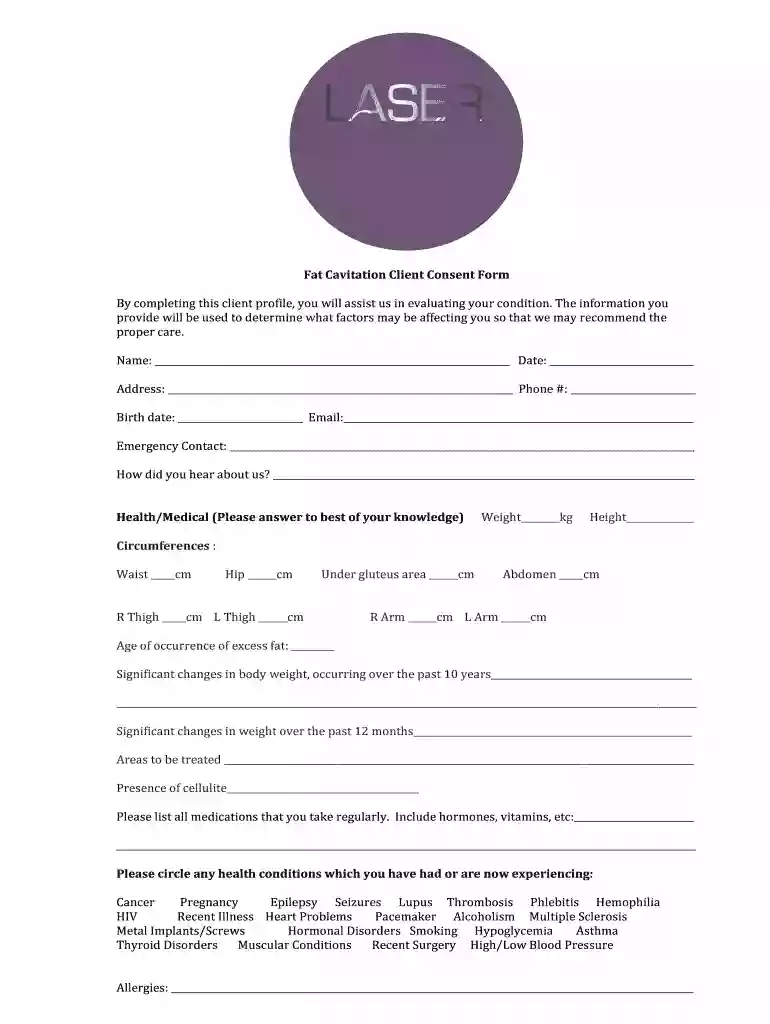
The Fat Cavitation Client Consent Form is a vital document used within clinics and therapeutic environments offering fat cavitation treatments. This form is essential for documenting a client's informed consent, specifically acknowledging their understanding of the procedure, potential risks, and intended outcomes associated with cavitation therapy. In a broader sense, this document acts as a written agreement between the client and service provider, safeguarding both parties' interests by outlining the treatment expectations and requirements.
Client Identification: Begin by filling in personal details including full name, contact information, and any identifying numbers specific to the clinic or service provider.
Medical History Disclosure: Include a comprehensive section for the client to disclose medical history. Key components may involve previous treatments, known allergies, past surgeries, and chronic conditions.
Lifestyle Information: Gather insights into the client's dietary habits and exercise frequency, which can impact the treatment's effectiveness.
Consent Acknowledgment: Clients must read a detailed overview of the procedure and its associated risks. This includes understanding potential side effects and the importance of complementary practices such as lymphatic drainage and nutrition counseling.
Signature Requirement: Conclude with the client's signature to formalize their consent. Make sure that each section of the form is understood and acknowledged by the client before signing.
Communication Tool: Ensure that verbal explanations accompany each section of the form, so the client fully understands the implications of the treatment.
Data Collection: Utilize the form to gather and record critical health and lifestyle information, aiding in tailored treatment planning.
Legal Protection: Serve as a legal document confirming the client's informed consent, thereby protecting the service provider against potential liabilities.
This form is predominantly used by clinics, wellness centers, and aesthetic practitioners who offer fat cavitation as part of their service offerings. These professionals require clients to complete the form to ensure everyone involved is clear on the procedure details, benefits, and risks.


Identification Information: Ensures accurate client identification.
Medical and Lifestyle History: Gathers necessary background for treatment customization.
Procedure Explanation and Risks: Details the procedure and associated risks, ensuring client awareness and consent.
Client Declaration and Signature: Obligates clients to acknowledge their understanding and agree to proceed with the treatment.
The consent form must adhere to specific legal standards, ensuring compliance with U.S. healthcare regulations such as HIPAA, which secures the client's private data. Additionally, the form must explicitly delineate the scope and limitations of the procedure to avoid potential legal disputes.
Cavitation Therapy: A non-invasive procedure using ultrasound to target and reduce fat deposits.
Informed Consent: A legal procedure ensuring a client is fully educated on the procedure before agreeing to treatment.
Lymphatic Drainage: Part of the post-treatment process to encourage the removal of released toxins from the body.
While traditional paper forms are widely used, electronic versions are becoming increasingly popular. This shift is due to the convenience and integration capabilities of platforms such as DocHub, which offer seamless online completion, electronic signatures, and improved data management.
Digital forms offer numerous advantages over traditional paper variants, including ease of distribution, data integrity, and streamlined storage. Digital forms can be completed, signed, and submitted online, leading to higher efficiency and reliability in managing client information.
These sections offer detailed insights into the various aspects and uses of the Fat Cavitation Client Consent Form, providing comprehensive knowledge for both clients and service providers.
We've got more versions of the Fat Cavitation Client Consent Form By completing this client form. Select the right Fat Cavitation Client Consent Form By completing this client version from the list and start editing it straight away!
| Versions | Form popularity | Fillable & printable |
|---|---|---|
| 2016 | 4.1 Satisfied (39 Votes) |
At DocHub, your data security is our priority. We follow HIPAA, SOC2, GDPR, and other standards, so you can work on your documents with confidence.


