







Definition & Meaning
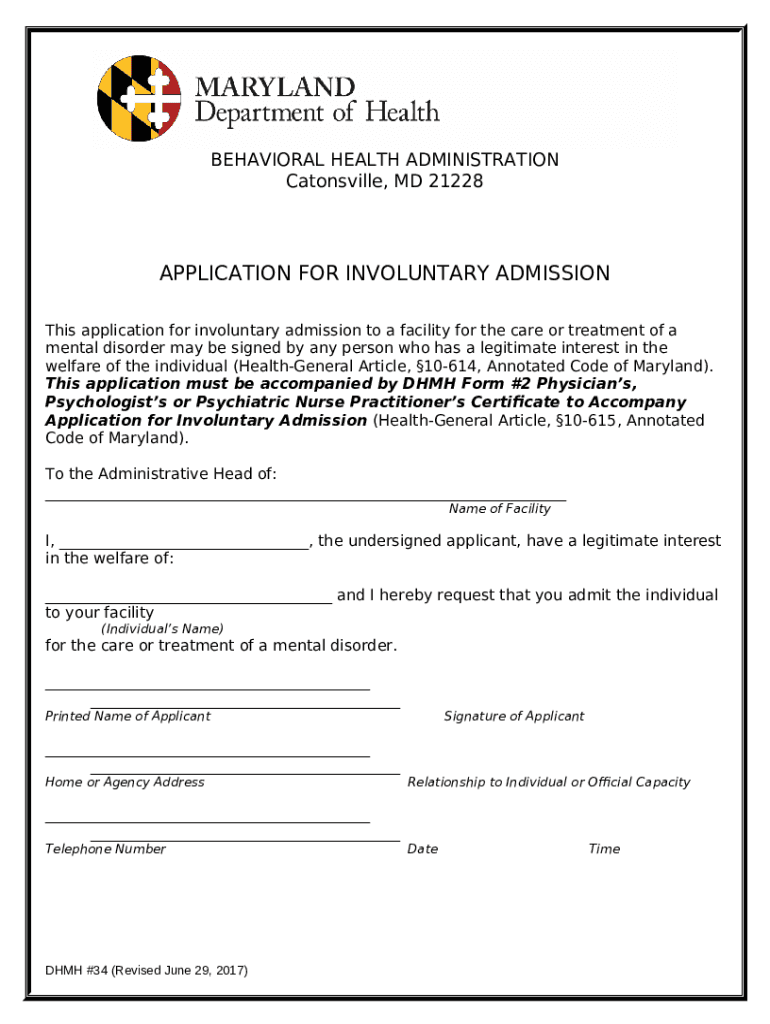
The "Certificate to Accompany Involuntary Admission (pdf)" serves as a crucial document used primarily to facilitate the involuntary admission of an individual to a mental health facility in the state of Maryland. This document ensures that the process adheres to legal standards and safeguards the rights of the individual in question. It involves a certification from a qualified healthcare professional affirming the need for such an admission based on medical criteria, which includes an evaluation of the individual's mental health status.
Key Components of the Certificate
- Certification by Healthcare Professional: A licensed practitioner must assess the individual and confirm the necessity of involuntary admission based on state regulations.
- Applicant's Information: Includes details such as the name, address, and relationship of the person applying for the admission.
- Reason for Admission: Specific mental health issues or behaviors that warrant involuntary admission must be clearly documented.
- Compliance with Civil Rights: The form emphasizes adherence to civil rights regulations to protect the individual's rights.
How to Use the Certificate to Accompany Involuntary Admission (pdf)
This document is intended for use when an individual is believed to require mandatory mental health treatment but is unwilling or unable to seek help voluntarily. The process involves multiple steps that ensure ethical and legal standards are met.
Step-by-Step Usage
- Assessment by Healthcare Professional: Before completing the form, a qualified professional evaluates the person’s mental health condition.
- Completion of Form: The applicant fills out their personal information and the details of the individual requiring admission.
- Submission to Relevant Authorities: Once completed, the form is submitted to the appropriate mental health facility or legal authority for action.
Practical Scenario
For instance, if a family member or caregiver notices that an individual is a danger to themselves or others, they may use this form to seek expedited care from a psychiatric facility, ensuring legal protocols are respected.
Steps to Complete the Certificate to Accompany Involuntary Admission (pdf)
Completing the form accurately ensures a seamless admission process. This involves providing thorough and truthful information across multiple sections.
Detailed Instructions
- Gather Required Information: Before beginning, ensure you have all necessary information, including patient and applicant details.
- Fill Out Personal Details: Provide clear and complete personal and contact details of both the applicant and the individual.
- Document Reason for Admission: Specify the rationale for seeking involuntary admission with as much detail as possible, referencing observed behaviors and medical evaluations.
- Certification Section: Ensure a qualified healthcare professional completes the certification section, providing their professional assessment.
Considerations
When completing this form, consider potential language barriers or accessibility issues that may arise, and seek translations or assistance if necessary to ensure clarity and compliance.
Key Elements of the Certificate to Accompany Involuntary Admission (pdf)
The document includes several critical sections that must be completed accurately to ensure compliance with state laws.
Essential Sections
- Personal Information: Details about the applicant and the individual needing admission.
- Professional Certification: Must be filled out by a licensed healthcare provider, detailing the professional opinion on the necessity of admission.
- Consent and Acknowledgment: While the admission is involuntary, legal consent from a qualified professional is required.
Detailed Example
For example, if the individual exhibits severe symptoms such as hallucinations or aggression, those should be noted in the certification section by the healthcare professional, citing specific criteria that justify the need for involuntary admission.
Legal Use of the Certificate to Accompany Involuntary Admission (pdf)
This document is used in legally sensitive scenarios and must be handled with care to respect the rights and dignity of the individual involved.
Compliance and Safeguards
- Adherence to State Laws: The form complies with Maryland’s specific legal requirements for involuntary admission.
- Rights Protection: Ensures the individual's civil rights are considered and respected throughout the process.
Legal Precedents
In Maryland, involuntary mental health admissions are regulated strictly, and this certificate acts as a safeguard for legal and ethical practices within mental health care systems.
Important Terms Related to the Certificate to Accompany Involuntary Admission (pdf)
A clear understanding of specific terms related to this documentation is essential for accurate completion and submission.
Key Terms Explained
- Involuntary Admission: Forced admission into a mental health facility when voluntary consent cannot be obtained.
- Certification: Verification from a licensed healthcare professional confirming the necessity for admission.
- Mental Health Facility: Certified institution capable of providing necessary psychiatric care and evaluation.
- Applicant: The individual or entity applying for the admission on behalf of the person needing treatment.
Examples in Context
Terms like "certification" involve legal and medical criteria, ensuring that only qualified professionals can authorize involuntary admissions based on observed criteria and standards.
State-Specific Rules for the Certificate to Accompany Involuntary Admission (pdf)
While this form pertains to Maryland, each state may have unique regulations dictating how involuntary admissions are handled.
Maryland-Specific Requirements
- Certification Validity: Certification by a healthcare professional is only valid for a specific period in Maryland, necessitating timely action.
- Legal Review: Some submissions may require review by a legal representative or be subject to specific legal proceedings.
Variation in Requirements
Other states may have differing protocols, such as longer or shorter evaluation periods, varying documentation requirements, or different standards for healthcare professional qualifications.
Who Typically Uses the Certificate to Accompany Involuntary Admission (pdf)
Understanding the typical users of this form helps in recognizing who can initiate the admission process.


Primary Users
- Family Members or Guardians: Typically initiate the documentation process when they notice severe mental health symptoms.
- Healthcare Professionals: Facilitate the submission as part of routine mental health evaluations.
- Legal Representatives: Might be involved in cases where additional legal oversight is necessary.
Scenarios
For instance, a guardian of a minor displaying dangerous behaviors due to their mental health condition may rely on this certificate to seek immediate intervention from a psychiatric facility.




