







Definition & Meaning
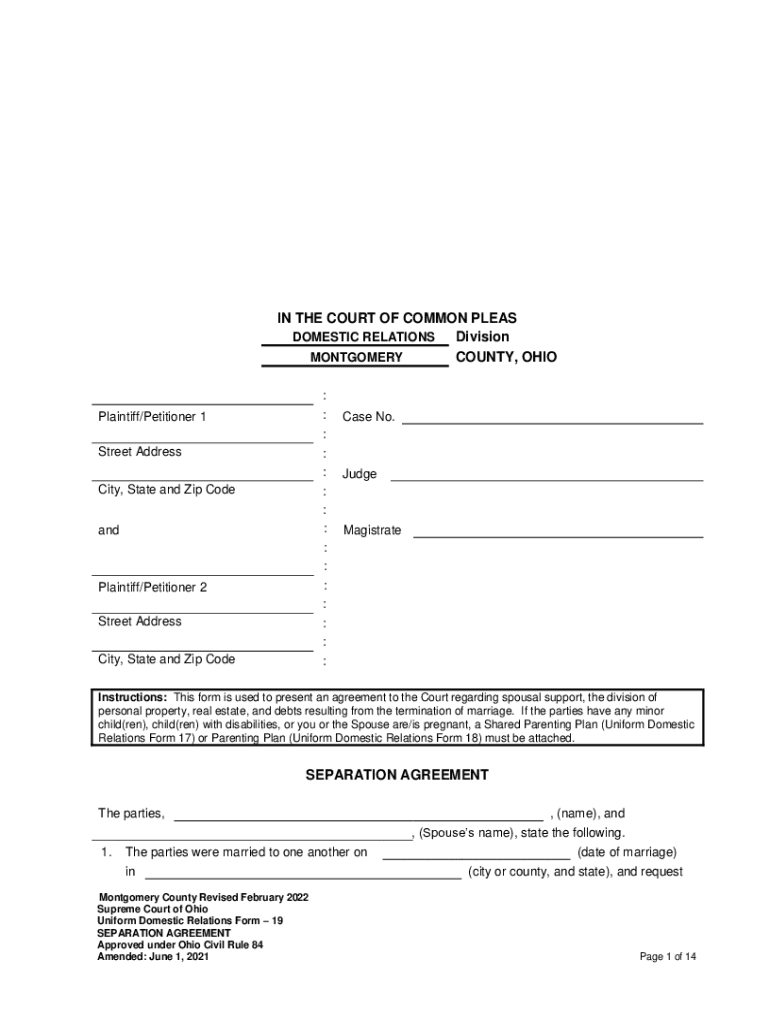
The "IN THE COURT OF COMMON PLEAS Domestic - mcohio" form is a legal document used in the Domestic Relations Division of the Court of Common Pleas in Montgomery County, Ohio. It is primarily utilized to outline important details such as the division of property, debts, and spousal responsibilities following the dissolution of a marriage. The form serves as a binding legal agreement between the parties involved, ensuring that all relevant matters, such as asset disclosure and living arrangements, are clearly defined and agreed upon.
Core Functions
- Defines terms for property and asset division post-marriage.
- Establishes spousal support agreements and conditions.
- Provides a framework for living separately post-divorce.
- Facilitates mutual understanding to prevent future claims.
How to Obtain the IN THE COURT OF COMMON PLEAS Domestic - mcohio
Obtaining this form involves several steps, typically beginning with a visit to the Montgomery County, Ohio, Domestic Relations Court's website, where forms are often available for download. Alternatively, individuals may visit the courthouse in person to pick up physical copies.
- Online Access: Locate and download from the Montgomery County Court's official website.
- In-Person Collection: Visit the Domestic Relations Division in Montgomery County to request a copy directly.
- Legal Counsel: Engage with a family law attorney who can provide guidance and access the necessary documentation.
Steps to Complete the IN THE COURT OF COMMON PLEAS Domestic - mcohio
Completing this form accurately is crucial to ensuring all legal and personal considerations are adequately addressed. Follow these steps to ensure a comprehensive completion process:
- Gather Information: Collect relevant details regarding assets, debts, income, and living arrangements.
- Fill Personal Information: Accurately input names, contact information, and relevant personal data.
- Property Division Details: Clearly outline how each asset and liability will be divided between the parties.
- Spousal Support Agreements: Specify the amount and conditions of alimony if applicable.
- Review & Sign: Both parties should thoroughly review and then sign the document in the presence of a notary or legal professional if required.
Considerations
- Ensure full disclosure of all assets and liabilities.
- Agree on co-parenting responsibilities if applicable.
- Seek legal advice to understand implications and modifications.
Legal Use of the IN THE COURT OF COMMON PLEAS Domestic - mcohio
The form serves as a legally binding agreement that can be enforced through the court. It is used primarily in cases concerning divorce or legal separation to formalize arrangements agreed upon by both parties.
Legal Binding Elements
- Spousal Support: Conditions for payment or termination must be specified.
- Property & Debt Division: Orders how assets and liabilities are distributed.
- Enforceability: Can be used in court to uphold agreed-upon arrangements.
Enforceability
- Both parties must understand the terms and affirm consent.
- Can be amended only through mutual agreement or court intervention.
- Provides a legal framework to resolve disputes.
Key Elements of the IN THE COURT OF COMMON PLEAS Domestic - mcohio
Understanding the key elements outlined in the form aids both compliance and the clarity of agreement terms. These components must be addressed thoroughly:
- Asset Disclosure: Complete transparency regarding financial status.
- Living Arrangements: Details where each party will reside post-separation.
- Support Arrangements: Defines terms for spousal or child support obligations.
- Release of Claims: Agrees to release any further legal claims against one another.
State-Specific Rules for the IN THE COURT OF COMMON PLEAS Domestic - mcohio
In Ohio, specific regulations and standards apply to the completion and enforcement of this form. Familiarize yourself with these to ensure compliance:
Ohio-Specific Requirements
- Residency Requirements: Parties must fulfill Ohio residency stipulations prior to filing.
- Waiting Periods: A mandatory waiting period may be required before the agreement takes effect.
- Legal Counsel: Engaging with a lawyer is advised for thorough comprehension and completion.
Considerations
- During asset disclosure, the state mandates transparency to prevent concealed holdings.
- Includes provisions for automatically voiding the agreement under specific conditions such as fraud.
Required Documents
Alongside the core form, supplementary documentation is necessary to support the form's statements and ensure legal standing. Prepare these documents before submission:
- Proof of Identity: Valid driver's licenses or state-issued IDs for both parties.
- Financial Statements: Details of income, expenses, and assets.
- Prior Agreements: Any existing prenuptial agreements or previous court orders.
- Property Titles: Documentation of ownership for significant assets.
Penalties for Non-Compliance
Failure to comply with the terms stipulated in the "IN THE COURT OF COMMON PLEAS Domestic - mcohio" form can lead to several legal repercussions. These may include:
- Contempt of Court: Non-compliance can result in legal penalties, potentially involving fines or jail time.
- Asset Seizure: Courts may order the seizure of assets to satisfy non-compliance penalties.
- Modification of Terms: Further court action may modify original terms to enforce compliance.
Key Consequences
- Legal costs for rectifying compliance failures.
- Potential negative impact on credit scores if debts are involved.
- Possible escalation to court hearings for resolution.




