




01. Edit your ffa consent online
Type text, add images, blackout confidential details, add comments, highlights and more.

Type text, add images, blackout confidential details, add comments, highlights and more.

Draw your signature, type it, upload its image, or use your mobile device as a signature pad.

Send it via email, link, or fax. You can also download it, export it or print it out.
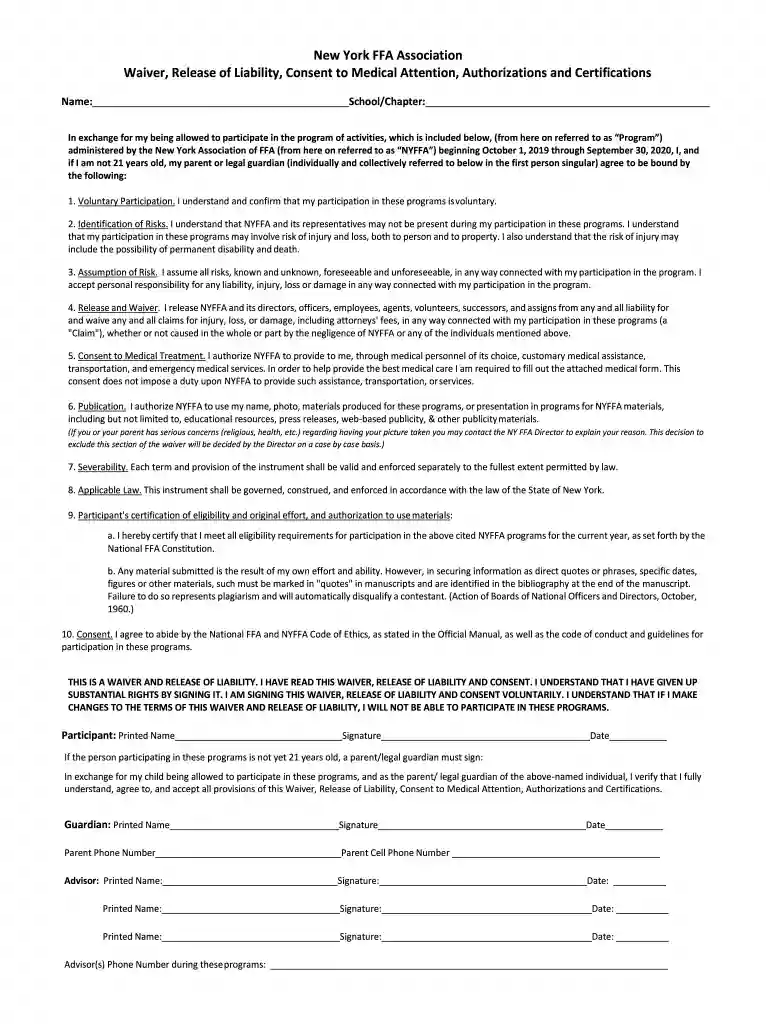
FFA Consent forms are essential legal documents used primarily in the context of the Future Farmers of America (FFA) programs. These forms outline the responsibilities and obligations of participants engaging in various activities under the FFA banner. They serve as a waiver and release of liability, indicating that participants understand the voluntary nature of the program and acknowledge the inherent risks involved. The form typically includes an agreement to abide by the FFA Code of Ethics and may authorize medical treatment if necessary during the event. Parental consent is required for participants under 21 years old, ensuring that guardians approve their children's involvement and understand the risks.
Obtaining the FFA Consent form typically involves a straightforward process. Participants or their guardians usually receive the form from FFA coordinators, who distribute it as part of the registration package for events or activities. Some regional FFA chapters may offer the form online, allowing for easy download and electronic completion. It's crucial to ensure that the most current version of the form is used, as it may have specific provisions pertinent to upcoming events or activities. Participants should read through the form thoroughly, ensuring all sections are complete and accurate, and returning it to the designated FFA representative or office before the deadline.
Read the Form Carefully: Begin by reviewing the entire document, paying particular attention to any sections detailing participant obligations, risk assumptions, and consent for emergency medical treatment.
Fill Out Participant Information: Provide personal information such as name, age, and contact details. Ensure accuracy to facilitate identification and communication.
Parental/Guardian Consent: For participants under 21, a parent or guardian must sign the appropriate section, indicating their consent and acknowledgment of the outlined risks and responsibilities.
Emergency Contact Information: Supply contact information for someone who can be reached in case of an emergency. This should be someone reliable and accessible during the event.
Sign and Date the Form: Complete the consent form with the participant's signature and the date of signing. Ensure all sections are marked and completed as required.
Submit the Form: Return the complete and signed form to the designated FFA representative by the specified deadline, either in person, by mail, or through online submission, if available.
Voluntary Participation: Participants acknowledge that they are engaging in activities voluntarily, understanding all associated risks.
Assumption of Risk: The document outlines potential risks involved and the participant’s acknowledgment of these risks.
Parental Consent Requirement: A necessary provision for participants under 21, ensuring that minors have parental approval.
Medical Treatment Consent: Includes authorization for necessary medical interventions should emergencies arise during FFA activities.
Publication Consent: Participants agree to the use of their photographs or materials in FFA publications or promotions.
Adherence to FFA Code of Ethics: A certification that participants will abide by the ethical guidelines established by the National FFA Organization.
The FFA Consent form is recognized as a legally binding document within the United States, especially in event-related scenarios involving minors or activities with inherent risks. It serves to protect both the participant and the organizing body by clearly communicating the risks and requiring acknowledgment from all parties involved. The consent form also adheres to state and federal laws concerning liability and parental consent, ensuring that necessary legal protections and authorizations are in place before participation. This document helps mitigate legal exposure for event organizers by documenting that participants have willingly accepted the activity's risks.
The primary users of the FFA Consent form are participants of the Future Farmers of America programs, including students, agriculturally inclined youth, and their guardians. The form is crucial for FFA chapters organizing events, as it provides a legal framework for participation. Additionally, educators, program coordinators, and administrative staff within the FFA employ these forms to ensure compliance with organizational policies and legal statutes. By completing and securing these documents, FFA chapters can conduct activities smoothly, ensuring that all participants and their guardians are informed and agree to the terms.


While the FFA Consent form is widely recognized across the United States, its application may vary slightly due to state-specific legal requirements. States may have distinct guidelines regarding the age of consent for minors, liability waivers, or educational programs involving minors. As such, FFA chapters are encouraged to review these elements to meet local legal criteria effectively. Adjustments might include additional clauses to comply with specific legal precedents or adding state-specific information relevant to the participant’s rights and obligations under the law.
FFA Consent forms are available in both digital and paper formats. Each format comes with its advantages; digital forms allow for convenient completion and submission, which can be particularly beneficial for accommodating participants and guardians who prefer online communications. This option often includes digital signatures and automated document tracking systems to ensure accuracy in form submission. On the other hand, paper versions of the form remain necessary for areas with limited internet access or for individuals who prefer traditional documentation methods. Both formats require comprehensive completion to ensure that all legal and procedural standards are met.
We've got more versions of the ffa consent form. Select the right ffa consent version from the list and start editing it straight away!
| Versions | Form popularity | Fillable & printable |
|---|---|---|
| 2024 | 4.9 Satisfied (56 Votes) | |
| 2022 | 4.8 Satisfied (32 Votes) | |
| 2022 | 4.8 Satisfied (53 Votes) | |
| 2021 | 4.8 Satisfied (58 Votes) | |
| 2021 | 4.7 Satisfied (140 Votes) | |
| 2021 | 4.8 Satisfied (105 Votes) | |
| 2020 | 4.8 Satisfied (60 Votes) | |
| 2020 | 4.4 Satisfied (30 Votes) | |
| 2020 | 4.4 Satisfied (1248 Votes) | |
| 2020 | 4.3 Satisfied (177 Votes) | |
| 2020 | 4.8 Satisfied (71 Votes) | |
| 2019 | 4.9 Satisfied (31 Votes) | |
| 2019 | 4.8 Satisfied (110 Votes) | |
| 2019 | 4.9 Satisfied (27 Votes) | |
| 2019 | 4.5 Satisfied (54 Votes) |
At DocHub, your data security is our priority. We follow HIPAA, SOC2, GDPR, and other standards, so you can work on your documents with confidence.


