




01. Edit your what is barcode in additional contact and legal representation information online
Type text, add images, blackout confidential details, add comments, highlights and more.

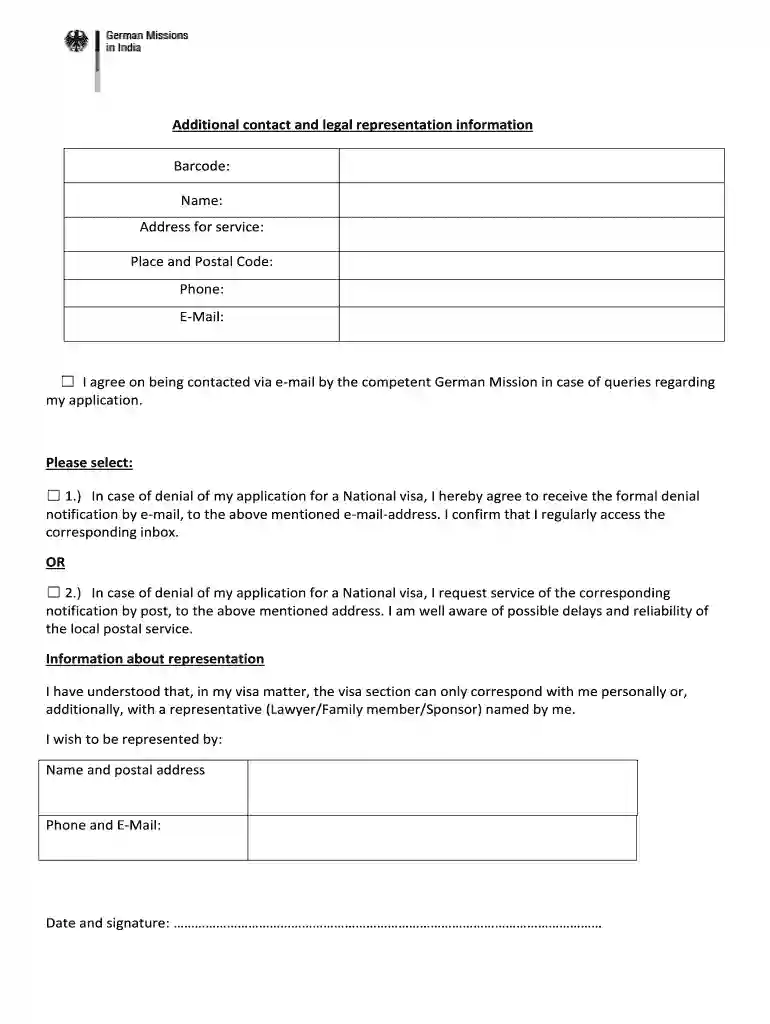
Type text, add images, blackout confidential details, add comments, highlights and more.

Draw your signature, type it, upload its image, or use your mobile device as a signature pad.

Send additional contact and legal representation information sample via email, link, or fax. You can also download it, export it or print it out.
Barcodes used in additional contact and legal representation forms serve as crucial identifiers. They enhance the organization and quick retrieval of related documents and information. This system assigns a unique barcode to each form, facilitating digital data management and streamlining processes. In legal and contact forms, barcodes enable quick access to detailed records, supporting efficient communication and legal proceedings by ensuring that the correct document is retrieved and processed.
Utilizing a barcode on these forms involves scanning the barcode using compatible software or a hardware scanner. This action automatically retrieves the associated file or information from a database. Scanners can be handheld or integrated into mobile devices and computers. The process is generally intuitive; however, familiarity with the specific scanner model and software is essential. Users should ensure their systems support barcode scanning to effectively integrate this feature into their workflows.
To obtain a barcode for these forms, individuals typically need to access specific software used during the form-generation process. Often, government or private institutions that require these forms provide guidelines for barcode generation. The process usually involves inputting personal and legal details into a form template, which then assigns a unique barcode. This ensures that any subsequent interaction with the document can be tracked and managed efficiently, aiding in audit trails and legal compliance.
Steps to fill out these forms include:
Barcodes in additional contact and legal representation documents are crucial for ensuring that the data is managed securely. They allow for easily organized, filed, and retrieved records in complex legal environments. Furthermore, they significantly reduce human error by automating data processing, ensuring reliable document management, and supporting legal compliance through accurate record-keeping.
These forms are used widely in legal, governmental, and business contexts where precise record-keeping is mandatory. Legal firms, governmental agencies, and businesses handling sensitive information rely on barcodes to manage client data efficiently. The process is particularly beneficial in high-volume scenarios, such as during legal proceedings, audits, and regulatory compliance reporting, where accuracy and retrieval speed are priorities.
Legal and contact forms involving barcodes can differ due to state-specific regulations. Each state might have unique requirements regarding barcode usage, affecting how forms are generated and processed. Familiarity with local regulations is essential for ensuring compliance. Users should consult with local legal experts or government guidelines to understand region-specific nuances associated with these forms.
Consider a law firm managing multiple client cases requiring efficient document retrieval; integrating barcodes into client documents allows legal staff to quickly access the necessary files. Another example includes governmental agencies that process vast volumes of applications — barcodes ensure each submission is correctly identified and tracked, facilitating swift administrative handling. These applications illustrate the barcode’s role in improving efficiency and accuracy in document-related processes.
We've got more versions of the what is barcode in additional contact and legal representation information form. Select the right what is barcode in additional contact and legal representation information version from the list and start editing it straight away!
| Versions | Form popularity | Fillable & printable |
|---|---|---|
| 2018 | 4.6 Satisfied (57 Votes) |
At DocHub, your data security is our priority. We follow HIPAA, SOC2, GDPR, and other standards, so you can work on your documents with confidence.
If you are unfamiliar with how to work with an attorney, the American Bar Associations Find Legal Help page is a good resource. Lawyer Referral Services.Read more
A system logging facility that provides administrators with tools to monitor server activity and respond to specific events as they occur. captures message


