




01. Edit your form online
Type text, add images, blackout confidential details, add comments, highlights and more.

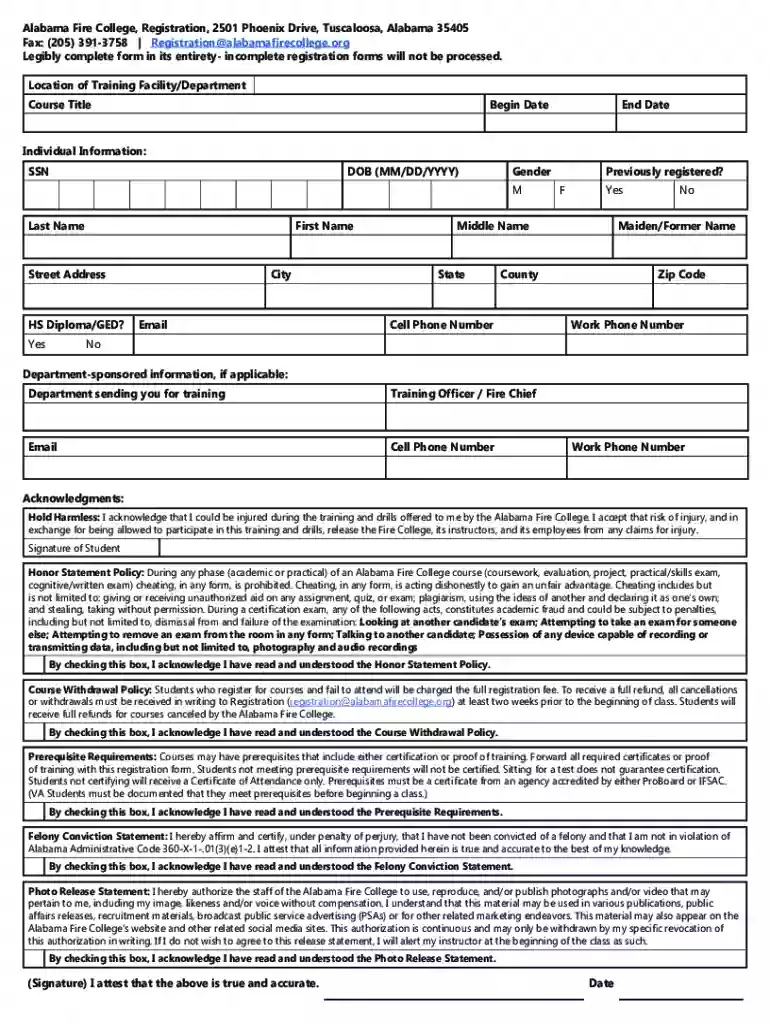
Type text, add images, blackout confidential details, add comments, highlights and more.

Draw your signature, type it, upload its image, or use your mobile device as a signature pad.

Send it via email, link, or fax. You can also download it, export it or print it out.
The Live Fire IIC Training conducted by the Maine Fire Service Institute is structured to enhance fire instructors' capabilities in delivering hands-on fire suppression training. This program is tailored specifically for fire service professionals seeking to improve their instructional techniques and ensure compliance with National Fire Protection Association (NFPA) standards. By participating in this course, instructors gain the necessary skills to plan and execute live fire training events safely and effectively. The training is conducted in collaboration with recognized institutions such as the Alabama Fire College, bolstering its credibility and relevance in the field.
For participants aiming to complete the Live Fire IIC Training, a series of steps must be meticulously followed:
Application Submission: Prospective trainees must submit an application along with proof of their certification and experience by a designated deadline, typically well in advance of the training start date.
Participate in Scheduled Sessions: The training is usually a five-day event, requiring full attendance to cover the comprehensive curriculum, including theoretical and practical segments.
Adherence to Safety Protocols: Given the inherent risks associated with live fire training, participants are expected to strictly follow all COVID-19 and safety guidelines outlined by the training providers.
Assessment and Certification: Completing the training successfully involves assessments against NFPA standards, concluding with Pro-Board certification for participants who meet the competency criteria.
Enrollment in the Live Fire IIC Training mandates the submission of several essential documents:
Submissions should include verifiable proof of previous certifications related to firefighting or fire instruction.
Applicants must provide evidence of their experience, typically requiring documentation of prior roles or trainings undertaken.
Additional materials may include identification and any completed pre-course assignments or questionnaires stipulated by the training organizers.
Post-completion of the Live Fire IIC Training, participants can leverage their newfound knowledge and skills in multiple ways:
Conducting Internal Training: Equipped with enhanced skills, certified instructors can conduct in-house training sessions for new recruits, ensuring standardized teaching methods that align with NFPA standards.
Continuous Professional Development: Instructors can continuously build upon their training experience to attain higher qualifications or specialized fire service roles.
Safety Protocols Implementation: With a robust understanding of safe practices, instructors can implement stringent safety protocols during practical training exercises, minimizing risks.
Eligibility to partake in the Live Fire IIC Training requires:
Candidates to possess a baseline level of fire instruction experience or relevant firefighting certification.
Prerequisites may also include specific certifications required by the NFPA or comparable industry standards.
Applicants need to exhibit a commitment to professional development within the fire service instruction domain.


The Live Fire IIC Training program at the Maine Fire Service Institute is meticulously crafted and includes several key elements:
Instructional Techniques: Training focuses heavily on developing effective teaching methodologies tailored for fire service operations.
Practical Fire Suppression: Practical sessions cover the techniques and safety measures necessary for conducting live fire drills.
Safety and Risk Management: Essential skills and knowledge in risk identification and management strategies are imparted to ensure safe practice environments.
Certification Requirements: Detailed instruction on compliance with Pro-Board and NFPA certification requirements is included to ensure participants are prepared to meet all official standards.
Potential participants should be acutely aware of the training schedule and associated deadlines:
The training typically occurs over a clearly defined period, often in early November, though this can vary based on availability and operational requirements.
Application deadlines, such as a cutoff in late October, are critical milestones ensuring all participatory prerequisites are met well in advance of the training.
The applicability of skills acquired in this specialized training is vast. Instructors use these competencies in real-world scenarios such as:
Emergency Response Drills: Implementing realistic training drills that simulate actual fire scenarios, enhancing the preparedness of fire service personnel.
Fire Scenario Analysis: Utilizing acquired knowledge to debrief and analyze past incidents, promoting a learning culture focused on continuous improvement.
Community Fire Safety Programs: Engaging the broader community through educative programs that emphasize fire safety and prevention strategies.
By completing the Live Fire IIC Training, fire instructors significantly expand their expertise, supporting both their personal career growth and the overall effectiveness and safety of their fire service operations.
We've got more versions of the Live Fire IIC Training - Maine Fire Service Institute form. Select the right Live Fire IIC Training - Maine Fire Service Institute version from the list and start editing it straight away!
At DocHub, your data security is our priority. We follow HIPAA, SOC2, GDPR, and other standards, so you can work on your documents with confidence.


