




01. Edit your form online
Type text, add images, blackout confidential details, add comments, highlights and more.

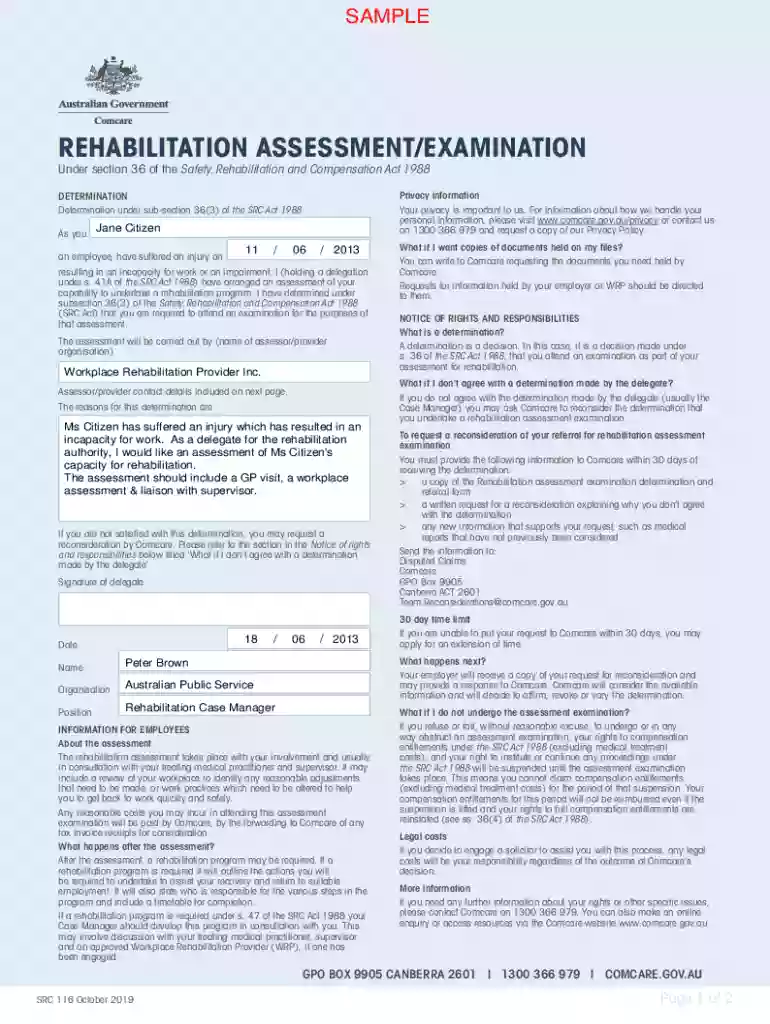
Type text, add images, blackout confidential details, add comments, highlights and more.

Draw your signature, type it, upload its image, or use your mobile device as a signature pad.

Send it via email, link, or fax. You can also download it, export it or print it out.
The Rehabilitation Assessment or Examination sample form is a comprehensive tool designed to evaluate an individual's rehabilitation needs following a work-related injury. Originating under frameworks like the Safety, Rehabilitation, and Compensation Act, this form serves as a standardized method for assessing an employee's capabilities to return to work. The primary goal is to identify the types of support and interventions needed to facilitate an individual's recovery and ensure their safe and effective reintegration into the workplace.
Obtaining the Rehabilitation Assessment form can be done through various channels. Employers typically provide this form to their employees as part of the worker’s compensation process. Alternatively, it may be available through occupational health services or insurance carriers associated with workplace injury claims. For those seeking a sample for informational purposes, online platforms and government websites might offer downloadable versions, often customizable to fit specific organizational needs.
The Rehabilitation Assessment form is used to determine an employee’s eligibility for certain benefits under acts such as the Safety, Rehabilitation, and Compensation Act. Completing this form is essential in ensuring compliance with both federal and state regulations. Employers must maintain accurate records of these assessments to demonstrate due diligence in supporting employees’ return-to-work processes. Non-compliance can result in legal challenges or penalties.
This form is predominantly used by human resources professionals, occupational health specialists, and rehabilitation consultants. These individuals utilize the form to coordinate and tailor rehabilitation programs for employees who have sustained injuries on the job. The form is also used by insurance companies that need to evaluate claims related to workplace injuries.


Modern document management platforms like DocHub make it easier to fill out and submit the Rehabilitation Assessment form digitally. These platforms support interactive features such as fillable fields and electronic signatures. They also integrate seamlessly with popular cloud services like Google Drive, ensuring secure data transfer and storage. This compatibility is beneficial for organizations seeking to digitize their documentation process while ensuring compliance with privacy standards.
Consider the case of Jane Citizen, an employee who experienced a back injury while lifting heavy boxes at work. Completing the Rehabilitation Assessment form involved documenting her injury, seeking input from her doctor, and outlining a specific rehabilitation plan. The form tracked her progress and adapted her workload to avoid further injury, highlighting the extensive utility of the form in real-world applications. Other scenarios may involve employees with repetitive strain injuries or those returning from medical leave, emphasizing the form’s flexibility across different cases.
We've got more versions of the Rehabilitation Assessment or Examination sample form An example of a completed rehabilitation assess form. Select the right Rehabilitation Assessment or Examination sample form An example of a completed rehabilitation assess version from the list and start editing it straight away!
At DocHub, your data security is our priority. We follow HIPAA, SOC2, GDPR, and other standards, so you can work on your documents with confidence.
by LA Turcotte 2023 Cited by 1 The interRAI Community Rehabilitation Assessment (CRA) is a comprehensive health assessment designed to collect essential health and functionRead more
This assignment includes three parts: o A completed survey form (50 points): Students will thoroughly complete the ADA form demonstrating professional
Apr 27, 2022 Stream restoration is an overarching term used to describe the process of returning stream structure and function to pre-disturbance conditions


