




01. Edit your form online
Type text, add images, blackout confidential details, add comments, highlights and more.

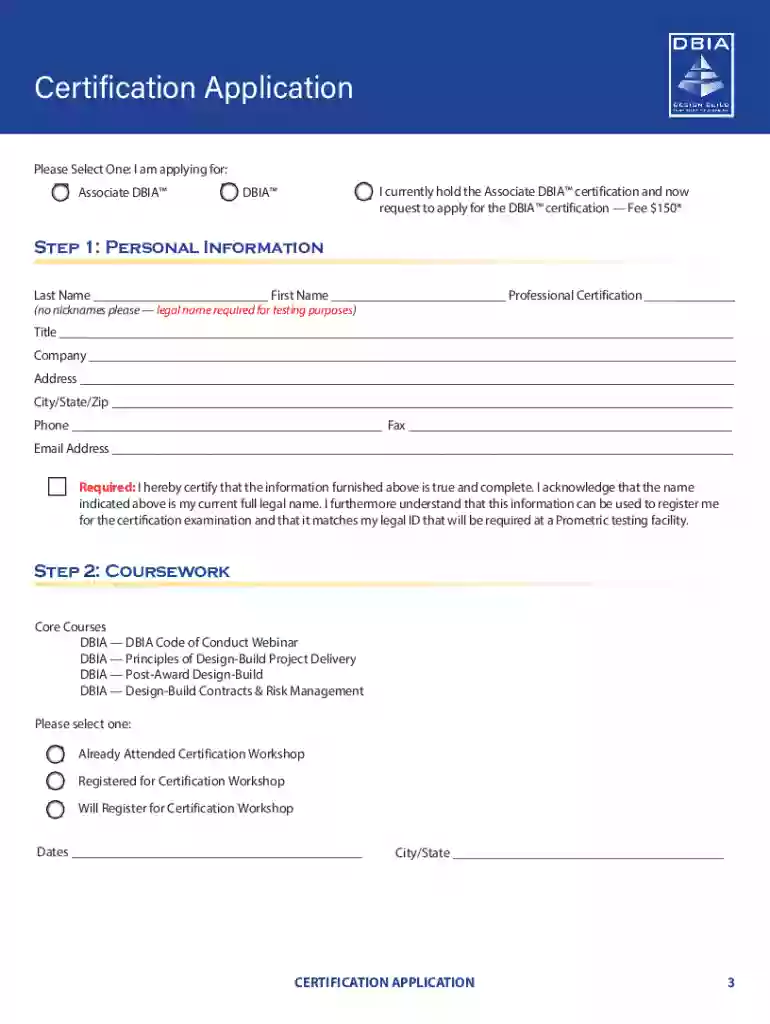
Type text, add images, blackout confidential details, add comments, highlights and more.

Draw your signature, type it, upload its image, or use your mobile device as a signature pad.

Send it via email, link, or fax. You can also download it, export it or print it out.
The DBIA Certification Application Certification is a critical credential process within the design-build industry. It serves to validate the skills and expertise of professionals and emerging practitioners in design-build practices. The certification process is governed by the Design-Build Institute of America's Design-Build Certification Board (DBCB), aimed at maintaining high standards and promoting best practices in the field. There are two main certifications: DBIA™ for seasoned professionals and Assoc. DBIA™ for those beginning their careers. These certifications underscore a commitment to ethical practice by adhering to the DBIA Code of Professional Conduct.
Professionals pursuing a DBIA Certification must first evaluate their eligibility based on educational qualifications, professional experience, and specific core courses. Once the application form is obtained, candidates need to provide comprehensive details about their academic background and work history. The form facilitates a streamlined process for applicants to showcase their qualifications and ensure they have met all requirements. Importantly, this form also serves as a tool for gathering endorsements and references from industry peers, which are mandatory for advancing through the certification phases.
Successful completion of each step ensures that all necessary components are considered, improving the likelihood of application approval.
Applicants must prepare a suite of documents to accompany their DBIA Certification Application. These typically include:
Meticulously organizing these documents can prevent delays in the application processing and help demonstrate eligibility clearly.
The DBIA Certification Application process involves several key milestones from submission to approval. Once the application is submitted, the Design-Build Certification Board reviews the materials for compliance and completeness. Typically, the review process may take several weeks to a few months depending on the volume of applications and completeness of submitted documentation. Applicants should ensure all requirements are met to avoid any undue delays. Communication with the board or certification body during this period can provide updates or highlight any additional information needed.
To be considered for DBIA certifications, candidates must meet specific eligibility criteria, such as:
These criteria are rigorously upheld to ensure that only qualified professionals earn certification, maintaining the integrity and standards of the design-build practices.


For professionals, certification acts as a distinguished marker of expertise within their field, often resulting in enhanced career opportunities and responsibilities. For organizations, employing DBIA-certified professionals can lead to improved project delivery metrics, higher client satisfaction, and competitive advantage in the market. Case studies involving DBIA certified professionals frequently highlight expedited project timelines and innovative solutions that are grounded in industry best practices.
Holding a DBIA certification signifies a legally recognized competence in design-build practices. This certification empowers professionals to offer their services in compliance with established industry guidelines and regulations. It acts as a safeguard for companies against legal complications, as it verifies the adherence to the DBIA Code of Professional Conduct. Certified professionals are expected to operate with a high level of ethical scrutiny, often reflecting positively in contractual agreements and professional engagements.
We've got more versions of the DBIA Certification Application Certification form. Select the right DBIA Certification Application Certification version from the list and start editing it straight away!
At DocHub, your data security is our priority. We follow HIPAA, SOC2, GDPR, and other standards, so you can work on your documents with confidence.
Mar 30, 2021 Students who complete CM 560 may qualify to receive credit applied towards DBIAs core course completion should they choose to pursue theRead more
Feb 28, 2024 DBIA delivers education and certification. Courses include close to 250 design-build courses, webinars, conference recordings, custom training.


