




01. Edit your form online
Type text, add images, blackout confidential details, add comments, highlights and more.

Type text, add images, blackout confidential details, add comments, highlights and more.

Draw your signature, type it, upload its image, or use your mobile device as a signature pad.

Send it via email, link, or fax. You can also download it, export it or print it out.
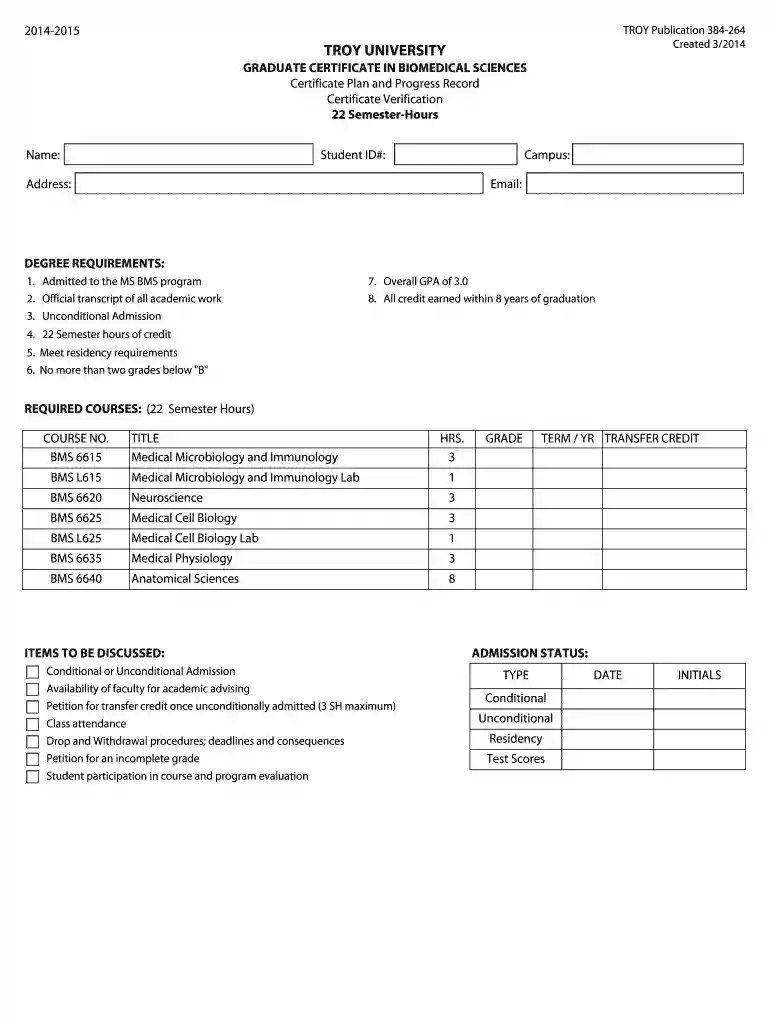
TROY Publication 384-264 is a document that outlines the Graduate Certificate in Biomedical Sciences at Troy University for the 2 academic year. It includes comprehensive information about the certificate's structure, admission requirements, and the academic expectations for students. This publication acts as a guide for prospective students, detailing the 22 semester hours required to complete the program and various administrative policies regarding student progress, academic advising, and course selection.
Using TROY Publication 384-264 effectively involves understanding its key components and how they apply to your academic planning. This publication provides guidance on:
Prospective students can use the publication as a roadmap for aligning personal education goals with university offerings.
Completing forms associated with TROY Publication 384-264 involves several detailed steps:
These steps help streamline the application process, ensuring all necessary components are addressed.
Understanding the terminology used in TROY Publication 384-264 enhances comprehension:
These terms are critical for navigating the content of the TROY Publication effectively.
Several core elements are critical to understanding TROY Publication 384-264:
These elements provide a framework for students and academic advisors to make informed decisions.
In a U.S.-centric context, TROY Publication 384-264 functions within educational legalities:
Legality surrounding the publication involves ensuring it adheres to these educational and privacy standards.
TROY Publication 384-264 serves specific groups:
Each group uses the publication to facilitate informed decisions about the educational process.
Real-world scenarios demonstrate the utility of the publication:
These examples illustrate the publication's practical applications for users.
We've got more versions of the TROY Publication 384-264 form. Select the right TROY Publication 384-264 version from the list and start editing it straight away!
At DocHub, your data security is our priority. We follow HIPAA, SOC2, GDPR, and other standards, so you can work on your documents with confidence.


