



01. Edit your form online
Type text, add images, blackout confidential details, add comments, highlights and more.

Type text, add images, blackout confidential details, add comments, highlights and more.

Draw your signature, type it, upload its image, or use your mobile device as a signature pad.

Send it via email, link, or fax. You can also download it, export it or print it out.
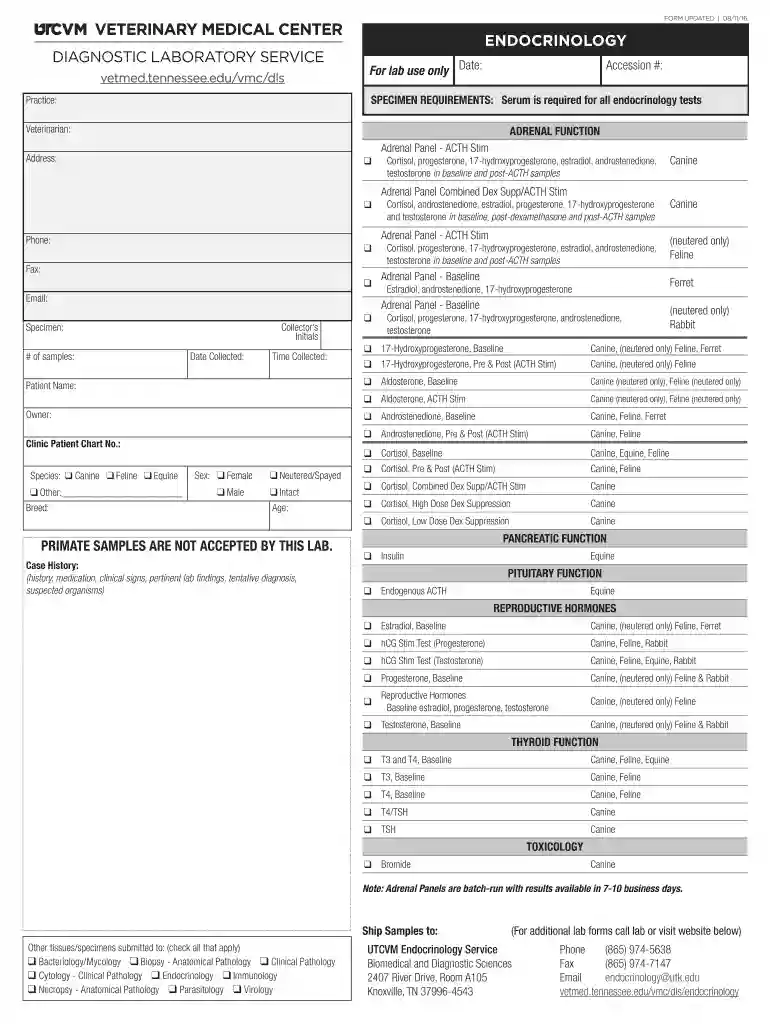
The "FORM UPDATED 08 11 16 - vetmed tennessee" is a specialized document used primarily within veterinary medicine practices in Tennessee. This form is utilized for the submission of specimens and the request for various diagnostic tests, including endocrinology services. It plays a crucial role in standardizing the data collection process necessary for laboratory analysis. The form ensures that all relevant information is provided, facilitating accurate and timely testing results.
When using this form, follow these steps to ensure it is filled out correctly:
Download or Access the Form: Obtain the form via the University of Tennessee’s Diagnostic Laboratory or an associated veterinary office.
Enter Specimen Information: Provide detailed information about the specimens being submitted, such as type and quantity, to ensure proper handling and testing.
Select Test Services: Indicate which tests are required for each specimen. This may include adrenal, pancreatic, or thyroid function tests.
Provide Veterinary Details: Include the submitting veterinarian's information, as well as the clinic's contact details.
Review and Double-Check: Ensure all sections are completed accurately to prevent any delays or errors in processing.
Veterinary practices can obtain this form from multiple sources:
Diagnostic Laboratory Distribution: The form is available through the University of Tennessee’s Diagnostic Laboratory website or by contacting them directly.
Veterinary Conferences and Workshops: Forms may be distributed at professional events related to veterinary medicine.
Professional Veterinary Associations: Associations conducting ongoing training often have access to necessary forms related to diagnostic testing.
To accurately complete the form, adhere to these steps:
Patient Identification: Clearly list the animal’s identification details, including any unique identifiers used within the practice.
Descriptive Data: Add specific descriptions of the specimens, noting any relevant symptoms observed.
Test Selection: Carefully select the required test services from the options provided, ensuring that all desired diagnostic procedures are requested.
Contact Details: Verify the contact and submission details, including email and phone contacts for the veterinarian responsible for interpretation of results.
Form Submission: Send the completed form and accompanying specimens to the designated diagnostic laboratory.
This form is integral for several reasons:
Precision in Testing: It eliminates ambiguity by accurately matching the specimen with the requested test service, enhancing result reliability.
Compliance with Standards: Ensures adherence to diagnostic standards and procedures.
Streamlined Process: Reduces the time and effort involved in coordinating specimen submission and test results, thus improving clinic efficiency.
The primary users of this form include:
Veterinary Clinics: Facilities engaged in diagnostic testing require this form to standardize submissions to laboratories.
Diagnostic Laboratories: Use the form to streamline and organize incoming specimen data and testing requests.
Veterinary Technicians: Responsible for preparing and submitting specimens per laboratory standards using this specific form.


The form includes several crucial sections:
Specimen and Test Identification: Allows for clear identification and linkage of the specimen to the desired test.
Clinic and Veterinarian Information: Ensures all results can be traced back and communicated directly to the responsible practice.
Submission Date and Time: Helps track the timeline for submission and testing, which is critical for management and response plans.
The use of this form is subject to compliance with several legal standards:
Confidentiality and Data Protection: All patient data, including test results, must be handled in compliance with privacy laws to protect client confidentiality.
Regulatory Compliance: The submission and analysis must adhere to federal and state regulations governing medical testing and diagnostics in animals.
Real-world scenarios where this form is utilized:
Routine Health Checkups: During regular veterinary visits, this form facilitates quick requests for screening tests.
Disease Diagnosis: In cases of suspected hormonal imbalance or toxicity, the form aids in requesting specific tests to confirm or rule out conditions.
Research Studies: Veterinary research involving multiple species and conditions often uses this standardized form for laboratory analysis.
By following these structured guidelines, veterinary practices in Tennessee can adequately utilize the "FORM UPDATED 08 11 16 - vetmed tennessee" to support accurate diagnostic testing and patient care.
We've got more versions of the FORM UPDATED 08 11 16 - vetmed tennessee form. Select the right FORM UPDATED 08 11 16 - vetmed tennessee version from the list and start editing it straight away!
At DocHub, your data security is our priority. We follow HIPAA, SOC2, GDPR, and other standards, so you can work on your documents with confidence.
Aug 12, 2024 September 16, 2024, 11:59. All applicants (resident and non-resident) must apply through the Veterinary Medical College Application Service (
by EW Morgan 1988 Cited by 3 The dosing phase of this study was accomplished according to the protocol and applicable amendments with the following exceptions: 1) Recorded observations were.Read more


