




01. Edit your form online
Type text, add images, blackout confidential details, add comments, highlights and more.

Type text, add images, blackout confidential details, add comments, highlights and more.

Draw your signature, type it, upload its image, or use your mobile device as a signature pad.

Send it via email, link, or fax. You can also download it, export it or print it out.
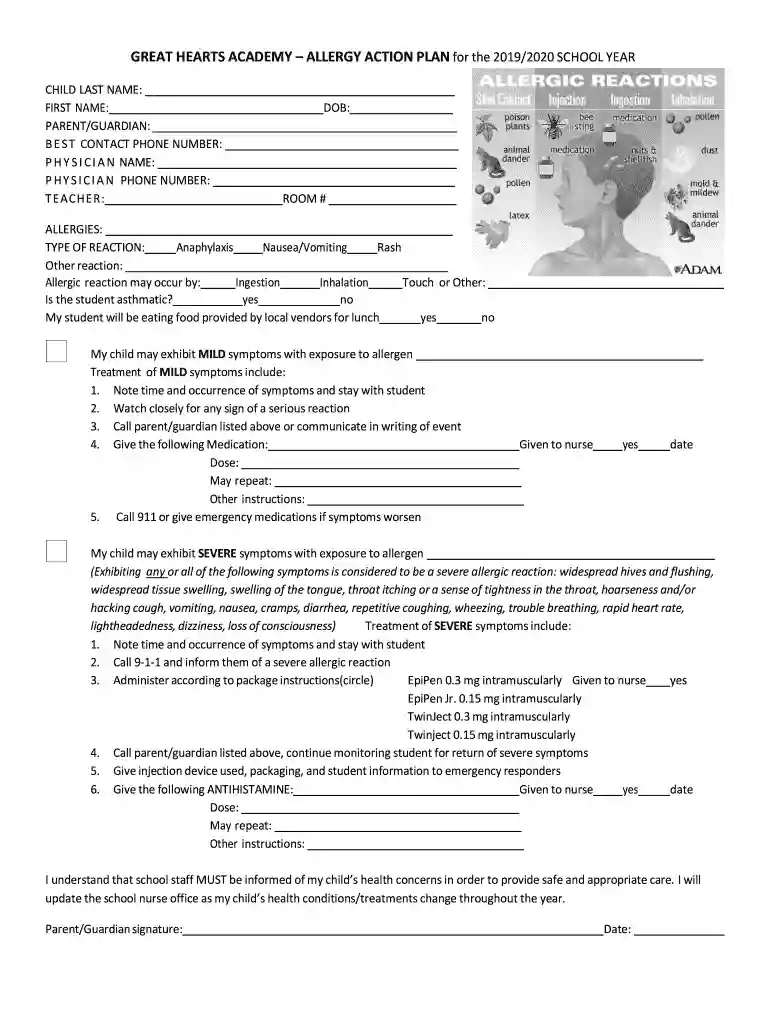
The Great Hearts Academy Allergy Action Plan for the 2019/2020 school year is an essential document for managing students with allergies. It provides clear guidelines and protocols to ensure student safety. Key components of the plan include:
Student and Parent Information: This section gathers critical details about the student, such as name, grade, and parental contact information. Having accurate contact details is vital for timely communication during an allergic reaction.
Types of Allergies: Here, specific allergies impacting the student are listed. This includes food, insect, medication, and environmental allergies. Knowing the precise allergens enables staff to prevent and manage exposure effectively.
Potential Reactions: This part describes the possible symptoms and severity of reactions. Distinguishing between mild and severe reactions helps staff intervene appropriately and promptly.
Treatment Protocols: Clear instructions on how to manage allergic reactions, including administering medications like epinephrine, are outlined here. Providing detailed treatment steps ensures preparedness in emergencies.
Emergency Contacts and Protocols: This includes the contacts to notify and steps to follow when a reaction occurs. Speedy and informed responses are crucial for the student’s safety and well-being.
Proper use of the Great Hearts Academy Allergy Action Plan ensures the health and safety of students with allergies. Key uses include:
Preventive Measures: Staff must familiarize themselves with the plan to avoid allergic exposures, ensuring that all necessary precautions are in place.
Training: School staff and students should be trained on the plan's procedures, emphasizing the importance of recognizing symptoms and administering treatment.
Communication: Regular updates and communications should be maintained between parents and the school to ensure that any changes in the student’s allergy status are reflected in the plan.
Completing the plan involves several critical steps to ensure accuracy and efficiency:
Gather Information: Collect comprehensive details about the student's allergies, medical history, and emergency contacts.
Consult Healthcare Providers: Work with the student's healthcare provider to confirm treatment protocols and ensure all medical directions are clear and actionable.
Document Allergic Reactions: Clearly articulate symptoms of mild to severe reactions and the corresponding action required in each scenario.
Review and Approval: The plan should be reviewed by both the parents and school officials to confirm its completeness and accuracy before implementation.
Disseminate to Relevant Parties: Ensure all relevant staff members have copies of the finalized plan, and conduct briefings to address any questions or clarifications.
This plan is a resource for a variety of stakeholders who are responsible for student care:
School Staff: Teachers, administrators, and nurses who interact with students daily and need to be prepared for potential allergic reactions.
Parents and Guardians: They play a crucial role in providing accurate information and ensuring that the plan aligns with the needs of their child.
Students: Older students are encouraged to understand their own allergy plans to become proactive participants in their health and safety.


Utilizing the Great Hearts Academy Allergy Action Plan offers numerous benefits:
Safety Assurance: The primary benefit is ensuring student safety through prepared and informed responses to allergic reactions.
Legal Compliance: It assists in meeting legal obligations to safeguard students’ health, thereby reducing liability issues for the school.
Parental Peace of Mind: Parents are reassured knowing that the school has a comprehensive and personalized action plan for their child.
Real-world application scenarios highlight the significance of the plan:
Case of a Peanut Allergy: In a case where a child with a peanut allergy accidentally ingests peanuts, the plan would outline immediate steps to administer antihistamines or epinephrine, if needed, followed by emergency contact protocols.
Bee Sting Reaction: On a field trip, if a student is stung by a bee and begins showing signs of a severe reaction, the staff would follow the plan’s protocols, ensuring rapid administration of emergency medication and contacting emergency services.
Understanding the legal implications ensures proper implementation:
FERPA Compliance: Student information within the plan must comply with the Family Educational Rights and Privacy Act, ensuring data privacy.
Administrative Guidelines: Aligning the plan with federal and state-level educational and healthcare guidelines assures compliance and thoroughness.
Familiarity with key terminology facilitates understanding and execution of the plan:
Epinephrine: A critical medication used in severe allergic reactions to counteract symptoms.
Anaphylaxis: A life-threatening reaction that requires immediate intervention, as outlined in the plan.
Antihistamine: A medication that may be used in managing mild allergic reactions.
To access and initiate the plan:
Contact School Administration: Begin by reaching out to the administration to request the plan documentation.
Online Access: Check whether the plan and related materials are available through the school's online portal for convenient access.
Healthcare Provider Liaison: Consult with a healthcare provider to ensure all medical directives and prescriptions are accurate and up to date before submitting the plan to the school.
We've got more versions of the GREAT HEARTS ACADEMY ALLERGY ACTION PLAN for the 2019 2020 SCHOOL YEAR form. Select the right GREAT HEARTS ACADEMY ALLERGY ACTION PLAN for the 2019 2020 SCHOOL YEAR version from the list and start editing it straight away!
At DocHub, your data security is our priority. We follow HIPAA, SOC2, GDPR, and other standards, so you can work on your documents with confidence.
Oct 31, 2019 The FAAP/EAP gives details about the childs food allergy, outlines the care that the child will need to manage the food allergy
by S Monzione 2022 All the studies included key information on food allergy guidelines including common allergens, how to identify allergic reactions, and steps toRead more


