
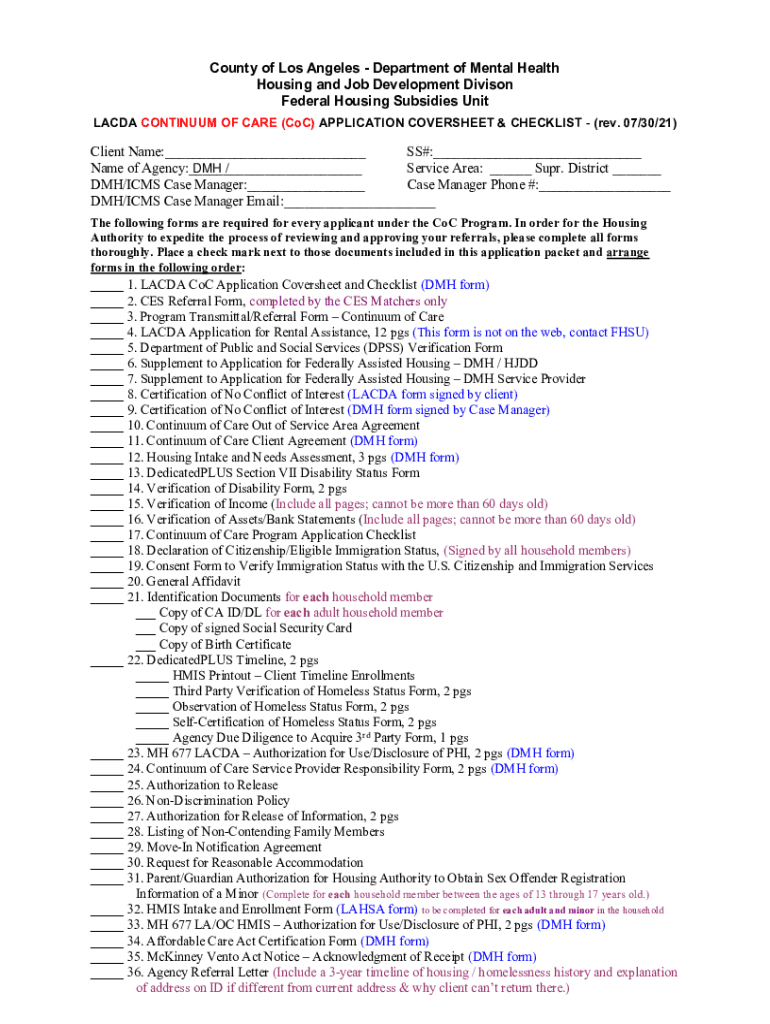







Definition and Meaning of Federal Housing Subsidies
Federal housing subsidies administered by the Department of Mental Health (DMH) in Los Angeles County are essential financial aids designed to assist eligible individuals and families in obtaining housing. These subsidies are part of a broader effort to provide constructive support to those experiencing mental health challenges, ensuring they have access to safe and affordable housing. This helps in stabilizing their circumstances and improving overall quality of life.
How to Use the Federal Housing Subsidies
To utilize federal housing subsidies, applicants must first demonstrate eligibility which typically involves providing documentation of income, disability status, and mental health needs. Once approved, the subsidies can be applied directly towards rental expenses, reducing the financial burden on recipients. DMH provides a network of resources to help applicants navigate the process and make the most of the assistance provided.
How to Obtain the Federal Housing Subsidies
The process of obtaining federal housing subsidies requires several steps:
- Initial Consultation: Engage with a DMH case manager to understand eligibility requirements.
- Documentation: Gather necessary documentation, including income statements, medical records, and other relevant paperwork.
- Application Submission: Complete and submit the application forms provided by the Los Angeles County DMH.
- Approval Process: Await the review and decision process, which may involve additional verification and interviews.
- Housing Placement: Upon approval, work with case managers to find suitable housing and apply the subsidies.
Steps to Complete the Federal Housing Subsidies Application
Completing the application for federal housing subsidies involves the following detailed steps:
- Gathering Documentation: Ensure all necessary documents are prepared, such as proof of income, disability certification, and identification.
- Form Completion: Accurately fill out the required forms, which can be obtained from the DMH.
- Verification and Submission: Submit the forms to the appropriate DMH office and attend any required interviews or follow-up meetings.
- Ongoing Communication: Maintain communication with your case manager to address any additional requirements or questions.
Key Elements of the Federal Housing Subsidies
Several critical elements define the Federal Housing Subsidies program:
- Eligibility Criteria: Income limits, mental health status, and residency requirements.
- Funding Limits: Maximum subsidy amounts and duration of support.
- Application Process: Step-by-step procedures for applying and obtaining approval.
- Housing Support: Types of housing options and assistance available through the program.
Required Documents for the Federal Housing Subsidies
Applicants must provide various documents to prove eligibility and expedite processing:
- Income Verification: Recent pay stubs, tax returns, or benefit statements.
- Identification: Government-issued ID or driver’s license.
- Proof of Residency: Utility bills or lease agreements.
- Medical Documentation: Certifications or reports highlighting mental health conditions.
Application Process and Approval Time
The application process for federal housing subsidies through the DMH typically involves:
- Filing the Application: Submitting all required forms and documentation.
- Review and Verification: DMH reviews the application for accuracy and completeness.
- Interview or Meeting with a Case Manager: Discussion of the application and any additional needs.
- Notification of Decision: Decision letter issued to the applicant detailing approval or denial.
Approval times can vary based on demand and completeness of the application, with average processing times ranging from a few weeks to several months.
Digital vs. Paper Version
Applicants have the option to submit their applications either digitally or via paper:
- Digital Submission: Offers convenience and faster processing times. Documents can be uploaded through the DMH online portal.
- Paper Submission: Suitable for those without reliable internet access, but may result in slower processing times.
- Advantages and Disadvantages: Digital enhances accessibility and trackability, while paper methods may appeal to those preferring physical document handling.




