




01. Edit your copic insurance online
Type text, add images, blackout confidential details, add comments, highlights and more.

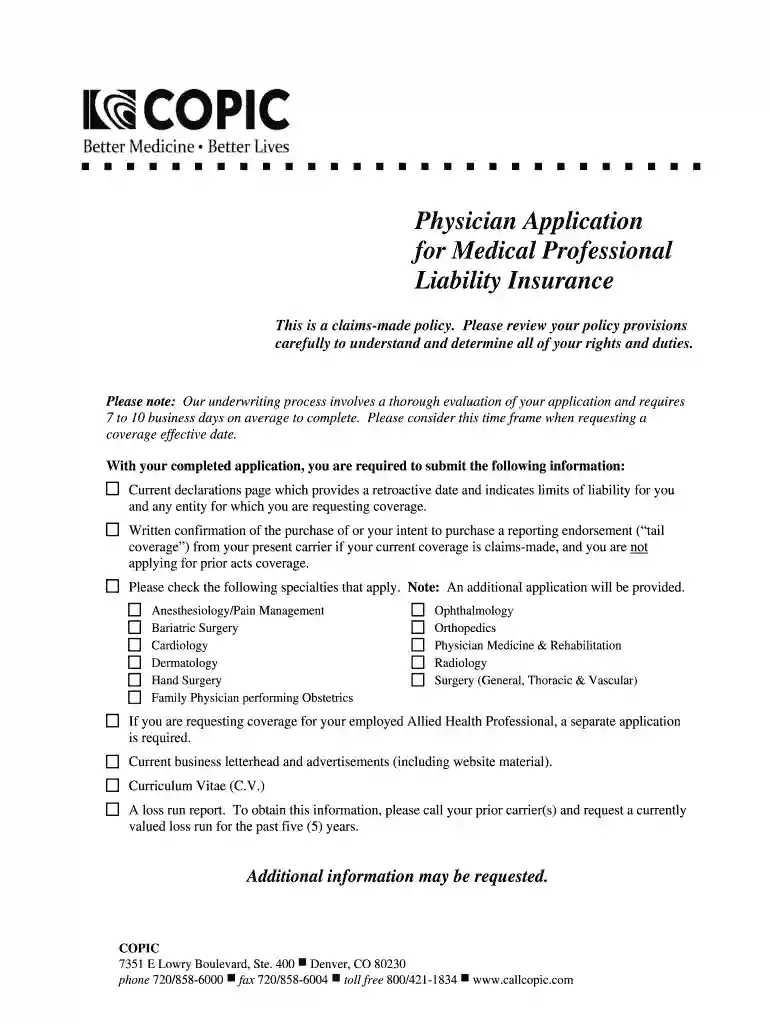
Type text, add images, blackout confidential details, add comments, highlights and more.

Draw your signature, type it, upload its image, or use your mobile device as a signature pad.

Send it via email, link, or fax. You can also download it, export it or print it out.
Medical Professional Liability Insurance (MPLI) is designed to protect healthcare professionals from the financial risks associated with malpractice claims. This insurance covers legal fees, settlements, and awards that may arise from lawsuits alleging negligence or errors in professional judgment or practice. The COPIC's Guide to Medical Professional Liability Insurance provides comprehensive information on how to obtain, use, and manage MPLI policies effectively. It is an essential resource for physicians and healthcare practitioners to understand the intricacies of their coverage and ensure they are adequately protected against potential legal challenges.
The COPIC's Guide serves as a crucial tool for navigating the complexities of MPLI. To utilize the guide effectively:
Completing the COPIC's MPLI Guide involves several steps to ensure all necessary information is included and accurately represented:
Understanding the terminology used in the COPIC's Guide is critical for maximizing the benefits of your MPLI policy:
The guide contains vital elements that every insured professional should be familiar with:
States may have specific regulations impacting MPLI policies:
Real-world scenarios illustrate the practical application of the Guide:
Failure to maintain proper MPLI coverage can lead to significant repercussions:
Submitting the COPIC insurance application can be performed through various methods:
We've got more versions of the copic insurance form. Select the right copic insurance version from the list and start editing it straight away!
| Versions | Form popularity | Fillable & printable |
|---|---|---|
| 2024 | 4.8 Satisfied (56 Votes) | |
| 2023 | 4.6 Satisfied (29 Votes) | |
| 2023 | 4.8 Satisfied (48 Votes) | |
| 2022 | 4.9 Satisfied (49 Votes) | |
| 2021 | 4.8 Satisfied (39 Votes) | |
| 2021 | 4.8 Satisfied (45 Votes) | |
| 2021 | 4.8 Satisfied (34 Votes) | |
| 2020 | 4.1 Satisfied (43 Votes) | |
| 2020 | 4.8 Satisfied (149 Votes) | |
| 2020 | 4.8 Satisfied (151 Votes) | |
| 2020 | 4.3 Satisfied (61 Votes) | |
| 2020 | 4.4 Satisfied (20 Votes) | |
| 2019 | 4.8 Satisfied (36 Votes) | |
| 2019 | 4.9 Satisfied (57 Votes) | |
| 2019 | 4.8 Satisfied (147 Votes) |
At DocHub, your data security is our priority. We follow HIPAA, SOC2, GDPR, and other standards, so you can work on your documents with confidence.
by T Baker Cited by 3 Medical malpractice insurance not only compensates injured pa- tients ex post, it also promotes patient safety ex ante. In that regard, it can
Jan 18, 2017 We credit your companys solid 2016 performance to shareholders who trust us, clients who rely on us, communities that support us, and.


