




01. Edit your form online
Type text, add images, blackout confidential details, add comments, highlights and more.

Type text, add images, blackout confidential details, add comments, highlights and more.

Draw your signature, type it, upload its image, or use your mobile device as a signature pad.

Send it via email, link, or fax. You can also download it, export it or print it out.
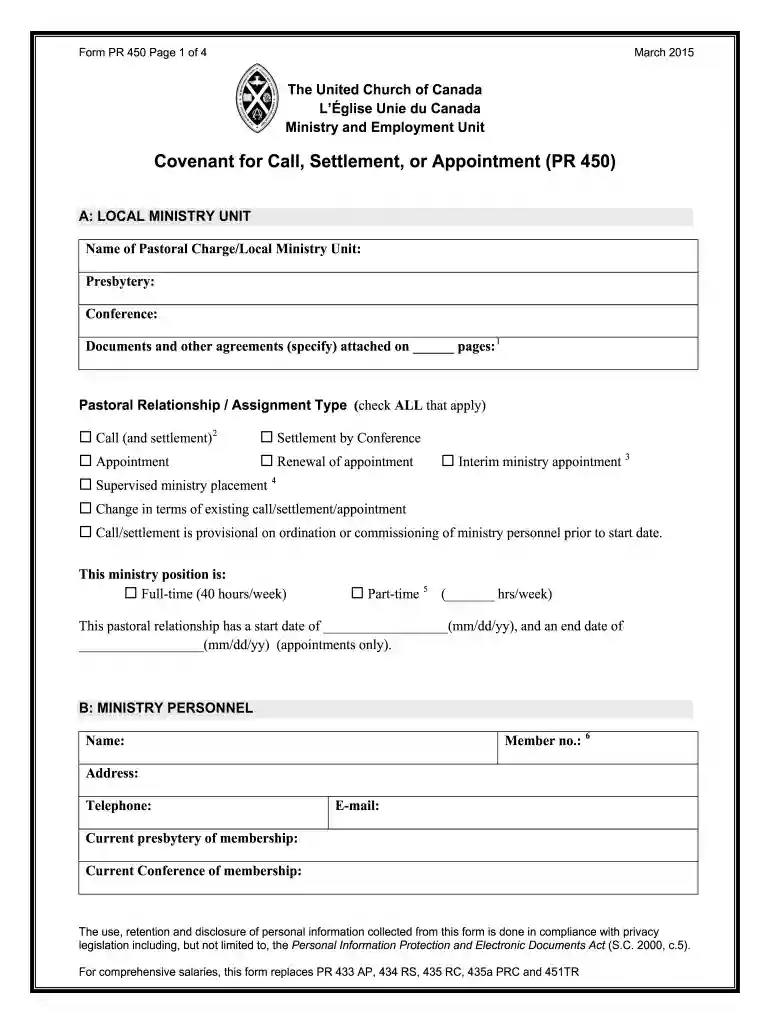
The Covenant for Call, Settlement, or Appointment (Form PR 450) is employed by The United Church of Canada to establish the terms and conditions for ministry personnel assignments within various local ministry units. This form provides a comprehensive framework to detail critical information such as local ministry unit specifics, ministry personnel data, remuneration terms, and additional terms of appointment. By standardizing these details, the form ensures alignment with relevant privacy legislation and supersedes previous iterations related to comprehensive salaries.
The Covenant for Call, Settlement, or Appointment (Form PR 450) includes several crucial components:
Completing Form PR 450 involves a series of structured steps:
Obtaining the Covenant for Call, Settlement, or Appointment (Form PR 450) is straightforward:
This form is primarily used by:


The Covenant for Call, Settlement, or Appointment (Form PR 450) is a binding document that serves multiple legal purposes:
Several scenarios illustrate the practical application of Form PR 450:
Understanding specific terminology related to Form PR 450 enhances clarity:
The Covenant for Call, Settlement, or Appointment (Form PR 450) can be accessed and managed digitally:
We've got more versions of the Covenant for Call Settlement or Appointment PR 450 For comprehensive salaries this form replaces PR form. Select the right Covenant for Call Settlement or Appointment PR 450 For comprehensive salaries this form replaces PR version from the list and start editing it straight away!
At DocHub, your data security is our priority. We follow HIPAA, SOC2, GDPR, and other standards, so you can work on your documents with confidence.
Dec 1, 2021 This act regulates restrictive employment agreements, which are agreements that prohibit or limit an employee or other worker from working
Feb 17, 2017 Accumulated Other Comprehensive Income (Loss). The components of accumulated other comprehensive income (loss), net of income taxes, consisted
This subpart sets forth the text of all FAR provisions and clauses (see 52.101(b)(1)) and gives a cross-reference to the location in the FAR that prescribes


