







Definition and Meaning of Individual Consumer Directed Attendant Care CDAC Disclosure All - DHS Iowa
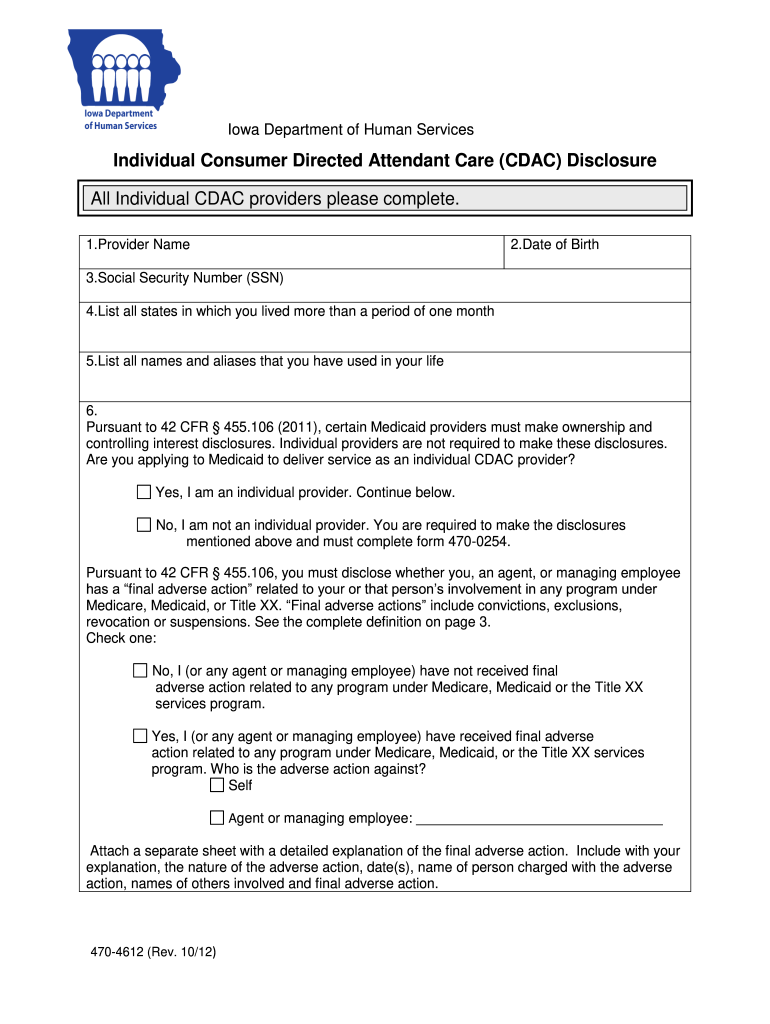
The Individual Consumer Directed Attendant Care (CDAC) Disclosure form from the Iowa Department of Human Services is a critical document designed to manage and disclose information for CDAC providers. It helps in establishing transparent communication between care providers and the state agency, ensuring all necessary personal, legal, and professional information is properly recorded. This form comprises disclosures related to final adverse actions in Medicare or Medicaid programs, alongside sections for criminal offenses and abuse cases, thereby maintaining high standards of care and trust within the community.
Steps to Complete the Individual Consumer Directed Attendant Care CDAC Disclosure
Completing the Individual Consumer Directed Attendant Care (CDAC) Disclosure requires precision and accuracy. Here’s a step-by-step guide:
- Personal Information Section: Start by filling out your full name, date of birth, and social security number accurately.
- Disclosures part: Clearly detail any final adverse actions in Medicare or Medicaid. This covers any previous sanctions or disqualifications.
- Criminal Background: Include information about any criminal offenses, focusing on those relevant to caregiving and financial misconduct.
- Abuse Cases: Ensure to report instances of child or dependent adult abuse, detailing case outcomes if applicable.
- Certification and Acknowledgment: Conclude by certifying the form’s accuracy and understanding the legal implications for any misrepresentation.
Always double-check entries for errors or omissions to avoid delays in processing.
Key Elements of the Individual Consumer Directed Attendant Care CDAC Disclosure
The CDAC Disclosure form is made of specific sections each crucial for the form’s purpose:
- Personal Identification: Includes full legal name, date of birth, and social security number to uniquely identify the care provider.
- Professional Disclosures: Encompasses any relevant history of adverse actions under Medicare or Medicaid participation.
- Legal Disclosures: Requires reporting of any significant legal entanglements, especially those affecting one's professional capacity as a caregiver.
- Abuse Record Indications: Focuses on cases of abuse, providing a platform for transparent reporting.
- Signature and Certification: Validates the form with the provider's signature; a legal affirmation of provided details.
Who Typically Uses the Individual Consumer Directed Attendant Care CDAC Disclosure
This disclosure form is primarily used by:
- CDAC Providers: Individuals offering personal care services to consumers under a Medicaid waiver program in Iowa.
- Iowa DHS Officials: For verifying compliance and maintaining an updated registry of qualified care providers.
- Compliance Officers: Ensuring that all active providers meet the required standards and have disclosed all necessary information.


State-Specific Rules for the Individual Consumer Directed Attendant Care CDAC Disclosure
In Iowa, CDAC providers must adhere to specific state regulations:
- DHS Verification: All disclosures are subject to verification by the Iowa Department of Human Services.
- Reporting Obligation: Providers must report any changes in their legal or professional status immediately.
- Data Privacy: Personal and professional data collected through this form is safeguarded under state confidentiality protocols.
These rules align with Iowa’s commitment to maintaining high standards of care through transparency and regulatory compliance.
Legal Use of the Individual Consumer Directed Attendant Care CDAC Disclosure
Understanding the legal implications is paramount:
- Legally Binding: Signing the form binds the provider to its contents, requiring accuracy and honesty.
- Misrepresentation Penalties: False information can lead to legal consequences, including fines or prohibition from caregiving roles.
- Compliance Verification: Regular auditing by the DHS ensures the integrity of the caregiving environment.
Examples of Using the Individual Consumer Directed Attendant Care CDAC Disclosure
Consider these practical scenarios:
- Renewing Service Contracts: Providers may need to submit a new disclosure form for contract renewals, ensuring all information is up-to-date.
- Background Checks: When a provider’s services are newly contracted by a consumer, they might submit this form as part of an initial vetting process.
- Compliance Audits: During routine audits, providers will present this form to demonstrate their compliance with state requirements.
Eligibility Criteria for the Individual Consumer Directed Attendant Care CDAC Disclosure
Eligibility to submit this form typically involves:
- CDAC Program Registration: You must be an active or intending participant in Iowa’s CDAC program.
- Background Clearance: A clean or disclosed record of any adverse professional actions or legal issues is necessary.
- Compliance with Iowa DHS: Adherence to all state rules and regulations governing personal care provision is mandatory.
This information helps ascertain the provider’s capability to offer care within regulated parameters.

Required Documents for the Individual Consumer Directed Attendant Care CDAC Disclosure
Ensure to gather these documents prior to submission:
- Identification Proof: Such as a driver’s license or passport to confirm identity.
- Social Security Documents: For verification of social security number.
- Criminal Record Certifications: Any official documents related to previously disclosed offenses.
- Professional Disclosures: Documentation of any prior sanctions or legal proceedings under Medicare or Medicaid programs.
Having these documents ready facilitates a smooth completion and submission process, ensuring compliance with state requirements.




