Definition & Purpose of FL-330 S
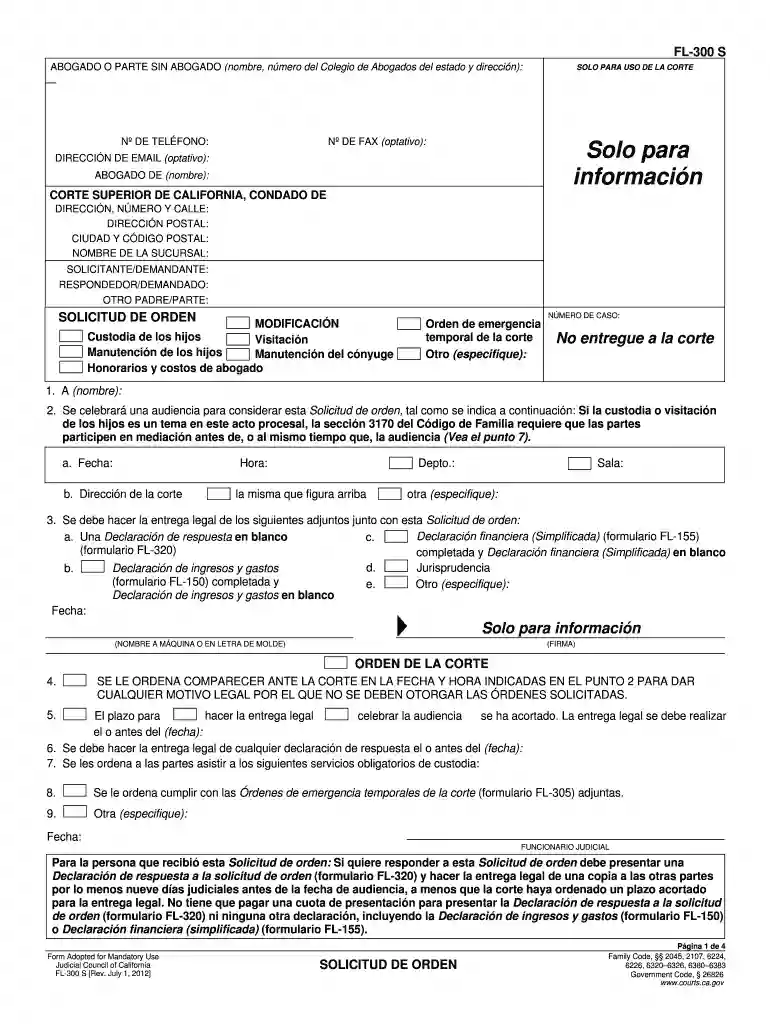
The FL-330 S, titled "Request for Order," is a legal form used in the Superior Court of California specifically for family law cases. Its primary purpose is to allow individuals to formally request court orders regarding matters such as child custody, visitation rights, child and spousal support, and attorney fees. This document is integral to the process of obtaining or modifying court orders and ensures that all parties involved are informed of the proceedings and any legal obligations arising from them.
Key Components of the Form
The FL-330 S contains several essential sections that guide users through the process of applying for court orders:
- Details of Applicant and Respondent: This section requires detailed personal information about the person requesting the order and the individual responding.
- Requested Orders: Applicants must specify the type of orders they seek, such as changes in child custody arrangements or alterations to support payments.
- Hearing Information: Details about the court hearing, including the location, date, and time, are outlined to ensure both parties are aware of the proceedings.
- Service Requirements: Instructions regarding the service of documents on the respondent are provided, emphasizing the importance of ensuring that the respondent receives all necessary paperwork.
How to Use the FL-330 S
Utilizing the FL-330 S form involves several steps, beginning with understanding its structure and requirements. Here is a streamlined process to effectively use this form:
- Obtain the Form: Secure a copy from the California Courts Self-Help Center or local court clerk's office.
- Fill Out Personal Information: Provide accurate details about yourself and the opposing party to ensure proper legal processing.
- Specify the Orders Needed: Clearly state the orders you are requesting from the court, providing detailed explanations and supporting information if necessary.
- Notarize and Submit: Some sections may require notarization before submission. Ensure all instructions are closely followed to avoid processing delays.
Examples of Orders:
- Child Custody Adjustments: Requests to modify existing custody arrangements due to changes in circumstances.
- Support Changes: Petitions to increase or decrease financial support based on new employment status or income changes.
Steps to Complete the FL-330 S
Completing the FL-330 S is a meticulous process that demands attention to detail at every step. Here's a detailed breakdown:
- Review the Form Instructions: Begin by reading through the entire form and any accompanying instructions to understand which sections apply to your situation.
- Complete Personal Information Fields: Enlist all required details about yourself and the respondent, ensuring accuracy to prevent any delays.
- Detail the Orders Needed: Clearly articulate the specific court orders you’re seeking, citing any relevant supporting documentation.
- Attach Supporting Documents: Add any required attachments, such as financial statements or child custody agreements, to bolster your request.
- Notarization: If any sections require notarization, ensure this is completed before proceeding.
- Submit the Form: Depending on your preference and court availability, submit the completed form in person, by mail, or through online systems where applicable.
- Follow Up with Court: After submission, keep in contact with the court for updates on your hearing schedule and any further documentation needed.
Who Typically Uses FL-330 S
The FL-330 S is primarily used by individuals involved in family law disputes within the state of California. This includes but is not limited to:
- Parents Seeking Custody Modifications: Individuals wishing to adjust custody arrangements due to significant changes in circumstances.
- Spouses or Ex-Spouses Requesting Support Adjustments: Those needing to modify spousal or child support obligations.
- Legal Representatives: Attorneys who represent clients in family law matters use this form to request judicial intervention.
Legal Use of FL-330 S
The FL-330 S is used legally as an instrument to communicate formal requests to the court. Its utilization is bound by several requirements:
- Adherence to Legal Standards: All information provided must be truthful and comply with California’s legal regulations.
- Proper Service of Documents: Legal procedures mandate that the respondent is served with court documents in a timely manner, maintaining due process.
- Court Sanctions: Unauthorized modifications or misrepresentations on the form can result in court sanctions or dismissals.
Important Legal Guidelines:
- The form must be filed with the correct jurisdiction.
- Legal advice should be sought if there is any uncertainty regarding the completion or implications of the form.
- The court may require verification or evidence to support the requests made in the FL-330 S.
State-Specific Rules for FL-330 S
California has specific rules and guidelines governing the use of the FL-330 S, ensuring that family law proceedings are conducted fairly and efficiently. Some of the state-specific considerations include:
- Mandatory Mediation: In many cases involving minor children, California mandates mediation to attempt resolution before courtroom litigation.
- Residency Requirements: The parties involved must meet specific residency prerequisites to file the form within California.
Important Terms Related to FL-330 S
Understanding certain key terms is crucial when dealing with the FL-330 S form:
- Applicant: The individual filing the request for court orders.
- Respondent: The party responding to the requested orders.
- Custody: Legal guardianship, either exclusive or shared, as it pertains to a minor child.
- Support: Financial assistance, either for children or spousal support, requested from or by the respondent.
Practical Scenarios:
- Parents co-parenting a child across state lines may need detailed custody arrangements.
- Individuals experiencing significant income changes requiring an amended support agreement.
Examples of Using FL-330 S
The implementation of the FL-330 S form varies widely depending on the specific circumstances of the case. Here are a few examples:
- Case of Relocation: A parent needing to relocate for work may use the FL-330 S to adjust visitation rights and ensure both parties comply with updated custody schedules.
- Income Shift: A change in employment status necessitating a reassessment of spousal or child support to align with current earnings.
This comprehensive examination and application of the FL-330 S form can guide individuals effectively through the complexities of family law proceedings in California.