







Definition and Meaning
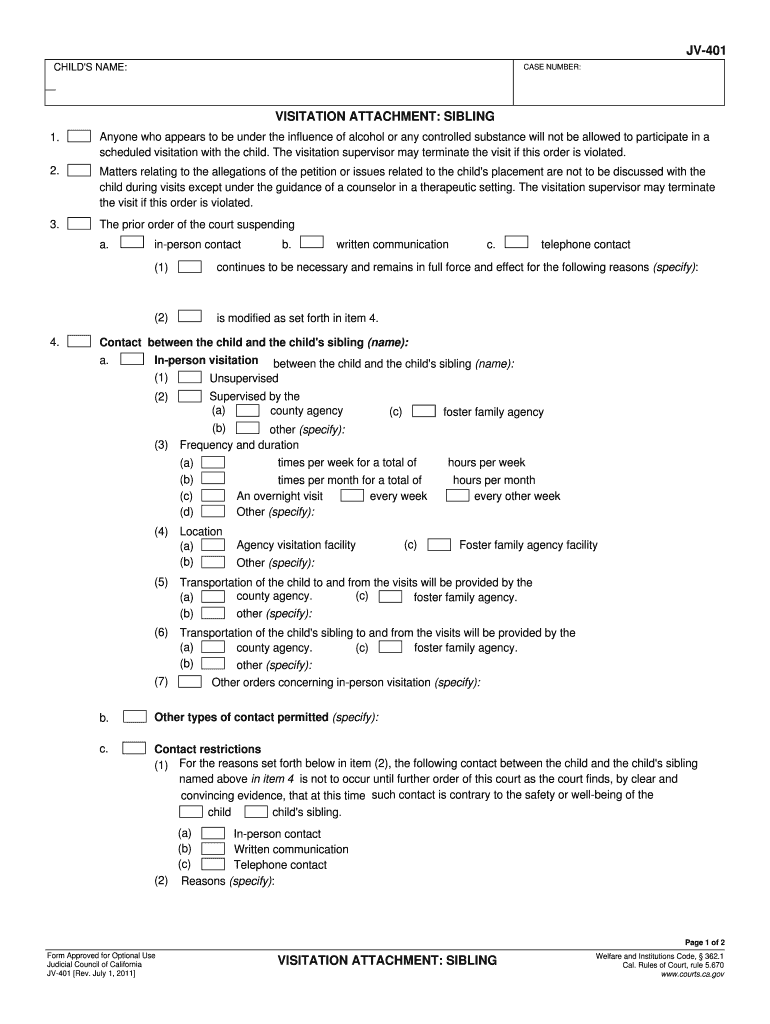
The JV-401 Visitation Attachment: Sibling Judicial Council forms - courts ca is a specific legal document used within the California judicial system, designed to regulate visitation rights and conditions between siblings in custody cases. This form ensures that visitation arrangements comply with court orders and addresses potential issues such as supervision, transportation, and restrictions. It plays a critical role in maintaining sibling relationships while protecting the children's welfare involved.
How to Use the JV-401 Visitation Attachment
To properly use the JV-401 Visitation Attachment, individuals must follow specific steps to ensure compliance with legal guidelines. The form should be completed by parties involved in a custody case, often with the assistance of a legal representative. The main aim is to outline a clear and enforceable visitation schedule reflecting the court's mandates.
-
Review the form's requirements: This involves understanding each section, ensuring that all relevant information and conditions are clearly specified.
-
Complete relevant sections: Provide detailed information about the visitation conditions, including dates, times, and locations.
-
Submit the form: Once completed, the form should be submitted to the court as part of the official custody documents.
-
Follow-up: Ensure all parties understand and adhere to the outlined visitation arrangements.
Steps to Complete the JV-401 Visitation Attachment
Completing the JV-401 Visitation Attachment involves a series of careful steps to ensure accuracy and adherence to judicial guidelines:
-
Gather necessary information: Collect all pertinent details about the siblings involved, including their names, ages, and current living arrangements.
-
Specify visitation details: Clearly define the schedule, including days and times, transportation plans, and any specific supervision requirements.
-
Outline restrictions and conditions: Specify any limitations such as no unsupervised visits or restrictions during certain situations (e.g., if under the influence of substances).
-
Include additional provisions: Address any other necessary conditions that pertain to the siblings' interactions.
-
Review and revise: Double-check all information for accuracy and completeness before submitting the form.
Key Elements of the JV-401 Visitation Attachment
The JV-401 incorporates various essential components to ensure that sibling visitation arrangements are clear and legally binding:
- Visitation Schedule: Details about frequency, duration, and location of visits.
- Transportation Arrangements: How siblings will travel to and from visits, specifying who is responsible for pickups and drop-offs.
- Supervision Requirements: Whether visits require supervision and, if so, who will provide it.
- Prohibitions: Restrictions related to behavior and substance use during visits.
Who Typically Uses the JV-401 Visitation Attachment
The JV-401 is typically utilized by parties involved in legal custody hearings and arrangements, including:
- Parents or guardians: Individuals responsible for the children's welfare in custody cases.
- Legal representatives: Lawyers or legal aides who help draft and submit the form on behalf of their clients.
- Judicial officers: Judges and court officials who review the form to ensure compliance with the court's custody stipulations.


Legal Use of the JV-401 Visitation Attachment
The JV-401 facilitates legally mandated visitation arrangements to foster sibling relationships while ensuring children's safety and welfare:
- Enforces court orders: Acts as an enforceable legal document outlining agreed visitation terms.
- Establishes clear protocols: Provides a structured framework for visitation that aligns with judicial decisions.
- Mitigates disputes: Reduces ambiguity and potential for conflict by clearly defining each party's responsibilities and rights.
Important Terms Related to the JV-401 Visitation Attachment
Understanding specific terms is essential for accurate completion and compliance with the JV-401:
- Visitation: Refers to the scheduled time siblings are allowed to spend together under specified conditions.
- Supervision: The presence of a designated adult during visits to ensure safety and adherence to rules.
- Prohibited Conduct: Behaviors that are not allowed during visitations, such as substance abuse or unsupervised contact.
State-Specific Rules for the JV-401 Visitation Attachment
Although the JV-401 is a form used in California, it reflects judicial guidelines that may vary across different states:
- California State Guidelines: These dictate the standard conditions and legal framework for sibling visitation within the state.
- Local Modifications: Courts may customize the form's conditions based on specific county regulations or case specifics.
Examples of Using the JV-401 Visitation Attachment
Several real-world scenarios illustrate how the JV-401 is applied in different custody situations:
- Structured Visitation: Where siblings live in separate households, the form delineates regular weekly visits and joint activities facilitated by a parent or guardian.
- Supervised Visits: In situations where one sibling's behavior raises concerns, the form can mandate supervised visitations to ensure safety.
- Adjustments for Changes: Holidays and special occasions might require modifications, all of which can be addressed within the form to accommodate unique circumstances.




