




01. Edit your form online
Type text, add images, blackout confidential details, add comments, highlights and more.

Type text, add images, blackout confidential details, add comments, highlights and more.

Draw your signature, type it, upload its image, or use your mobile device as a signature pad.

Send it via email, link, or fax. You can also download it, export it or print it out.
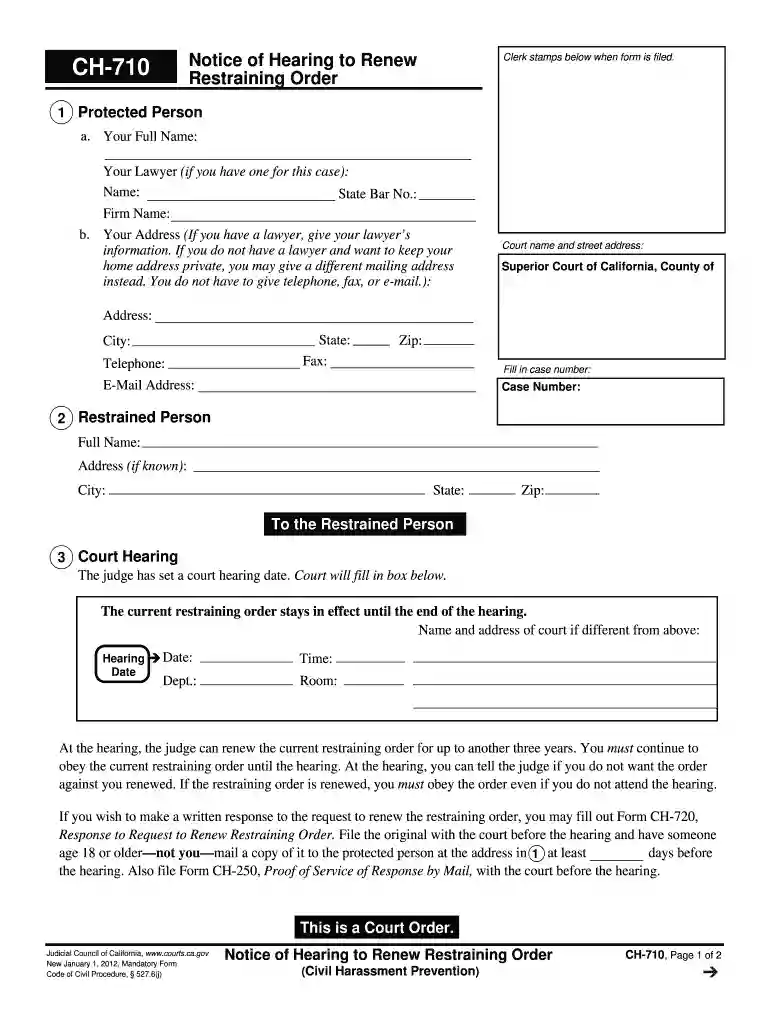
The CH-710 Notice of Hearing to Renew a Restraining Order, issued by the Superior Court of California, is a judicial form used for renewing existing restraining orders. This form provides crucial information regarding the hearing scheduled to determine whether the restraining order should be extended. It includes details for both the protected person and the restrained individual, and outlines procedures for notification and subsequent actions related to the renewal process.
Individuals involved in a legal restraining order case rely on the CH-710 to understand the timeline and requirements for renewal, significantly impacting personal safety and legal obligations.
Understanding how to properly utilize the CH-710 Notice of Hearing form is crucial for those involved in restraining order cases. Its correct use ensures that all necessary legal steps are followed, ultimately affecting the outcome of the renewal process.
Acquiring the CH-710 form is the initial step for those seeking to renew a restraining order. The process is straightforward but must be approached with attention to detail to avoid errors.
The form can typically be accessed in different formats such as PDF for printing and manual completion or in fillable digital formats that allow for online submission through platforms like DocHub.
Completing the CH-710 form accurately is critical to ensuring that the renewal process proceeds without unnecessary delays or complications.
Certain elements of the CH-710 form hold particular importance, as they directly impact the legal standing and processing of the restraining order renewal.
By detailing these elements, the form ensures clarity and compliance with legal standards, ultimately seeking to preserve the safety and rights of all parties involved.
The legal application of the CH-710 form is central to its perceived effectiveness in the judicial process, particularly regarding restraining order renewals.
Correct use of the CH-710 significantly influences court decisions related to the extension of protection measures, ultimately affecting the lives of those involved.
State regulations can impact the completion and submission procedures for the CH-710 form, with California laws explicitly guiding its use.
Practical examples can illustrate how individuals engage with the CH-710 form in real-life situations, showcasing its role in the legal process.
These examples underline the form’s utility in adapting to personal circumstances while adhering to legal requirements.
We've got more versions of the CH-710 Notice of Hearing to Renew Restraining Order Judicial Council forms - courts ca form. Select the right CH-710 Notice of Hearing to Renew Restraining Order Judicial Council forms - courts ca version from the list and start editing it straight away!
At DocHub, your data security is our priority. We follow HIPAA, SOC2, GDPR, and other standards, so you can work on your documents with confidence.
Notice on protective order. All protective orders issued under section 4954 (relating to protective orders) shall contain in large print at the top of the order
by M Dunleavy THE REGULATIONS REPRODUCED HERE HAVE BEEN PROVIDED BY THE. DEPARTMENT OF ENVIRONMENTAL CONSERVATION AS A PUBLIC COURTESY.


