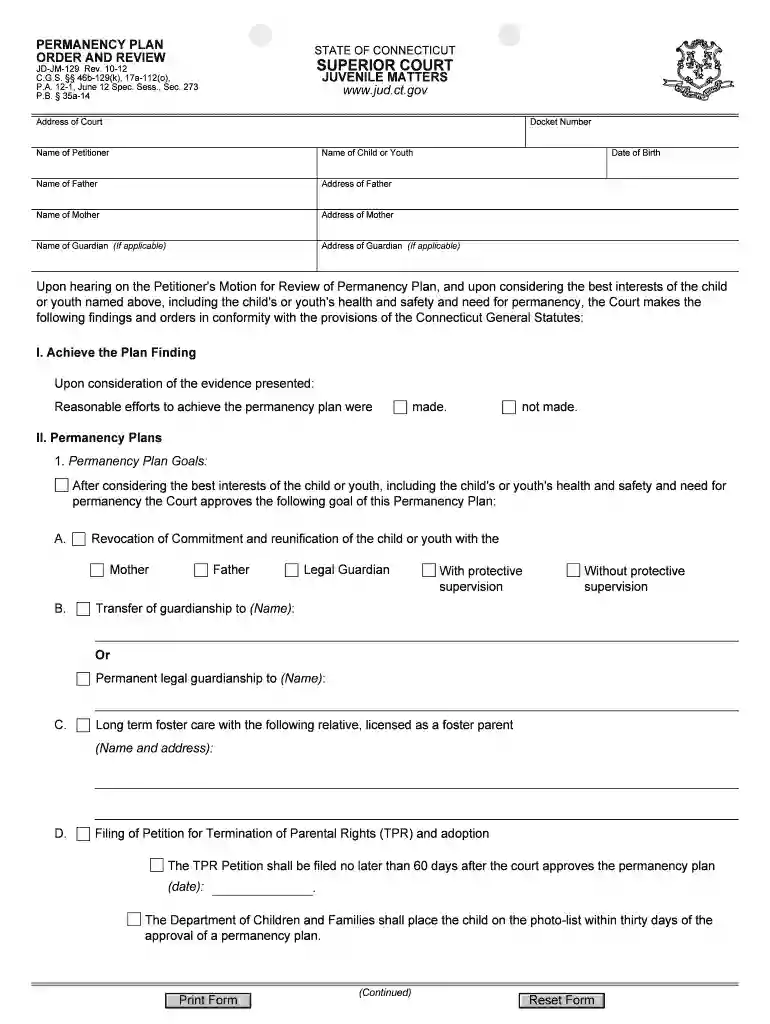
PERMANENCY PLAN ORDER AND REVIEW - CT - jud ct 2026

Get Form
PERMANENCY PLAN ORDER AND REVIEW - CT - jud ct Preview on Page 1

Here's how it works

01. Edit your form online
Type text, add images, blackout confidential details, add comments, highlights and more.

02. Sign it in a few clicks
Draw your signature, type it, upload its image, or use your mobile device as a signature pad.

03. Share your form with others
Send it via email, link, or fax. You can also download it, export it or print it out.

Definition and Purpose of the Permanency Plan Order and Review

The Permanency Plan Order and Review is a crucial legal document in the State of Connecticut that guides the decision-making process regarding a child's long-term welfare. It serves as a comprehensive directive from the court detailing the child's best interests and possible future arrangements. These arrangements might include reunification with parents, transfer of guardianship, long-term foster care, or the termination of parental rights. Each decision within the plan is tailored to ensure that the child's welfare and stability are the foremost priorities.

Key Components of the Plan

  • Review Timeline: The document outlines specific timelines within which the Department of Children and Families must take action. This timeline ensures that there's a consistent evaluation of the child's circumstances.
  • Findings and Decisions: The plan includes detailed court findings and decisions, noting the child's current placement and the appropriateness of that placement.
  • Future Hearings: Provisions for future court hearings are detailed, ensuring ongoing judicial oversight.

How to Use the Permanency Plan Order and Review

To effectively utilize the Permanency Plan Order and Review, involved parties should meticulously follow the court's directive. It is pivotal for child welfare officials, legal guardians, and related stakeholders to understand the specific legal obligations and timelines to secure the child's best interests.

Responsibilities of Stakeholders

  • Department of Children and Families: Must adhere to timelines and procedures outlined, ensuring each step is documented and reported as required.
  • Legal Representation: Attorneys must ensure compliance with the document's directives, advising clients (parents or guardians) on legal ramifications and rights.
  • Parents or Guardians: Should work closely with legal representatives to understand their rights and responsibilities as outlined in the document.

Steps to Complete the Permanency Plan Order and Review

Filling out the Permanency Plan Order and Review involves multiple stakeholders and steps, ensuring the document is comprehensive and meets legal standards.

  1. Data Collection: Gather all necessary information regarding the child's current placement, background, and needs.
  2. Filling Out the Form: Complete all sections of the form as required, providing detailed and accurate information.
  3. Review and Verification: Ensure all information is accurate and verified by the appropriate authorities.
  4. Submission to Court: Submit the completed form to the court within the stipulated deadlines for approval and subsequent judicial review.

Collaboration with Legal Professionals

  • Verification of Details: Utilize legal expertise to verify all information, ensuring compliance with state laws.
  • Revisions: Amend any sections as directed by court officials or legal counsel.

Important Terms Related to the Permanency Plan Order and Review

Understanding key terms associated with the Permanency Plan Order and Review is critical for all involved parties.

  • Reunification: The process of returning a child to their biological parents after being in alternative care.
  • Guardianship: A legal status where a person is appointed to make decisions on behalf of a child.
  • Termination of Parental Rights: A legal process where a parent's rights to their child are permanently terminated.
  • Foster Care: Temporary care arrangement for children who cannot live with their parents.

Legal Use of the Permanency Plan Order and Review

The legal framework governing the Permanency Plan Order and Review ensures that all decisions and actions comply with Connecticut's child welfare laws.

Compliance and Enforcement

  • Judicial Oversight: The plan is directly subject to court approval and oversight, ensuring decisions are in the child's best interests.
  • Mandated Actions: Specific actions are mandated within the document to ensure compliance with legal standards and the child's welfare plan.

Examples of Using the Permanency Plan Order and Review

Several scenarios illustrate the effective use of the Permanency Plan Order and Review.

  • Reunification Case: A child is successfully reunified with their biological parents after fulfilling conditions outlined in the plan.
  • Guardianship Transfer: Legal guardianship is transferred to a relative, offering a stable home environment.
  • Long-term Foster Placement: The child remains in foster care with continued efforts for a possible future adoption.

By following this structured content, stakeholders can ensure that implementation and understanding of the Permanency Plan Order and Review are effectively aligned with Connecticut's legal standards and the child's best interests.

See more PERMANENCY PLAN ORDER AND REVIEW - CT - jud ct versions

We've got more versions of the PERMANENCY PLAN ORDER AND REVIEW - CT - jud ct form. Select the right PERMANENCY PLAN ORDER AND REVIEW - CT - jud ct version from the list and start editing it straight away!
Versions Form popularity Fillable & printable
2020 4.8 Satisfied (90 Votes)
2015 4.4 Satisfied (127 Votes)
2012 4.4 Satisfied (248 Votes)
be ready to get more

Complete this form in 5 minutes or less

Get form

Got questions?

We have answers to the most popular questions from our customers. If you can't find an answer to your question, please contact us.
Contact us
Legal Process Still, when the court is not involved, the guardianship is typically only valid for six months before it needs to be renewed, while court-appointed voluntary guardianships last until it is no longer needed.
A permanent guardianship is intended to last until the minor docHubes age 18 and to provide permanency for the minor without terminating the parental rights of the parents.
STANDBY GUARDIAN: Custody of a child can also be obtained without going to court by becoming a Standby Guardian. A standby guardianship is created by having the parents sign a document available from the probate court stating that they are consenting to have the grandparent or relative take guardianship of their child.
A parent has the right to request reinstatement of guardianship as long as the guardianship is temporary. A reinstatement of guardianship means that you will once again be your childs legal guardian and be able to decide where they live, go to school, get medical care, go to church, and do other daily activities.
In California, parents can petition to terminate guardianship, but the court will only approve it if doing so is in the childs best interest. To regain custody, you must prove that your circumstances have improved and that you can provide a stable, supportive home.

Security and compliance

At DocHub, your data security is our priority. We follow HIPAA, SOC2, GDPR, and other standards, so you can work on your documents with confidence.

Learn more
ccpa2
pci-dss
gdpr-compliance
hipaa
soc-compliance
be ready to get more

Complete this form in 5 minutes or less

Get form

People also ask

There are two types of guardianship for minors: guardianship of the person and guardianship of the estate. A guardian of the person has the responsibility to care for the minor. A guardian of the estate manages the minors assets. User Guide - Guardians of Minors (CT Probate Courts, 2022).

Related links