




01. Edit your form online
Type text, add images, blackout confidential details, add comments, highlights and more.

Type text, add images, blackout confidential details, add comments, highlights and more.

Draw your signature, type it, upload its image, or use your mobile device as a signature pad.

Send it via email, link, or fax. You can also download it, export it or print it out.
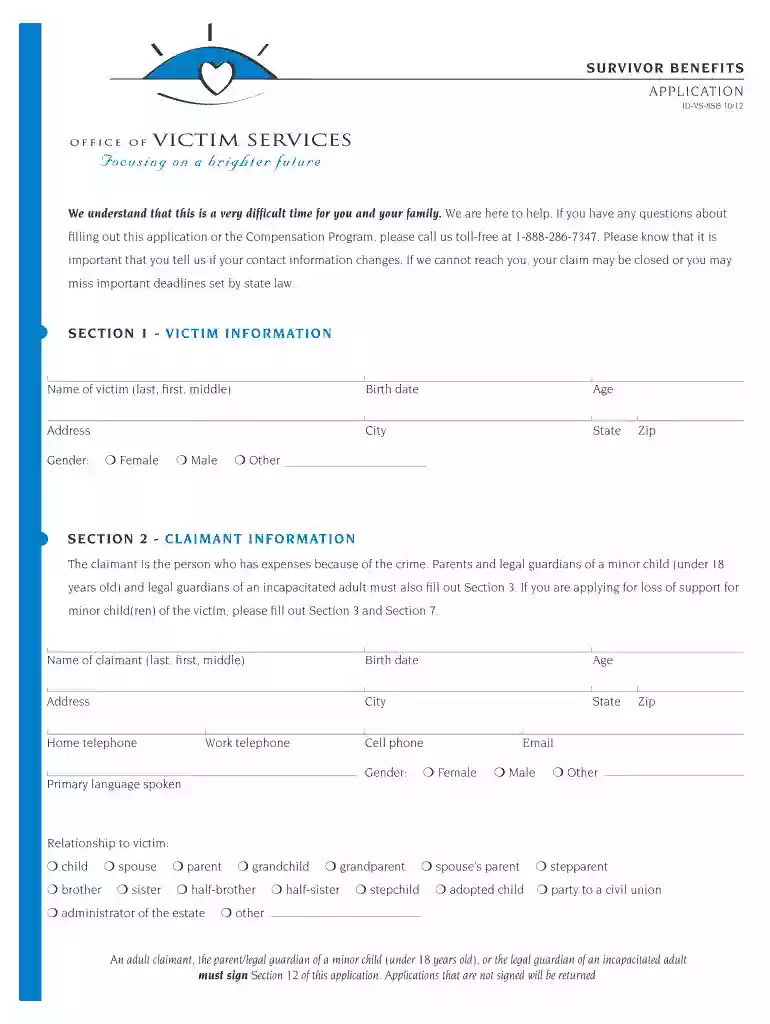
The "Survivor Benefits Application Section One: Victim" is a critical component of the application process for those seeking compensation through the Office of Victim Services in the United States. This section gathers essential information about the victim to assess eligibility for financial support due to crime-related impacts. It encompasses various aspects of the victim's situation, including identity verification, crime-related details, and other pertinent information necessary for claim processing. Understanding its function and completing it accurately is vital for applicants to ensure a seamless application experience.
The form includes several key components designed to collect comprehensive details about the victim:
Accurate information is imperative as inaccuracies could delay or negate the processing of benefits.
Successfully utilizing this form requires understanding its structure and requirements. Here is a step-by-step guide on how to use this section:
Adhering to these steps ensures an organized and efficient application process.
Completing this form involves several crucial steps to ensure thoroughness and compliance:
Careful attention to each section helps establish a solid foundation for subsequent parts of the application.
Eligibility to apply for benefits requires meeting specific criteria related to the victim’s circumstances:
Understanding and meeting these criteria is crucial for determining if an applicant is qualified to receive benefits.


Completing the form necessitates a set of documents that substantiate the claim, including:
Including these documents helps validate the application and facilitates a smoother approval process.
There are various methods available for submitting the "Survivor Benefits Application Section One: Victim":
Selecting the most suitable submission method can speed up the overall process and ensure the form reaches the appropriate authorities promptly.
Completing and submitting the Survivor Benefits Application involves adhering to certain legal obligations to prevent any issues:
Applicants should remain aware of these legal implications to maintain compliance throughout the application process.
Understanding real-world applications of survivor benefits can illuminate the significance of the form:
These scenarios underscore the importance of accurate and timely application submission for accessing needed financial support.
We've got more versions of the SURVIVOR BENEFITS application SECTION ONE VICTIM - jud ct form. Select the right SURVIVOR BENEFITS application SECTION ONE VICTIM - jud ct version from the list and start editing it straight away!
At DocHub, your data security is our priority. We follow HIPAA, SOC2, GDPR, and other standards, so you can work on your documents with confidence.
Jul 21, 2021 If you have any questions about filling out this application or the Victim Compensation Program, please call OVS at 1-888-286-7347. Please know
Jun 14, 2012 By the plain language of the statute, the public duty doctrine is a defense only if the injury alleged is the result of (1) a law enforcement
If you have questions about the application or need help with the claim process, you can call the Victim. Compensation Program at 1-888-286-7347 or email


