




01. Edit your secretary of state hearings illinois online
Type text, add images, blackout confidential details, add comments, highlights and more.

Type text, add images, blackout confidential details, add comments, highlights and more.

Draw your signature, type it, upload its image, or use your mobile device as a signature pad.

Send it via email, link, or fax. You can also download it, export it or print it out.
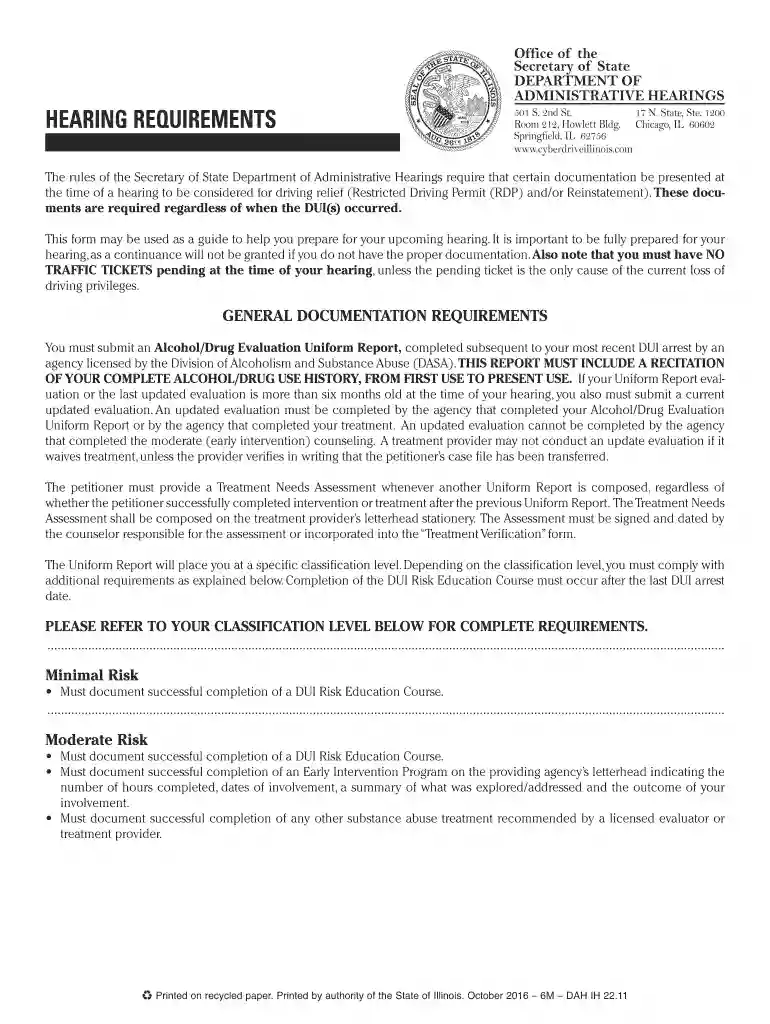
The Hearing Requirements set by the Illinois Secretary of State are designed for individuals seeking driving relief after DUI offenses. These requirements ensure that individuals demonstrate their commitment to responsible driving behaviors. They include specific documentation such as the Alcohol/Drug Evaluation Uniform Report and Treatment Needs Assessment. Different levels of risk classification, ranging from minimal to high risk, dictate the necessary steps in the hearing process. Each classification requires varying degrees of educational courses and substance abuse treatments.
Evaluate Your Risk Level: Determine your risk classification—minimal, moderate, significant, or high. This classification will inform the specific requirements you must meet.
Gather Documentation: Collect required documents, including the Alcohol/Drug Evaluation Uniform Report and Treatment Needs Assessment.
Complete Education and Treatment: Fulfill any required DUI education courses and substance abuse treatments based on your risk level.
Schedule the Hearing: Contact the Illinois Secretary of State’s office to arrange a hearing date. Be prepared to discuss your compliance with all requirements.
Attend the Hearing: Present yourself before the Department of Administrative Hearings. Ensure that all documents are complete and accurate to avoid continuances.
Await Decision: After the hearing, wait for a decision regarding your driving privileges.
Obtaining the Hearing Requirements form involves reaching out to the Illinois Secretary of State's office or visiting their official website. This form is crucial in compiling and documenting your compliance with the specified requirements. It's advisable to regularly check for updates or changes to the form or associated processes.
Alcohol/Drug Evaluation Uniform Report: This report provides an assessment of your substance use and the associated risks.
Treatment Needs Assessment: Required for those evaluated with a moderate to high-risk classification, detailing any necessary substance abuse treatment.
Proof of Completion of Courses: Documentation verifying the completion of DUI education courses if mandated by your risk level.
Attendance Certificates: From any administered substance abuse programs or counseling.
Failure to comply with the Hearing Requirements can lead to continued revocation of driving privileges. The requirements are legally enforced, ensuring that drivers rehabilitate before regaining their licenses. Individuals who do not meet these requirements may face delays or denial in restoring their driving rights.
While the Hearing Requirements are specific to Illinois, similar processes may exist in other states but with variations in criteria and documentation. It's essential to adhere strictly to Illinois-specific regulations to avoid any non-compliance issues.
Individuals with a DUI offense seeking to restore their driving privileges primarily use the Hearing Requirements. This can include a wide array of people from different backgrounds who have been classified under various risk levels. Substance abuse counselors and legal professionals might also interact with these requirements to assist their clients.


Risk Classification: Central to determining the path and requirements for regaining driving privileges.
Documentation: Precise and thorough submission is crucial for successful hearings.
Treatment Completion: Completion of necessary treatment as a demonstration of responsible behavior.
DUI Education Courses: Mandatory courses designed to educate offenders about the dangers of impaired driving.
Evaluation Reports: Assessments needed to determine an individual's risk level related to alcohol or drug use.
Understanding these terms and the process ensures compliance and increases the chances of a favorable outcome in the hearing process.
We've got more versions of the secretary of state hearings illinois form. Select the right secretary of state hearings illinois version from the list and start editing it straight away!
At DocHub, your data security is our priority. We follow HIPAA, SOC2, GDPR, and other standards, so you can work on your documents with confidence.
Hearing officer applies administrative code requirements to the facts of the case. A decision is mailed to the petitioner. Petitioner must have evaluator.
Feb 9, 2013 (b) When documentary material produced pursuant to a demand is no longer required for use in connection with the investigation for which it was


