




01. Edit your form online
Type text, add images, blackout confidential details, add comments, highlights and more.

Type text, add images, blackout confidential details, add comments, highlights and more.

Draw your signature, type it, upload its image, or use your mobile device as a signature pad.

Send it via email, link, or fax. You can also download it, export it or print it out.
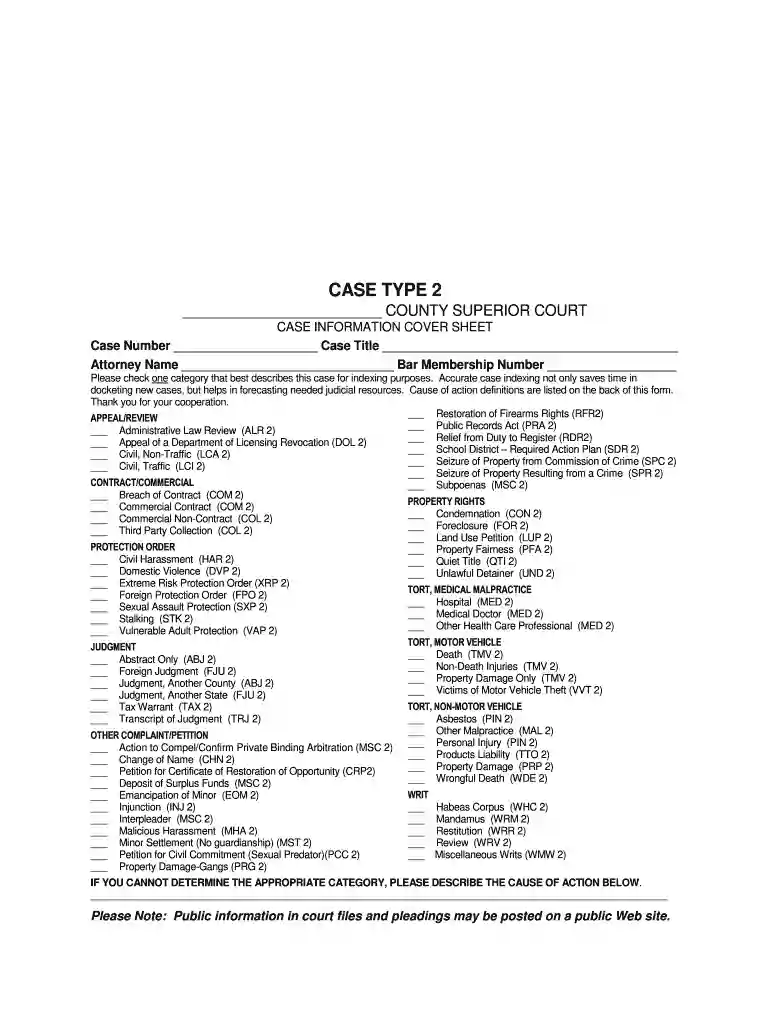
The "2014 WA Case Type 2" is a form used by the County Superior Court in Washington State to categorize and index various legal cases. This document aids in the organization of court records, making it easier for legal professionals, court staff, and the public to access case information. The form serves as a comprehensive cover sheet that outlines the case type, assisting in resource forecasting and judicial planning.
Filling out the 2014 WA Case Type 2 requires attention to detail to ensure accurate classification of the legal matter. The form necessitates comprehensive information about the case, including specific classifications and relevant legal definitions.
The efficacy of the 2014 WA Case Type 2 hinges on understanding its essential elements. Each section of the form corresponds to vital information that influences court operations.
Legally, the 2014 WA Case Type 2 serves as a foundational document in the filing and management of court cases. Proper use ensures compliance with judicial procedures.
The process for obtaining and filing this form is straightforward but requires adherence to local court processes.
The form is indispensable to a range of legal practitioners and individuals navigating the judicial system.


A clear understanding of related legal terminology is crucial when dealing with the 2014 WA Case Type 2.
We've got more versions of the 2014 WA Case Type 2 form. Select the right 2014 WA Case Type 2 version from the list and start editing it straight away!
At DocHub, your data security is our priority. We follow HIPAA, SOC2, GDPR, and other standards, so you can work on your documents with confidence.
Aug 24, 2022 A recent case further tests the contours of WA Rule 413 by ruling about when immigration status is permissible in a criminal trial. Cesar
by J Szabo 2017 Cited by 9 This formulation was used historically, and it contains PFOA and PFOS, which can be found as ground water contaminants at some sites, but are not in many modern
Case Type Civil. Civil; Criminal; Domestic; Probate/Guardianship. Court Name PIERCE DISTRICT COURT #2; PIERCE DISTRICT COURT #3; PIERCE DISTRICT COURT #4


