




01. Edit your form online
Type text, add images, blackout confidential details, add comments, highlights and more.

Type text, add images, blackout confidential details, add comments, highlights and more.

Draw your signature, type it, upload its image, or use your mobile device as a signature pad.

Send it via email, link, or fax. You can also download it, export it or print it out.
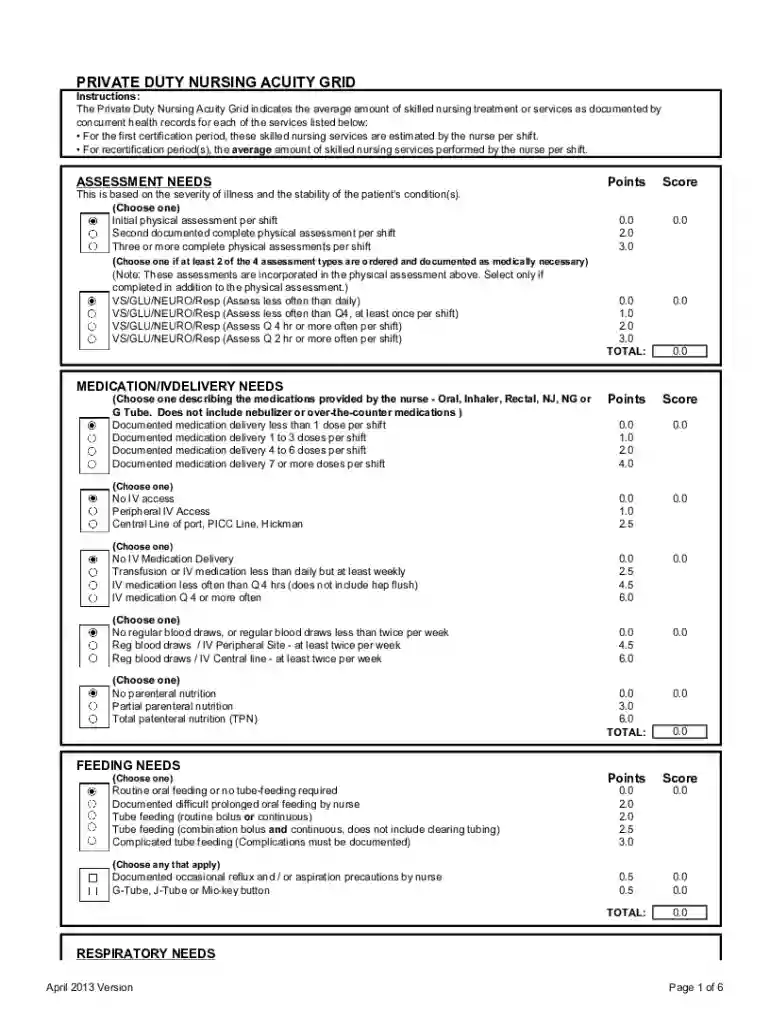
The Private Duty Nursing Acuity Grid, developed by the Utah Department of Health Medicaid program, is a comprehensive tool used by healthcare providers to evaluate the level of skilled nursing care necessary for patients. This grid incorporates various categories to systematically assess patient needs, focusing on aspects such as medication delivery, feeding requirements, respiratory support, and more. Each category is assigned a specific score reflecting the severity of the patient's condition and the complexity of required care, guiding healthcare professionals in resource allocation and care planning.
Using the Private Duty Nursing Acuity Grid involves a step-by-step assessment process to determine the level of nursing care a patient requires. Healthcare providers should:
Completing the Private Duty Nursing Acuity Grid requires careful attention to detail. Follow these steps:
Gather Patient Information:
Assess Each Category:
Score the Patient’s Needs:
Calculate the Total Score:
Review and Document:
Implement Findings:
Several key elements define the functionality and utility of the acuity grid:
Categories of Care: Includes detailed subcategories such as respiratory support, feeding assistance, and medication needs, each requiring specific evaluations.
Scoring Criteria: Provides a structured approach for scoring patient needs, ensuring objectivity and consistency in evaluations.
Comprehensive Assessment: Emphasizes accurate documentation, fostering effective communication among healthcare providers and assisting in care continuity.
The acuity grid is predominantly used by:
Healthcare Providers: Including nurses and case managers who assess patient needs for Medicaid-covered services.
Medicaid Program Administrators: Utilize the grid to allocate resources and ensure compliance with state healthcare regulations.
Care Coordinators: Employ the tool to optimize patient care plans and manage nursing staff deployment effectively.


Key terms associated with the grid include:
Acuity Level: Represents the assessed intensity of a patient's required care, determining nursing resource allocation.
Categories of Care: Specific areas of patient needs, such as medication administration, that guide evaluation and scoring.
Scoring Criteria: Standardized rating metrics used to assess each category and compute an overall patient acuity level.
The grid is tailored to align with Utah's healthcare regulations and Medicaid policies:
Regulatory Compliance: Adherence to Utah state guidelines ensures proper use of the grid in evaluating Medicaid patients.
Documentation Requirements: Emphasizes the need for thorough documentation and accurate scoring to maintain compliance and data integrity.
The acuity grid is utilized legally under the Medicaid framework:
Compliance with Medicaid Policies: The grid’s implementation within Medicaid services must follow defined policies and standards.
Confidentiality Standards: Patient assessments conducted using the grid must adhere to HIPAA regulations to protect personal health information.
Each section aims to provide comprehensive insights into the structure and use of the Private Duty Nursing Acuity Grid, offering detailed examples and context where applicable to enhance understanding and application.
We've got more versions of the PRIVATE DUTY NURSING ACUITY GRID - Utah Department of Health Medicaid form. Select the right PRIVATE DUTY NURSING ACUITY GRID - Utah Department of Health Medicaid version from the list and start editing it straight away!
At DocHub, your data security is our priority. We follow HIPAA, SOC2, GDPR, and other standards, so you can work on your documents with confidence.
The Private Duty Nursing Acuity Grid indicates the average amount of skilled nursing treatment or services as documented by concurrent health records for each
by J Park 2007 Cited by 5 The second component examines the impacts of state minimum staffing standards on financial performance for a national sample of freestanding Medicare-certified


