




01. Edit your form online
Type text, add images, blackout confidential details, add comments, highlights and more.

Type text, add images, blackout confidential details, add comments, highlights and more.

Draw your signature, type it, upload its image, or use your mobile device as a signature pad.

Send it via email, link, or fax. You can also download it, export it or print it out.
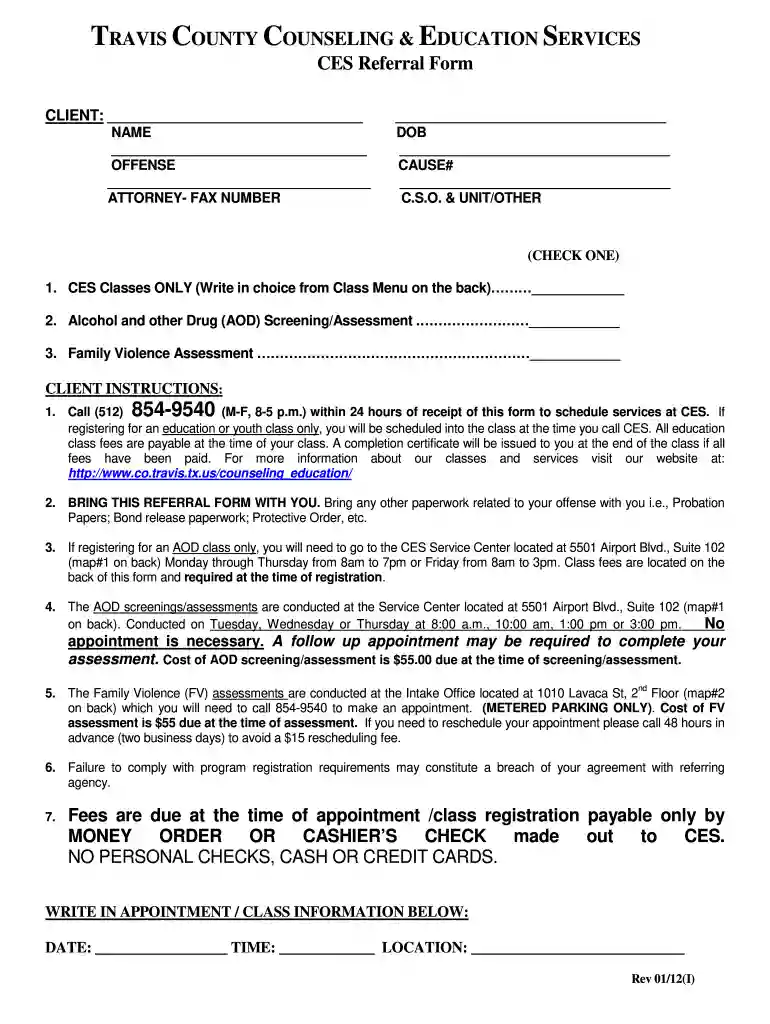
The "Referral Form - Travis County - co travis tx" is a crucial document designed to streamline the process of referring individuals to various classes and assessments offered by Travis County Counseling & Education Services (CES). These services commonly deal with offenses related to alcohol, drug use, and family violence. The form aids in scheduling and managing such classes, ensuring that clients receive the necessary interventions and educational support. It details important elements such as class locations, required documentation, and payment procedures, making it an invaluable tool for streamlining client management and enhancing service delivery in Travis County.
To effectively utilize the Referral Form in Travis County, individuals need to follow specific steps to ensure its proper completion and submission. First, gather all required documentation as outlined by the Counseling & Education Services, such as personal identification and any court orders related to the offense. This preparation ensures accuracy and completeness. Then, carefully fill out the form, paying close attention to each section, including personal details, the type of offense, and the desired class or assessment. Submit the form following the guidelines provided – typically via mail or in-person at the specified CES location – to secure participation in the relevant classes and assessments.
Completing the Referral Form involves several key steps to ensure accuracy and compliance with Travis County requirements:
Gather Required Information: Collect personal identification documents, court orders, and any additional paperwork specified by the CES.
Fill Out Personal Details: Provide full name, contact information, and details of the referring authority (e.g., court or probation officer).
Specify the Offense and Required Services: Clearly state the type of offense and choose the appropriate classes or assessments recommended by the CES.
Documentation Submission: Attach photocopies of required documents alongside the referral form, ensuring all information aligns.
Sign and Date the Form: Include the client's and referring authority's signatures to validate the referral.
Submit the Form: Deliver the completed form to the designated CES office either through mail or in-person submission as directed.
The Referral Form is primarily used by individuals who have been mandated by a court, probation officer, or other legal authorities to attend educational or counseling sessions following incidents involving substance abuse or domestic issues. It is also a critical tool for legal professionals, case workers, and social workers within the Travis County system who facilitate the rehabilitation and re-education of offenders by connecting them with necessary resources and support systems offered through the CES. Additionally, family members or advocates may assist in the process to ensure compliance and successful participation in mandated programs.


The Referral Form encompasses several critical components that ensure comprehensive data collection and facilitate the smooth processing of referrals:
Each element is carefully structured to gather relevant information while maintaining the confidentiality and security of the client's personal data.
The Referral Form is legally endorsed by the Travis County judicial system and is designed to comply with local, state, and federal regulations concerning client privacy and data protection. The form ensures that all participants fulfill judicial requirements for educational interventions, supporting both individual rehabilitation and broader public safety objectives. Compliance with this process is not only a legal obligation but also significantly contributes to the individual's successful reintegration and adherence to court-mandated educational programs.
Practical use of the Referral Form can be illustrated through several scenarios. For instance, consider a first-time DUI offender required to attend a state-certified alcohol education program. The offender uses the form to register for the appropriate class, providing all necessary documentation as instructed. Another example involves a domestic violence case where the court orders the individual to participate in anger management counseling. The completed referral form ensures the client enrolls in the correct session, facilitating timely intervention and compliance with legal mandates. These real-world examples underscore the form's pivotal role in connecting clients to required services efficiently.
Understanding specific terms associated with the Referral Form enhances comprehension and accurate completion:
Familiarizing oneself with these terms is essential for successful interaction with the referral process and ensures proper adherence to legal and procedural requirements.
We've got more versions of the Referral Form - Travis County - co travis tx form. Select the right Referral Form - Travis County - co travis tx version from the list and start editing it straight away!
At DocHub, your data security is our priority. We follow HIPAA, SOC2, GDPR, and other standards, so you can work on your documents with confidence.
Check out the revised electronic CES Referral Form (en espaol) located on the CES website. You have two options to complete the form.
Referral Sources a) Travis County Officials: 1. Court Administration: Makes direct appointments of mental health coded defendants in jail through Attorney


