




01. Edit your rt3193 online
Type text, add images, blackout confidential details, add comments, highlights and more.

Type text, add images, blackout confidential details, add comments, highlights and more.

Draw your signature, type it, upload its image, or use your mobile device as a signature pad.

Send driver s single line working ticket rt3193 via email, link, or fax. You can also download it, export it or print it out.
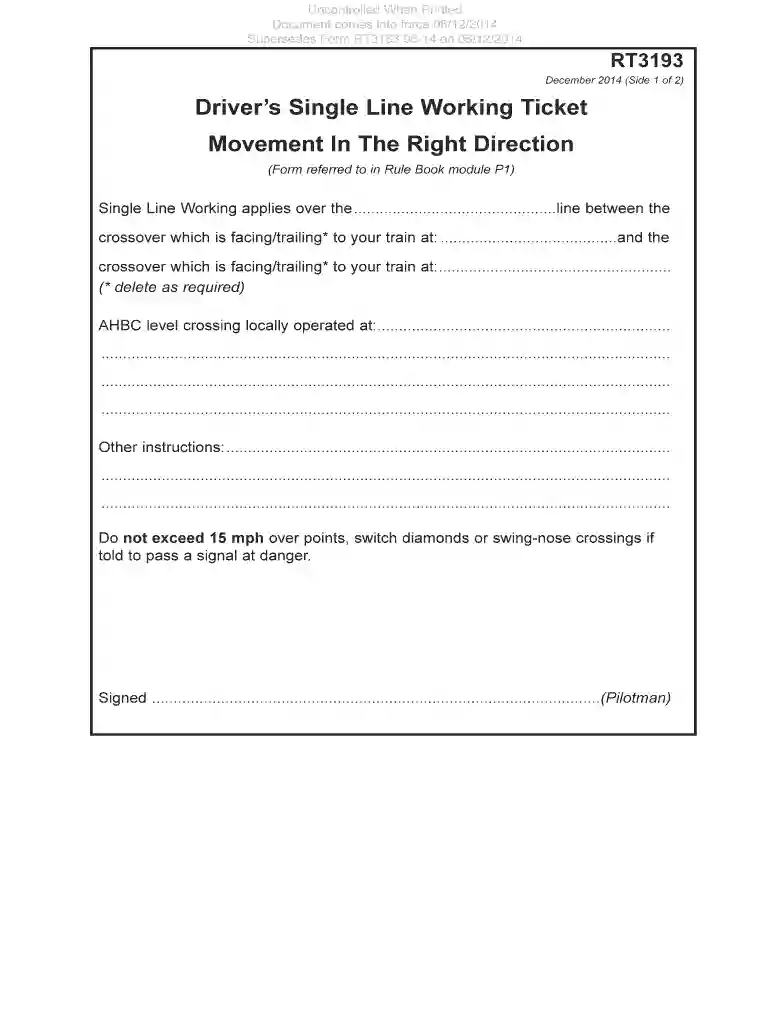
RT3193 refers to a specific form used for Driver's Single Line Working Tickets. It is primarily concerned with outlining the protocols and instructions for movements on a single line, both in right and wrong directions. The form is crucial for maintaining safety standards and ensuring compliance with operational guidelines related to railway operations. Enshrined in it are the specifics of speed limits, details about level crossings, and the requirements for pilotman signatures.
The form is legally binding and serves as an indispensable tool for operational transparency in railway management. Compliance with this form is obligatory to ensure that safety practices are upheld at every level of the single line operations. Non-compliance may result in legal consequences and jeopardize operational safety.
RT3193 is typically issued by the relevant transportation authority or railway management body. It can often be accessed through internal communication channels or directly from regulatory offices. Ensuring timely acquisition of the form is vital for continuous operations on single lines.
While the RT3193 covers general guidelines, certain states may impose additional requirements or modifications to cater to local operational necessities and legal stipulations. It is paramount for users to be aware of any such state-specific differences and to adhere accordingly to ensure compliance.
This form is commonly employed by railway operators, engineers, conductors, and other personnel involved in the operation and management of railway transport on single lines. It is also utilized in training setups for new recruits and ensures standardized operation procedures are followed.


RT3193 is available in both digital and paper formats. The digital version simplifies data storage and retrieval, allowing for instant access and updates, while the paper version serves as a tangible record for audits and physical reference in on-site situations.
Leveraging digital forms allows for integration with software solutions like TurboTax or QuickBooks for seamless management and archiving of compliance documents. Such compatibility is beneficial in scenarios requiring quick referencing during audits or reporting.
Through comprehensive understanding and implementation of RT3193, entities involved in railway operations ensure safety, compliance, and efficient management of single-line operations.
We've got more versions of the rt3193 form. Select the right rt3193 version from the list and start editing it straight away!
At DocHub, your data security is our priority. We follow HIPAA, SOC2, GDPR, and other standards, so you can work on your documents with confidence.
Dec 2, 2022 This page reports the specimens in the MUSSELpdb and provides a map if geocodes are known. The taxonomic history reports the record of different names and
XAVIER BECERRA. Attorney General of California. LANCE E. WINTERS. Chief Assistant Attorney General. JAMES WILLIAM BILDERBACK II.


