




01. Edit your di 7600 online
Type text, add images, blackout confidential details, add comments, highlights and more.

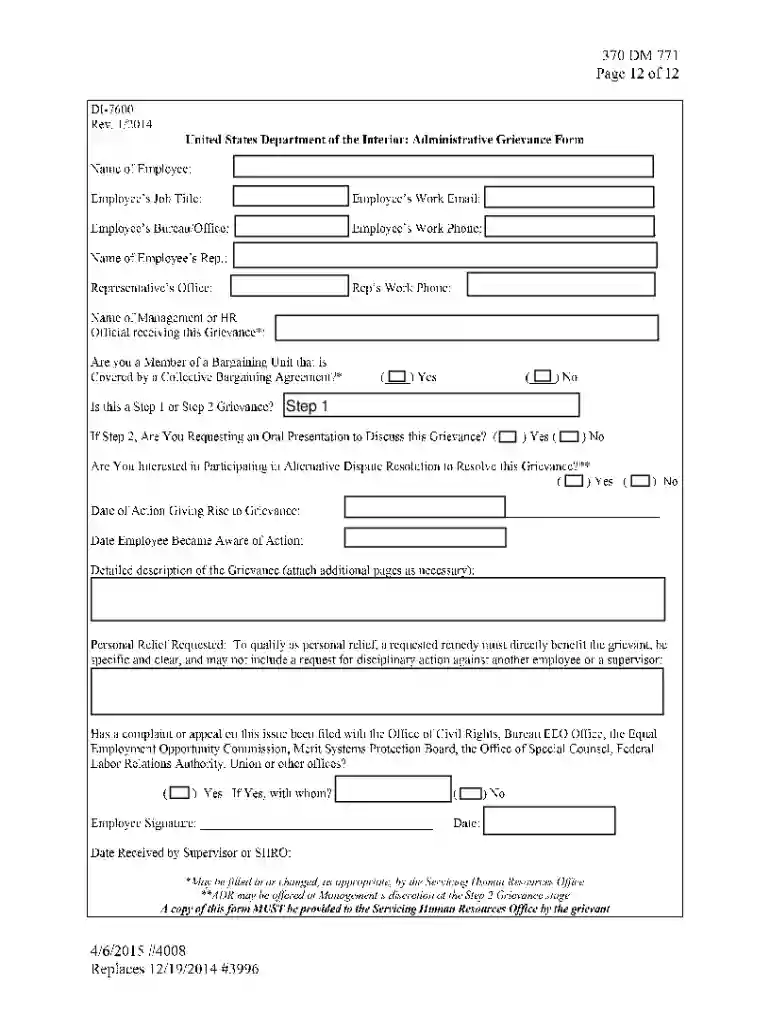
Type text, add images, blackout confidential details, add comments, highlights and more.

Draw your signature, type it, upload its image, or use your mobile device as a signature pad.

Send di 7600 form via email, link, or fax. You can also download it, export it or print it out.
The "form DI 7600 form" is a specialized administrative grievance form developed by the United States Department of the Interior. It serves the critical function of formally addressing workplace issues, enabling employees to document and submit grievances related to their employment conditions.
Understanding this form's purpose is crucial for employees seeking to address workplace concerns through official channels.
Completing the form DI 7600 form involves a detailed, step-by-step process to ensure all necessary information is captured accurately.
Personal Information: Start by filling out your personal information, including your name, position, and department. This ensures that the grievance is correctly attributed to you as an employee of the Department of the Interior.
Grievance Details: Accurately describe the issue you are facing. Provide clear and concise details, including dates, locations, and any individuals involved. This section is pivotal, as it forms the basis of the grievance investigation.
Previous Complaints: Indicate any prior grievances you have filed related to the same issue. This information helps in understanding the context and repeated nature of the complaint.
Resolution Options: Select or suggest preferred methods for resolving the grievance. This might include mediation or direct resolution with involved parties.
Signatures: Ensure both you and the receiving official sign the form to validate the submission. This step is essential for the legal acknowledgment of the grievance.
This form is predominantly used within a specific professional environment—namely, employees of the United States Department of the Interior.


The form DI 7600 form has several legal implications and uses, particularly in formal grievance procedures.
Understanding each component of the form is necessary to ensure it is filled out accurately and completely.
Each section is integral to the form's function, reinforcing a standardized approach to handling employee grievances.
Submission of the form DI 7600 form may necessitate additional documentation to support the grievance.
These documents contribute clarity and credibility to the grievance process.
The form DI 7600 form supports multiple submission methods to accommodate different preferences and needs.
The method of submission can vary based on departmental practices and employee convenience.
Failing to comply with proper grievance procedures tied to the form DI 7600 form might result in significant repercussions.
Understanding these penalties underscores the importance of adhering to the submission and procedural guidelines associated with the form DI 7600 form.
We've got more versions of the di 7600 form. Select the right di 7600 version from the list and start editing it straight away!
At DocHub, your data security is our priority. We follow HIPAA, SOC2, GDPR, and other standards, so you can work on your documents with confidence.
Sep 5, 2007 Administrative Grievance Form (AGF). Form DI 7600 must be used when the grievant files a formal grievance. The AGF may also be used for
Mar 2, 2022 Object form shall mean any form resulting from mechanical transformation or translation of a Source form, including but not limited to
Thumbnails Document Outline Attachments Layers. Current Outline Item. Previous. Next. Highlight All Match Case. Match Diacritics Whole Words.


