




01. Edit your ohio uniform incident report 2011 2019 online
Type text, add images, blackout confidential details, add comments, highlights and more.

Type text, add images, blackout confidential details, add comments, highlights and more.

Draw your signature, type it, upload its image, or use your mobile device as a signature pad.

Send ohio uniform incident report via email, link, or fax. You can also download it, export it or print it out.
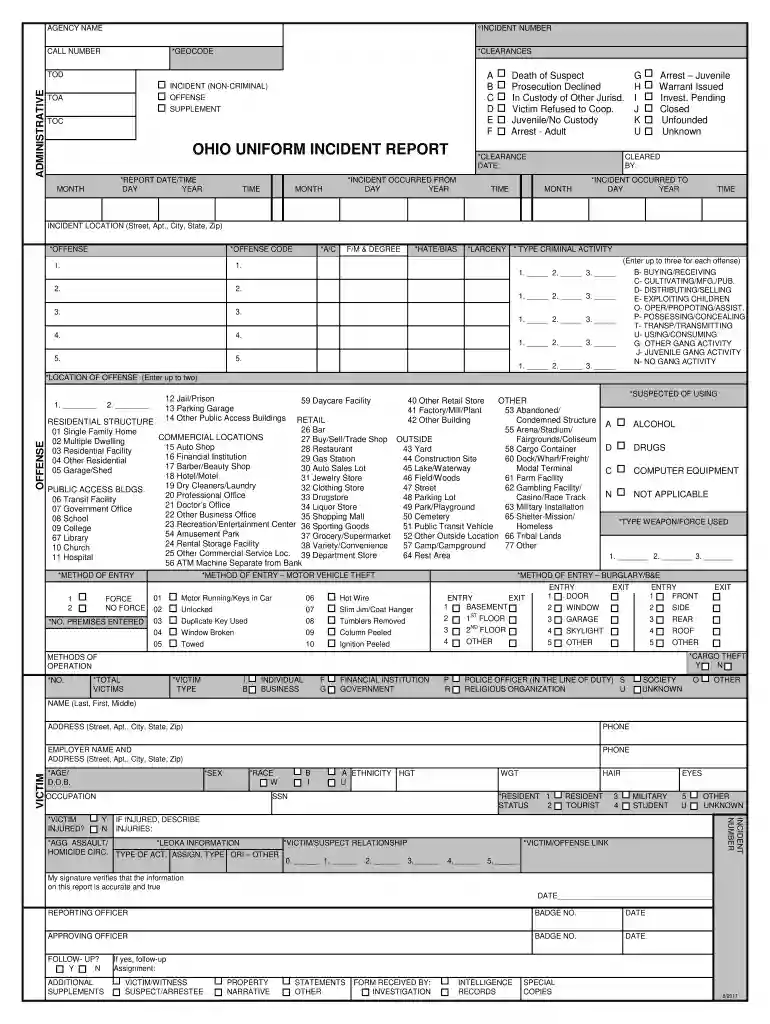
The Ohio Uniform Report is a standardized form used primarily by law enforcement agencies across Ohio to document various incidents, including non-criminal offenses. This form ensures consistency in reporting, which facilitates efficient administrative processing and effective investigations. It includes detailed sections such as incident numbers, clearance statuses, offense codes, and victim details. The uniformity provided by this report is crucial for data accuracy and can significantly impact the resolution of cases by providing clear and organized information to support investigations.
Completing the Ohio Uniform Report requires attention to detail and an understanding of its structure. Here is a step-by-step guide:
Gather Preliminary Information: Before completing the report, collect all necessary details regarding the incident—this includes information about the location, time, and date of occurrence, as well as the parties involved.
Fill in Incident Details: Start with the incident number, which serves as a unique identifier. Include the clearance status and relevant offense codes to classify the nature of the incident.
Document Parties Involved: Record information about suspects, victims, and witnesses, ensuring accurate demographic and contact details are included. This will assist in subsequent investigations and follow-ups.
Describe the Incident: Provide a narrative of the events leading to and during the incident. Be thorough and unbiased in your account to maintain the form's integrity.
Finalize the Report: Review all sections to ensure completeness and accuracy. Submit the report through designated channels once verified.
Accessing the Ohio Uniform Report can be done through several avenues depending on your needs:
Law Enforcement Agencies: Typically, these reports are issued and available through local police departments. Contact the specific department involved in handling the incident for copies.
Online Platforms: Some agencies may provide downloadable versions of the report from their websites, allowing easier access for both officers and the public.
Document Management Solutions: Software like DocHub can be used to manage digital versions of the form, providing tools for editing, sharing, and secure storage.
Several critical components define the Ohio Uniform Report and aid in achieving its purpose:
The Ohio Uniform Report's legal standing is significant in various judicial and administrative proceedings:
Primarily, this report is used by:


Understanding certain terms is essential when dealing with the Ohio Uniform Report:
Various scenarios highlight the report's applicability:
These comprehensive insights clarify the Ohio Uniform Report's significance and practical uses, ensuring efficient incident documentation and subsequent investigations.
We've got more versions of the ohio uniform incident report 2011 2019 form. Select the right ohio uniform incident report 2011 2019 version from the list and start editing it straight away!
At DocHub, your data security is our priority. We follow HIPAA, SOC2, GDPR, and other standards, so you can work on your documents with confidence.
If a contribution is made from an inter vivos or testamentary trust or a decedents estate, the treasurer shall report the amount to be attributed to each
by SE Ragone 1988 Cited by 2 This report pro- vides a brief description of the major components of the program and includes selected abstracts of presentations made that meeting. The Cape


