



01. Edit your form online
Type text, add images, blackout confidential details, add comments, highlights and more.

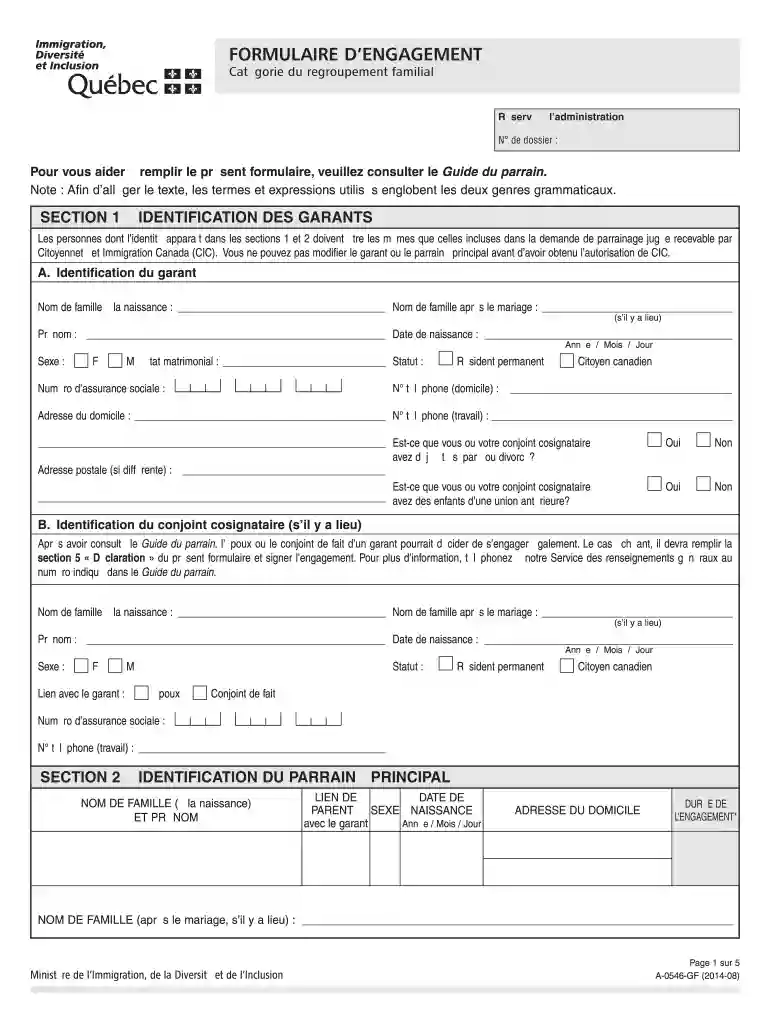
Type text, add images, blackout confidential details, add comments, highlights and more.

Draw your signature, type it, upload its image, or use your mobile device as a signature pad.

Send it via email, link, or fax. You can also download it, export it or print it out.
The "SECTION 1 IDENTIFICATION DES GARANTS" form is a critical component in the process of family sponsorship within Quebec's immigration framework. This document serves as a legal declaration, identifying and detailing the sponsors, known as "garants," responsible for financially supporting incoming family members. By completing this form, sponsors affirm their commitment to meeting both financial and moral obligations for those they choose to support, ensuring a successful transition into Canadian society.
This section breaks down the practical steps and guidelines for using the form effectively in the sponsorship process.
Obtaining the necessary form is the foundational step towards starting the immigration sponsorship process.
Filling out this form requires attention to legal and administrative details to ensure a valid application.
Understanding the core components of this form is essential for a complete application.
The legal dimension of this form is significant, influencing the sponsorship's validity and the sponsors' obligations.
Understanding specific terminology ensures clarity and compliance throughout the sponsorship process.
Real-world scenarios provide context for how this form integrates into the sponsorship process.
Identifying the typical users of this form helps tailor the completion process to different sponsor profiles.

We've got more versions of the SECTION 1 IDENTIFICATION DES GARANTS - immigration-quebec gouv qc form. Select the right SECTION 1 IDENTIFICATION DES GARANTS - immigration-quebec gouv qc version from the list and start editing it straight away!
At DocHub, your data security is our priority. We follow HIPAA, SOC2, GDPR, and other standards, so you can work on your documents with confidence.
Bas sur 26 entretiens qualitatifs, cet article analyse les parcours et les expriences de travailleurs temporaires qualifis au Qubec la lumire de la
Mar 9, 2016 This report describes the law and policy on refugees and other asylum seekers in twenty-two geographically dispersed countries and,


