




01. Edit your form online
Type text, add images, blackout confidential details, add comments, highlights and more.

Type text, add images, blackout confidential details, add comments, highlights and more.

Draw your signature, type it, upload its image, or use your mobile device as a signature pad.

Send it via email, link, or fax. You can also download it, export it or print it out.
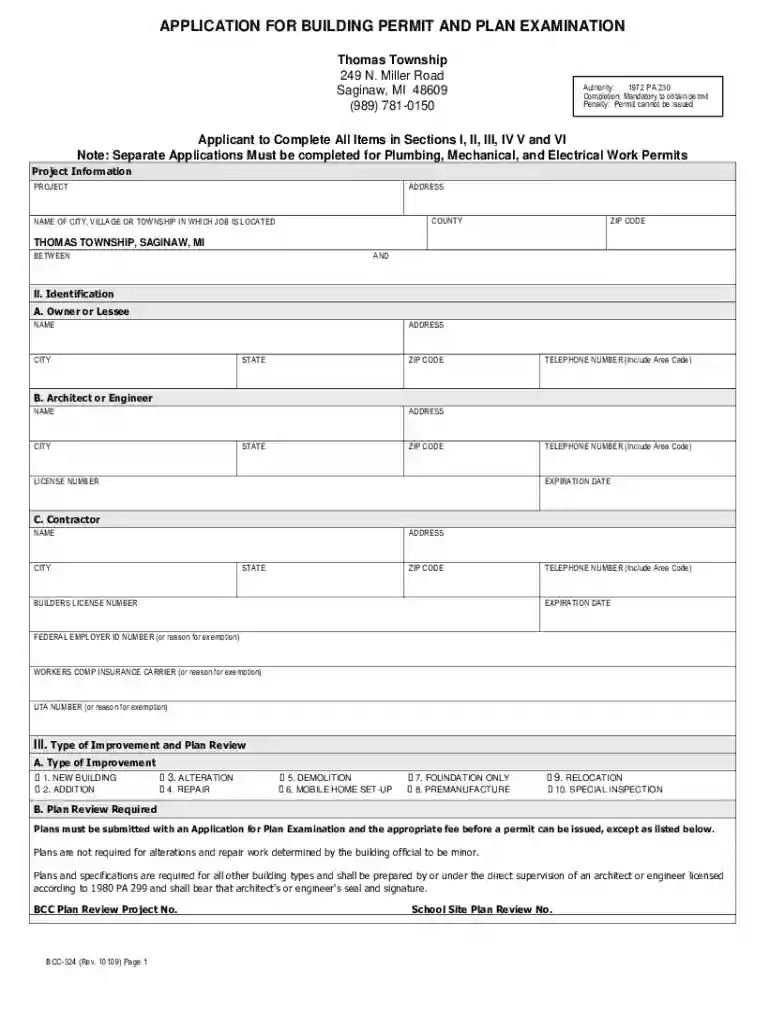
The Thomas Township Storm Water Plan Review Processing Form, formally titled "thomastwp wp-contentuploadsTHOMAS TOWNSHIP STORM WATER PLAN REVIEW PROCESSING FORM 249 N," is an essential document used by those planning to undertake projects in Thomas Township, Saginaw, MI, that may impact local stormwater systems. This form is designed to gather critical information about proposed construction or development projects, ensuring they comply with stormwater management regulations. The form plays a pivotal role in safeguarding the township's infrastructure and environment from potential adverse effects due to changes in stormwater runoff patterns.
Key components of the form include sections for project descriptions, identification of responsible parties such as property owners, architects, engineers, and contractors, and detailed plans for handling stormwater on the project site. Proper completion and submission of this form are critical for gaining necessary approvals before construction begins.
Gather Project Details: Begin by collecting all relevant information about the planned project, including location, scale, and purpose.
Identify Parties Involved: Clearly list all entities involved in the project, including the owner, architect, and contractors. Providing accurate contact information for each entity is essential.
Detail Storm Water Management Plans: Include comprehensive plans on how the project will address stormwater runoff, manage water quality, and prevent pollution. This section should cover any proposed infrastructure changes, such as alteration in drainage, installation of retention ponds, or sewer modifications.
Complete Sections on Environmental Impact: Outline the project’s anticipated impact on local ecosystems and how you plan to mitigate any negative effects. Incorporate data or studies that support your approach.
Review Compliance with Local and State Regulations: Ensure that your project aligns with all necessary regulations and obtain any additional permits required for compliance.
Submit the Form: Once the form is fully completed and reviewed for accuracy, submit it to the appropriate township office for processing.
Project Identification: Includes the project's name, location, and a concise description of its goals and purpose.
Contact Information: Specific sections dedicated to the identification and roles of the project owner, lead architect, and contractors.
Environmental Considerations: Requires information on potential environmental impacts and proposed mitigation strategies.
Stormwater Management Plans: Detailed outlines of stormwater handling methodologies, including calculations and proposed systems or infrastructure changes.
Compliance Statements: Confirmation that the project meets local and state regulatory requirements, supported by environmental reports if necessary.
This form ensures legal compliance with state and local stormwater management laws. It serves as a formal declaration by the project initiators that they will adhere to the standards set forth by Thomas Township and the State of Michigan. Failure to complete and submit a fully compliant form before the commencement of construction activities may lead to penalties, project delays, or legal action.
Using this form streamlines the review process and provides a structured approach to assessing the potential impact of development on local stormwater systems. It protects public infrastructure and waterways by ensuring that all planned construction activities are evaluated for their ecological footprint and alignment with current environmental standards. The form is also a critical tool for minimizing legal risks associated with non-compliance.
This form is primarily used by:
Developers and Builders: Need to ensure compliant infrastructure alterations, especially regarding drainage and runoff.
Architects and Engineers: Utilize the form to integrate stormwater management strategies into design and planning phases.
Local Government Agencies: Review the form to assess environmental compliance and approve projects based on municipal regulations.


The form can be obtained through the Thomas Township's official government website or by visiting the local municipal offices. It is important to use the latest version of the form to ensure all necessary details are captured accurately, considering any recent updates to regulatory requirements.
Consider a developer planning a new residential subdivision. Using the form, the developer outlines the creation of detention basins to manage increased stormwater runoff, lists involved construction companies, and submits the form along with site plans and hydrological studies. Through a detailed review process involving the township's planning department, the project is assessed for compliance and ultimately approved, illustrating the effective use of the form in a real-world scenario.
By following the outlined steps and utilizing the form effectively, stakeholders can facilitate project approvals while upholding environmental integrity and regulatory compliance.
We've got more versions of the thomastwp wp-contentuploadsTHOMAS TOWNSHIP STORM WATER PLAN REVIEW PROCESSING FORM 249 N form. Select the right thomastwp wp-contentuploadsTHOMAS TOWNSHIP STORM WATER PLAN REVIEW PROCESSING FORM 249 N version from the list and start editing it straight away!
At DocHub, your data security is our priority. We follow HIPAA, SOC2, GDPR, and other standards, so you can work on your documents with confidence.


