




01. Edit your form online
Type text, add images, blackout confidential details, add comments, highlights and more.

Type text, add images, blackout confidential details, add comments, highlights and more.

Draw your signature, type it, upload its image, or use your mobile device as a signature pad.

Send it via email, link, or fax. You can also download it, export it or print it out.
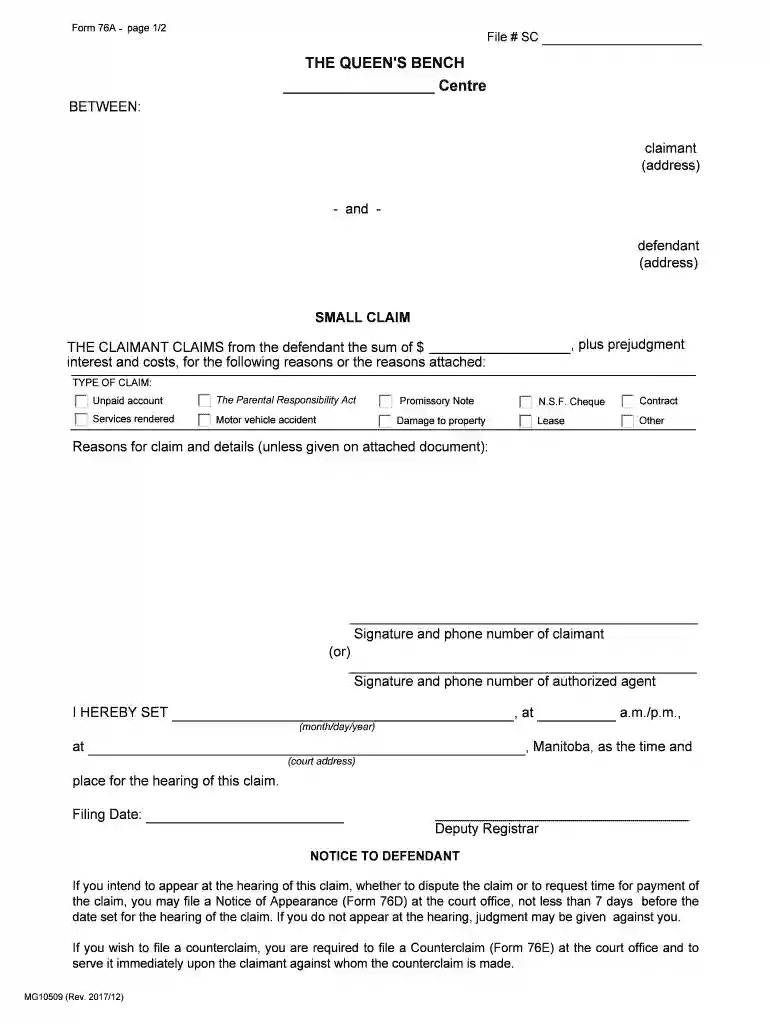
Form 76A is a legal document commonly used in the Small Claims Court of Manitoba to file a small claim against a defendant. The form is essential for individuals or entities seeking to initiate a court process to settle financial disputes or claims under a certain monetary limit. It includes sections where the claimant must specify their claim, provide reasons for the action, and outline details of the hearing. Through this form, both claimants and defendants are informed of their respective rights and responsibilities.
Utilizing Form 76A involves a structured process that guides the claimant through properly filing a small claim. Each section of the form is designed to capture specific information, ensuring clarity and completeness in the filing. Key steps include identifying the parties involved, detailing the claim's nature, and providing any supporting evidence. Proper use of the form ensures that legal procedures are initiated smoothly, facilitating easier case management in court settings.
Form 76A can be acquired through multiple channels to ensure accessibility for all claimants. It is available for download from the Manitoba Small Claims Court's official website, providing instant access for those who prefer digital copies. Alternatively, physical copies can be obtained directly from court offices or legal aid centers. Each method ensures that claimants can choose a format that best suits their needs for preparing their claim.
The core elements of Form 76A include sections for the claimant's and defendant's details, claim description, evidence attachment, and hearing particulars. Each component is tailored to prompt comprehensive input, streamlining the judicial process. These elements play a crucial role in effectively communicating the particulars of the claim to all parties involved, thereby supporting informed legal proceedings.
Form 76A is predominantly used by individuals or businesses aiming to resolve minor financial disputes legally. Common scenarios involve small business owner claims against customers, tenant-landlord disputes, and personal loan recovery actions. It is particularly beneficial for those seeking a structured and legal channel to address claims without resorting to extensive litigation or higher courts.
Form 76A is legally recognized for initiating small claims under the Manitoba judicial structure. It aligns with provincial regulations, ensuring that claims filed are compliant with legal standards. The form effectively establishes the groundwork for subsequent hearings where parties present their cases before a judge, ultimately expediting dispute resolution within the legal framework of small claims courts.
Manitoba legislation dictates specific rules governing the use of Form 76A. These include designated monetary limits for small claims, filing fees, and procedural guidelines on submitting evidence and attending hearings. Claimants must adhere to these state-specific protocols to maintain the validity of their claims and achieve desired legal outcomes.
These examples illustrate the form's applicability across various minor legal disputes.
We've got more versions of the Form 76A - page 1 2 form. Select the right Form 76A - page 1 2 version from the list and start editing it straight away!
At DocHub, your data security is our priority. We follow HIPAA, SOC2, GDPR, and other standards, so you can work on your documents with confidence.
Standard Form 76A, Registration and Absentee Ballot Request. I REQUEST ABSENTEE BALLOTS FOR ALL ELECTIONS IN WHICH I AM ELIGIBLE TO VOTE AND I AM
1. Standard for Sealing Court Records. Court records may not be removed from court files except as permitted by statute or rule. 2. Court Records. For purposesRead more


