




01. Edit your criminal record supplemental questionnaire online
Type text, add images, blackout confidential details, add comments, highlights and more.

Type text, add images, blackout confidential details, add comments, highlights and more.

Draw your signature, type it, upload its image, or use your mobile device as a signature pad.

Send it via email, link, or fax. You can also download it, export it or print it out.
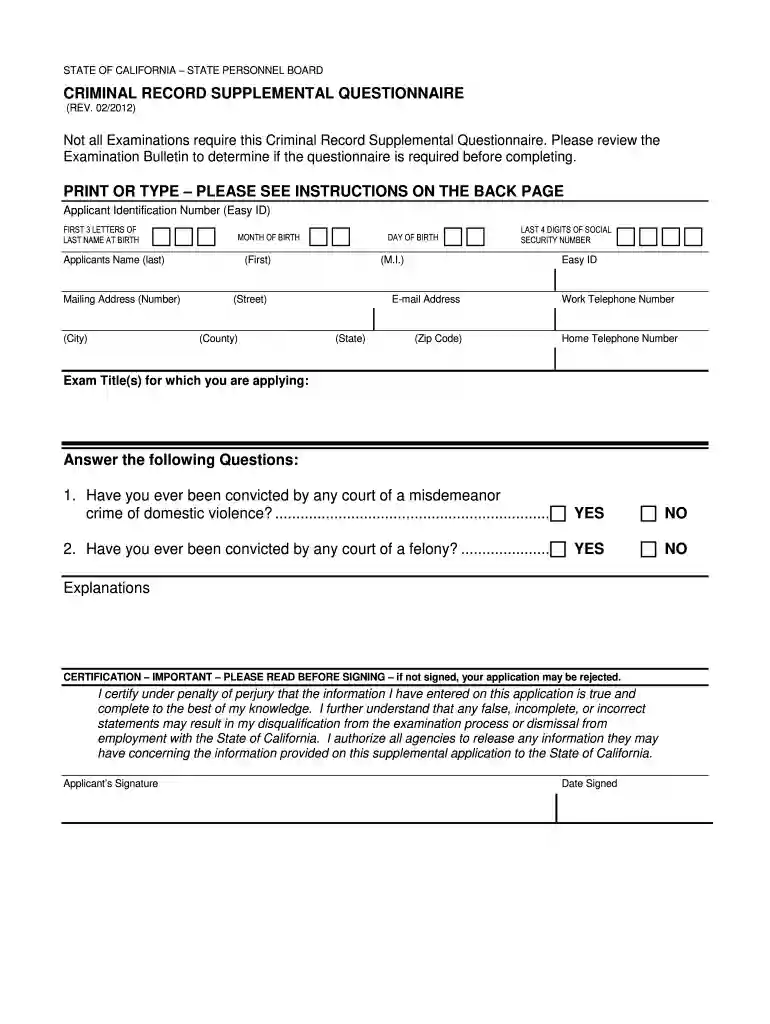
The Criminal Record Supplemental Questionnaire is a vital component for job applicants in California, particularly for positions linked to the State Personnel Board. This document serves the explicit purpose of gathering detailed information about any past misdemeanors or felonies an applicant may have. Such disclosures are crucial as part of the examination application process to ensure transparency and maintain the integrity of the hiring process. The questionnaire aims to establish a complete legal background of the applicant, which employers weigh when determining the candidate’s eligibility for certain roles. Ultimately, this form protects both the employer and the candidate by clearly outlining the information required and how it will be used.
Applicants can obtain the Criminal Record Supplemental Questionnaire directly from the State Personnel Board’s official website. It is often provided as a downloadable form, ensuring ease of access for applicants. In some cases, it may also be included as part of a larger employment application packet, either in a digital or physical format when applying for state positions. Ensuring that you have the most current version of the form is critical, as outdated forms might not reflect the latest compliance requirements or may omit newly required information.
When completing the Criminal Record Supplemental Questionnaire, thoroughness and accuracy are essential. Here is a step-by-step guide to ensure that the form is filled out correctly:
Read All Instructions Carefully: Begin by reviewing any instructions provided to understand what is required and how to accurately present the information.
Personal Information: Enter your full name, contact details, and any identification numbers requested to ensure the form is correctly linked to your application.
Disclosure of Criminal Records: Clearly list any misdemeanor or felony convictions. This includes specifying the nature of the offense, the date of conviction, and the jurisdiction in which the conviction occurred.
Provide Additional Details: If the form requests, provide detailed explanations regarding the circumstances surrounding each conviction, including the outcomes or any rehabilitation efforts.
Certification: Carefully read the certification statement prior to signing. It affirms truthfulness in the information provided—a crucial component to avoid future legal repercussions.
Review and Submit: Double-check all entries for accuracy and completeness before submitting the form. Ensure you follow any submission guidelines specific to your application, such as fax, mail, or in-person delivery.
By following these steps, applicants can make sure they meet all requirements and increase their chances of a successful application.
The questionnaire comprises several critical sections that applicants must address carefully to ensure compliance and accuracy:
Applicant Identification:
Legal Self-Disclosure:
Certification and Signature:
Each of these sections plays a crucial part in providing a clear and thorough representation of the applicant's past legal interactions, which is necessary for positions involving trust or security-sensitive responsibilities.
The legal significance of the Criminal Record Supplemental Questionnaire extends beyond merely being a part of the job application process. The information gathered is used to evaluate an applicant’s suitability for certain roles, especially those requiring a high level of moral or ethical adherence. Adherence to privacy laws and confidentiality agreements is ensured through clear declarations on the form, indicating how the information will be used and stored. This emphasis on legality and confidentiality protects the applicant’s rights while ensuring that employers can make informed hiring decisions.
Primarily, individuals applying for positions within California’s state departments are required to use the Criminal Record Supplemental Questionnaire. This includes roles that may involve public trust or access to confidential information, where a criminal background could affect one's ability to perform job duties. Additionally, the form may be requisite for applicants seeking licensure in fields heavily regulated by the state. Ultimately, the form serves as a tool to balance the opportunity given to applicants with a fair assessment of their past conduct.


Given that this questionnaire is specific to California, several state-specific rules apply. These regulations dictate how the information is collected, stored, and used. For instance, California’s “Ban the Box” law affects when employers can inquire about convictions, ensuring the primary focus remains on an applicant’s qualifications rather than their criminal history. As such, applicants should be aware of what information they are obligated to disclose and the circumstances under which this information may impact their employment eligibility. These state-specific nuances are integral in maintaining compliance and fairness within the application process.
Using the Criminal Record Supplemental Questionnaire serves multiple purposes. For applicants, it provides a structured and comprehensive format to disclose their criminal history, thereby exercising transparency and honesty. For employers, the form acts as a safeguard, aiding in risk management by providing necessary background details before employment is finalized. This mutual benefit underscores the rationale behind the form's usage, emphasizing its role in fostering trust and reliability within the employment landscape.
In today's digital age, many state departments offer both paper and digital versions of the Criminal Record Supplemental Questionnaire. The digital version provides the benefit of ease in editing and submission, often integrating into a broader online application system. Meanwhile, paper versions may still be acceptable for those who prefer or require a physical submission method. When choosing between these formats, applicants should consider their own comfort level and the department's submission guidelines to decide the most appropriate version.
We've got more versions of the criminal record supplemental questionnaire form. Select the right criminal record supplemental questionnaire version from the list and start editing it straight away!
At DocHub, your data security is our priority. We follow HIPAA, SOC2, GDPR, and other standards, so you can work on your documents with confidence.


