




01. Edit your form online
Type text, add images, blackout confidential details, add comments, highlights and more.

Type text, add images, blackout confidential details, add comments, highlights and more.

Draw your signature, type it, upload its image, or use your mobile device as a signature pad.

Send it via email, link, or fax. You can also download it, export it or print it out.
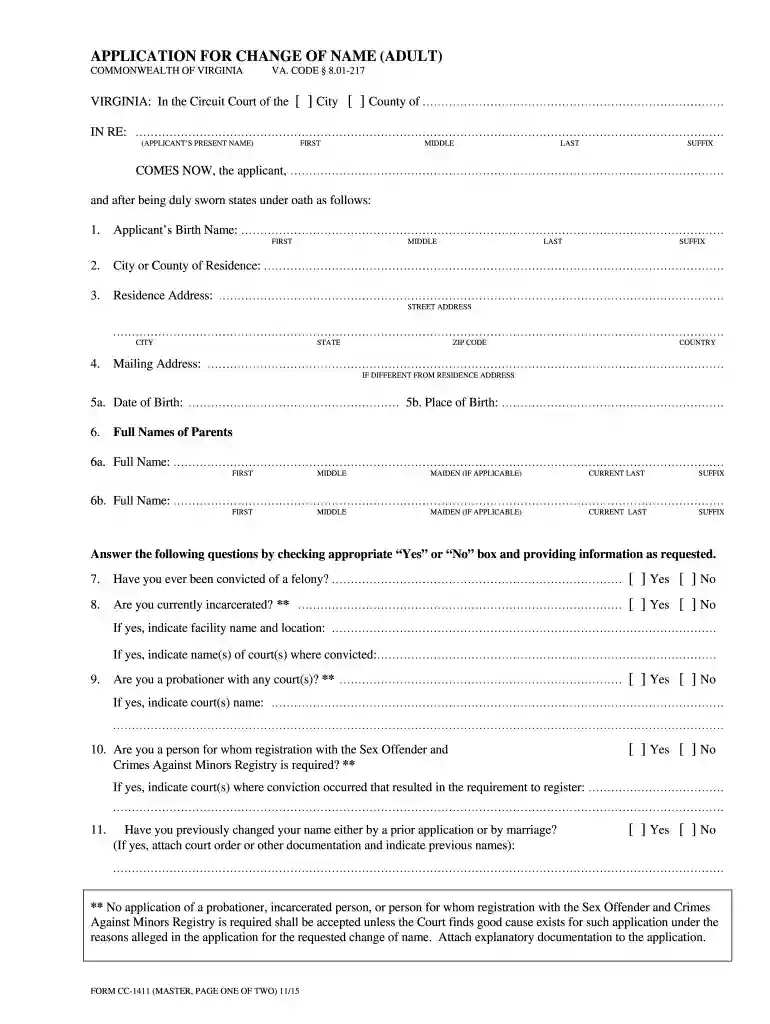
An "Application for Change of Name (Adult)" is a legal document used by individuals in the United States who wish to legally change their name through the court system. This form is significant for those needing to update their legal identity due to marriage, divorce, personal preference, or other personal reasons. The application is comprehensive, capturing necessary personal and historical information about the applicant to facilitate the legal name change process.
Using the Application for Change of Name (Adult) involves several important steps. First, the applicant must fill out the form with accurate personal information, including name, address, and reasons for the name change. Some sections may require documentation to support the name change request, such as marriage or divorce certificates. After completing the form, the applicant typically submits it to the local court for approval. The process may require attending a court hearing where a judge will review the application and any supporting documents before granting the name change.
Obtaining the Application for Change of Name (Adult) can generally be done through the local court's website or office. Many states provide downloadable versions of the form online, which can be printed and filled out. Alternatively, individuals can visit the courthouse in person to request a physical copy. It is essential to check for state-specific variations of the form, as requirements can differ across jurisdictions.
Personal Information: Fill out basic personal details, including current name, new desired name, and contact information.
Reason for Name Change: Provide a comprehensive explanation of why you are seeking a name change. This might include personal reasons or life events such as marriage.
Supporting Documentation: Attach any required documents, such as birth certificates, marriage licenses, or divorce decrees, which support your name change request.
Affirmation of Purpose: Sign a statement affirming that the name change is not for fraudulent purposes or to evade legal obligations.
Submission: Submit the completed application to the appropriate court, paying any applicable filing fees.
Court Hearing: Attend the scheduled hearing, if required, to finalize the name change process.
Applying for a change of name is often necessary to align your legal identity with your current personal or professional identity. Common reasons include marriage, divorce, personal preference, or transition-related changes. It ensures that all identifying documents, like passports, driver's licenses, and social security records, reflect your new identity, facilitating smoother interactions with government services, financial institutions, and employers.
Each state in the U.S. has its own rules and procedures for legal name changes. For example, Virginia requires applicants to affirm that the name change isn’t for fraudulent purposes. Some states may not require a court appearance, while others do. Be sure to review local state regulations and requirements, as failing to comply can lead to delays or denial of the application.
The application typically includes sections that capture:
When applying for a name change, applicants must provide several essential documents, including:
Applications for a legal name change can be submitted in various ways:
Each method may have specific requirements or additional fees, so it's crucial to verify the details with the local court.
We've got more versions of the APPLICATION FOR CHANGE OF NAME (ADULT) form. Select the right APPLICATION FOR CHANGE OF NAME (ADULT) version from the list and start editing it straight away!
At DocHub, your data security is our priority. We follow HIPAA, SOC2, GDPR, and other standards, so you can work on your documents with confidence.
Petition for Change of Name (Adult) Family Law Forms / Domestic Relations Court Resources / Family 850) 922-5081
Apr 1, 2025 The first step to changing your legal name is acquiring a court order authorizing the change. First an applicant must have a Notice of Intent


