







Definition & Meaning
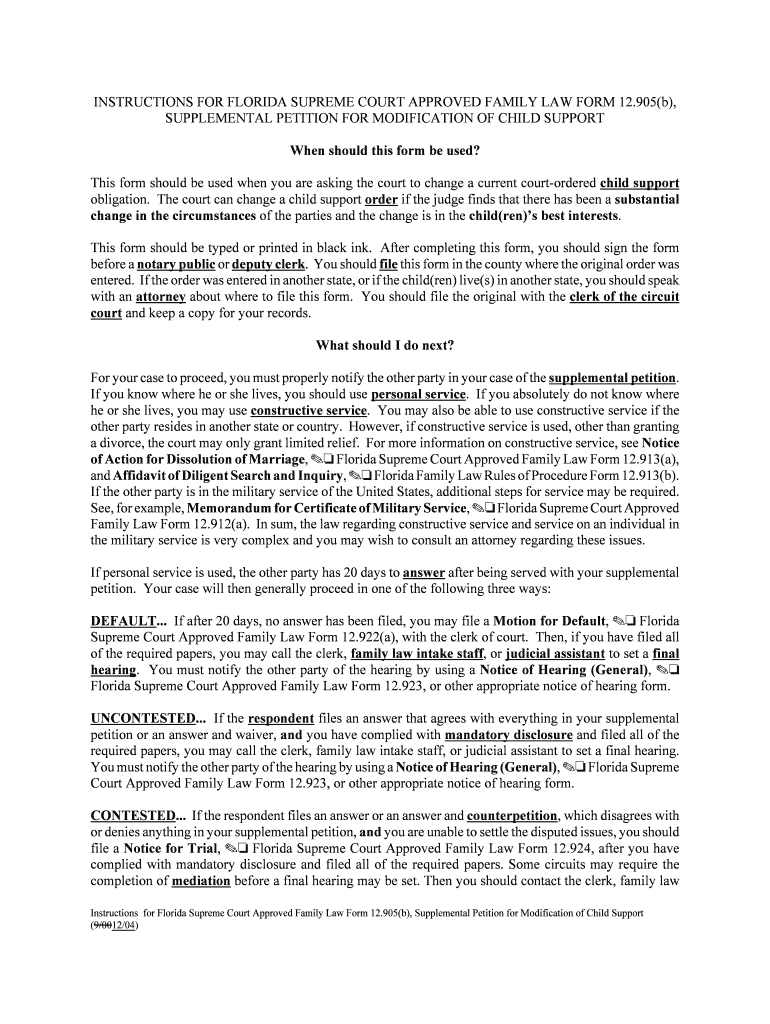
The "INSTRUCTIONS FOR FLORIDA SUPREME COURT APPROVED FAMILY LAW FORM 12" provide detailed guidance on using specific family law forms authorized by the Florida Supreme Court. These instructions are designed to help individuals understand how to correctly fill out, file, and proceed with family law matters like modifying child support or custody arrangements. The official name reflects the form’s legal standing and adherence to Florida’s statutory requirements.
How to Use the Form
This Florida family law form is typically used in circumstances where there is a need to modify existing child support, custody, or visitation arrangements. Users must follow the instructions attentively to ensure that submissions comply with judicial expectations. The steps include completing specific sections of the form based on individual circumstances, notifying other involved parties, and preparing for various types of cases, whether they are uncontested, contested, or default.
How to Obtain the Form
The form can be accessed through the official website of Florida Courts or local court clerks. Requests for physical copies can be made at the courthouse. Additionally, some legal service providers may offer downloadable versions. Ensuring the document is the latest approved version by checking the website or asking court personnel for updates is vital for compliance.
Steps to Complete the Form
- Gather Information: Collect necessary personal and case-related information, including current child support details and legal identifications.
- Fill Out the Form: Input data into the specified sections, addressing all relevant questions.
- Attach Required Documents: Prepare financial affidavits and any existing court orders related to the case.
- Notify Other Party: Legally inform the other parent or guardian about the petition filed.
- Submit the Form: File the completed form and accompanying documents at the court clerk’s office.
- Attend Court Hearings: Appear for any scheduled hearings to present the case for modifications.
Who Typically Uses the Form
This form is generally utilized by parents or guardians seeking to change existing orders related to child support or custody. It is essential for those who may have undergone changes in circumstances, such as alterations in income or changes in the child’s living situation. Legal professionals and self-represented individuals alike rely on these instructions to guide their actions.


Important Terms Related to the Form
- Petition: The legal document initiating the request for changes.
- Respondent: The other party who is notified about the petition.
- Affidavit: A sworn statement verifying the financial or factual assertions presented.
- Modification: A formal adjustment to existing legal orders regarding child support and custody.
Key Elements of the Form
- Supplemental Petition: Initiates the modification process.
- Financial Disclosure: Essential for revealing the petitioner’s financial status.
- Legal Notice: Alerts the opposing party about the legal action being taken.
- Verification: Confirms the truthfulness of the petitioner’s claims.
State-Specific Rules
Florida-specific rules require adherence to particular processes and legal standards, such as mandatory mediation in some cases before court hearings and the necessity to use court-approved mediation facilities. The form exists within the framework of Florida family law, which dictates how modifications are approached, ensuring compliance with the state’s best interests for the child guidance.
Examples of Using the Form
Consider a scenario where a parent’s financial situation changes due to job loss, necessitating a modification of child support payments. By correctly utilizing the instructions, the parent can file for a reduction in payment amounts to reflect the new financial realities. Similarly, parents relocating may use the form to adjust visitation schedules accordingly.
Required Documents
- Current child support order
- Financial affidavits from both parties
- Proof of income or financial statements
- Court-approved mediation documents if required
- Notice of related court cases, if applicable
Form Submission Methods
Online
Many Florida counties offer e-filing systems, allowing for the submission of forms digitally via authorized platforms.
Forms can be mailed to the court clerk’s office, ensuring all accompanying documents are included securely.
In-Person
Visiting the courthouse allows for direct submission and on-the-spot clarifications with court officials.
Legal Use of the Form
The form supports legal proceedings by providing a structured route to request changes in family law orders. Individuals must use the form as intended, ensuring that petitions to modify existing orders are substantiated by changes in circumstances and compliant with Florida family law.




