Definition and Meaning
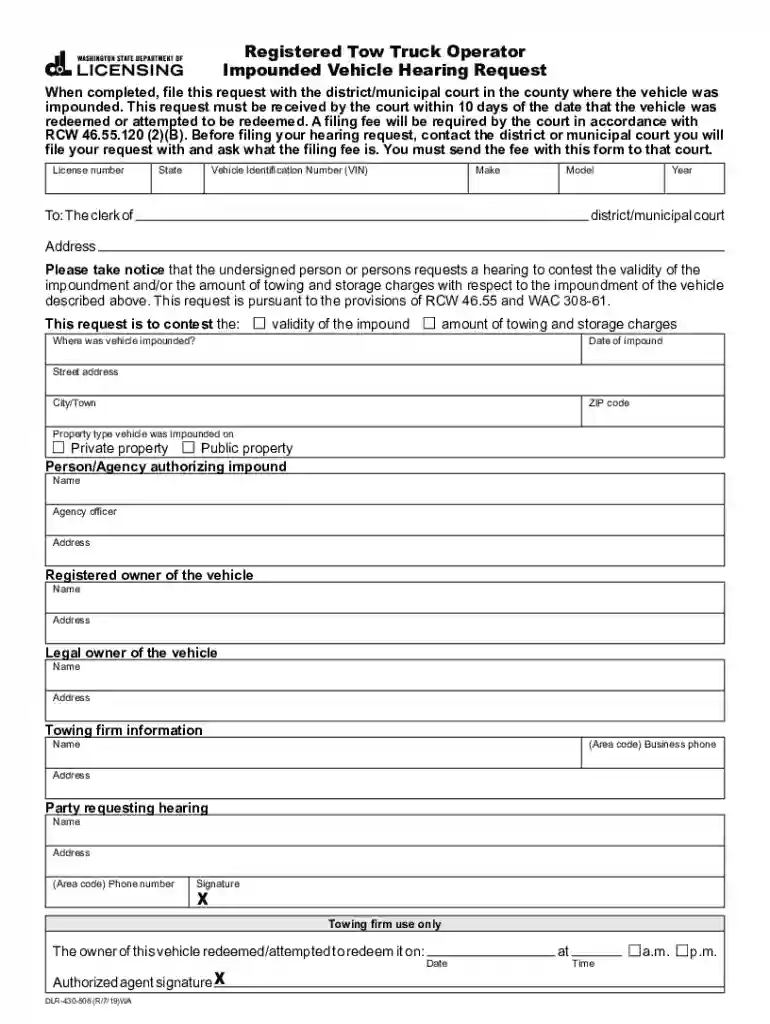
A "Registered Tow Truck Operator Impounded Vehicle Hearing Request" is a document primarily used by vehicle owners or custodians to contest the validity of a vehicle's impoundment and the associated fees. The form is pivotal in initiating a legal process that allows the vehicle owner to present their case regarding why the impoundment should be considered invalid or the fees excessive. File this request with the appropriate district or municipal court to have the matter reviewed. It often must be submitted within ten days of the vehicle being redeemed or attempted to be redeemed, highlighting the importance of acting promptly upon vehicle impoundment actions.
Elements of the Request
- Vehicle Information: Critical details such as make, model, year, and VIN (Vehicle Identification Number) of the impounded vehicle.
- Impoundment Details: Information regarding the date and location of the impound, along with the entity responsible for the towing.
- Owner's Information: The name, contact details, and relationship to the vehicle's owner or operator at the time of impoundment.
- Reason for Hearing Request: The grounds on which the impoundment is being challenged, which could include improper procedure or incorrect fee application.
- Supporting Documentation: Evidence or documentation supporting the claims, such as receipts, photographs, or affidavits.
How to Use the Form
The use of the "Registered Tow Truck Operator Impounded Vehicle Hearing Request" is straightforward when approached systematically. The primary purpose is to legally challenge the impoundment and associated fees through a hearing in the district court. Here's how to utilize it effectively:
- Gather Necessary Documentation: Collect all supporting evidence related to the vehicle's impoundment, such as towing receipts, notices, and any communication with the tow company.
- Complete the Form Accurately: Fill out the form with exact details, paying particular attention to the vehicle's credentials and the impoundment incident's specifics.
- File with the Correct Court: Ensure that the request is filed with the correct district or municipal court as per jurisdictional requirements.
- Prepare for the Hearing: After filing, prepare to attend the hearing, bringing all relevant documents and potentially a legal representative.
Steps to Complete the Form
Filing the "Registered Tow Truck Operator Impounded Vehicle Hearing Request" requires attention to detail. Follow these steps to ensure completeness and accuracy:
- Download the Form: Obtain the form from the local district court's website or a physical copy from the clerk's office.
- Fill Out Personal and Vehicle Information: Provide your name, address, and contact information along with detailed information about the impounded vehicle.
- State the Grounds for Request: Clearly articulate the reasons for requesting a hearing, focusing on legal grounds and supported evidence.
- Attach Supporting Documentation: Include all necessary attachments, verifying details mentioned within the form.
- Sign the Form: Ensure the form is signed correctly, affirming the truthfulness of the details provided.
- Pay Any Required Fees: Submit the applicable filing fee—often necessary to process the hearing request—either online or directly at the court.
- Submit the Form: Deliver the completed form to the designated district court within the specified time frame.
Tips for Accurate Filing
- Verify Accuracy: Double-check all entries to prevent errors that could delay the process.
- Read Instructions Thoroughly: Review all provided instructions accompanying the form to ensure compliance with specific filing regulations.
- Seek Legal Advice if Needed: Consider consulting a legal professional to guide the filing process and provide supplementary legal assistance during the hearing.
Importance and Benefits
Understanding the significance of filing this hearing request is essential as it provides several advantages for vehicle owners affected by impoundment:
- Challenge Unfair Practices: Provides a legal avenue to contest excessive towing and storage charges or improper procedural actions during impoundment.
- Legal Recourse: Serves as a structured opportunity to dispute impoundment within a legal framework, ensuring due process is adhered to.
- Reclaim Rights: Assists vehicle owners in reclaiming their rights and possibly recouping unwarranted fees through court adjudication.
- Ensure Compliance: Encourages tow truck operators and enforcing bodies to act within legal bounds, reducing the likelihood of wrongful impoundments.
Real-World Implications
- Prevalence in Urban Areas: This process is common in urban settings where parking violations frequently result in impoundments, necessitating a method to dispute such incidents.
- Protection for Vehicle Owners: It acts as a safeguard for individuals whose vehicles may have been impounded under ambiguous circumstances.
Required Documents
Filing this request requires several key documents to substantiate your case before the hearing:
- Proof of Vehicle Ownership: Title document or vehicle registration proving legal ownership.
- Impound Notice: The notice received at the time of impoundment listing charges and grounds for seizure.
- Payment Receipts: Any receipts for towing and storage charges already paid.
- Additional Evidence: Photographic evidence, witness statements, or prior correspondence with towing companies.
Essential Inclusions
- Detailed Impoundment Account: A written narrative supporting your claims detailing what occurred and why the impoundment is contested.
- Contact Details: Ensure contact information is clearly listed so the court can reach out regarding the hearing schedule.
Key Elements of the Form
The form consists of various sections critical for a comprehensive hearing request:
- Header Section: Contains basic information such as the form title and jurisdiction.
- Applicant Information: Includes fields for personal data of the person initiating the request.
- Vehicle Description: Asks for details like the vehicle's make, model, year, and unique identification number.
- Description of Incident: A section to outline why the impound was inappropriate or erroneous.
- Request Justification: Space for extensive explanation or supporting legal precedents.
State-Specific Rules
Different states may have varied regulations concerning vehicle impoundments and the subsequent hearing requests:
- Time Frames: Some states have more stringent deadlines for filing hearing requests post-impoundment.
- Jurisdictional Variances: Certain districts may require specific forms or have additional steps in the filing process.
- Fee Structures: Filing fees can differ, necessitating a check of local court costs.
Examples of State Variances
- California: Known for detailed procedural steps and specific local ordinances impacting the hearing request process.
- New York: May involve unique city-specific regulations impacting filing and adjudication.
Examples of Utilizing the Form
Consider some illustrative scenarios when this form might be applied:
- Parking Violation Dispute: A vehicle was impounded after a parking violation notice that the owner contends was erroneously issued.
- Fee Discrepancy Issue: An impound resulted in fees far exceeding standard rates, prompting a hearing request to dispute the charges.
- Procedural Non-Compliance: The towing company failed to provide adequate notice, violating state regulations, providing grounds for contestation.
Practical Scenario Applications
- Challenging Out-of-State Impounds: When traveling outside your state, your vehicle may be towed in error, necessitating jurisdictional strategies in your hearing request. Understanding and applying these various real-world scenarios helps vehicle owners navigate the complexities of contesting impoundments effectively.